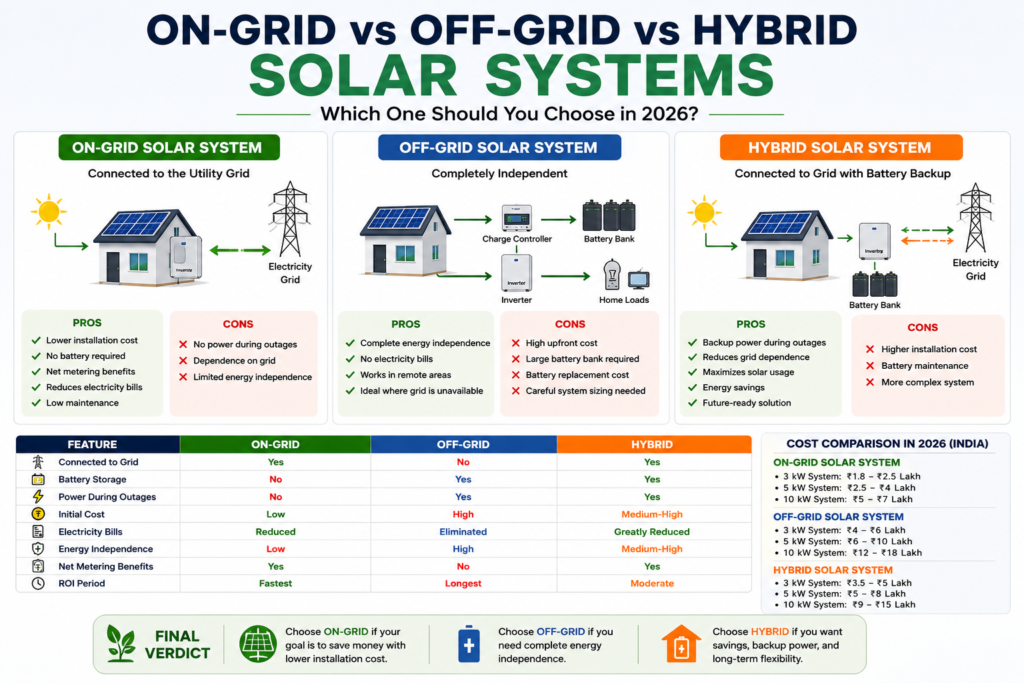
Discover the key differences between On-Grid, Off-Grid, and Hybrid Solar Systems. Compare costs, benefits, battery requirements, and savings to choose the best solar solution for your home in 2026.
If you’re planning to install solar panels in 2026, you’ve probably come across three common options: On-Grid, Off-Grid, and Hybrid Solar Systems. At first glance, they may seem similar because all of them use solar panels to generate electricity. However, the way they store, use, and manage that electricity is completely different.
Choosing the wrong solar system can lead to higher costs, lower savings, and even power issues during outages. That’s why understanding the differences before making an investment is so important.
The good news? You don’t need to be a solar expert to make the right decision.
In this guide, we’ll break down how each solar system works, compare their costs, benefits, and limitations, and help you decide which one makes the most sense for your home or business in 2026.
Understanding the Three Types of Solar Systems
Think of solar systems as different ways of managing the electricity your panels produce.
Some systems work closely with the utility grid, some operate completely independently, and others combine the best of both worlds.
The three main types are:
- On-Grid Solar Systems
- Off-Grid Solar Systems
- Hybrid Solar Systems
Let’s take a closer look at each one.
On-Grid Solar Systems: The Most Popular Choice
An On-Grid Solar System, often called a Grid-Tied Solar System, is directly connected to your local electricity network.
During sunny hours, your solar panels generate electricity for your home. If they produce more power than you need, the extra electricity is sent back to the grid. In return, many utility providers offer credits through net metering programs.
At night or during cloudy weather, your home simply pulls electricity from the grid.
Why Homeowners Love On-Grid Solar
The biggest reason people choose on-grid systems is simple: maximum savings at the lowest cost.
Since there are no batteries involved, installation costs remain relatively affordable. You also avoid battery maintenance and replacement expenses.
Benefits of On-Grid Solar Systems
✔ Lower installation costs
✔ Fast return on investment
✔ Reduced electricity bills
✔ Net metering benefits
✔ Minimal maintenance requirements
Things to Consider
The downside is that on-grid systems usually shut down during power outages for safety reasons. That means if the grid goes down, your solar panels stop supplying power to your home.
Best For
- Urban homes
- Residential properties with reliable electricity
- Homeowners focused on reducing monthly energy bills
Off-Grid Solar Systems: Complete Energy Independence
Imagine never receiving an electricity bill again.
That’s the biggest advantage of an Off-Grid Solar System.
Unlike on-grid systems, off-grid setups are completely independent of the utility grid. They generate, store, and supply all the electricity your property needs.
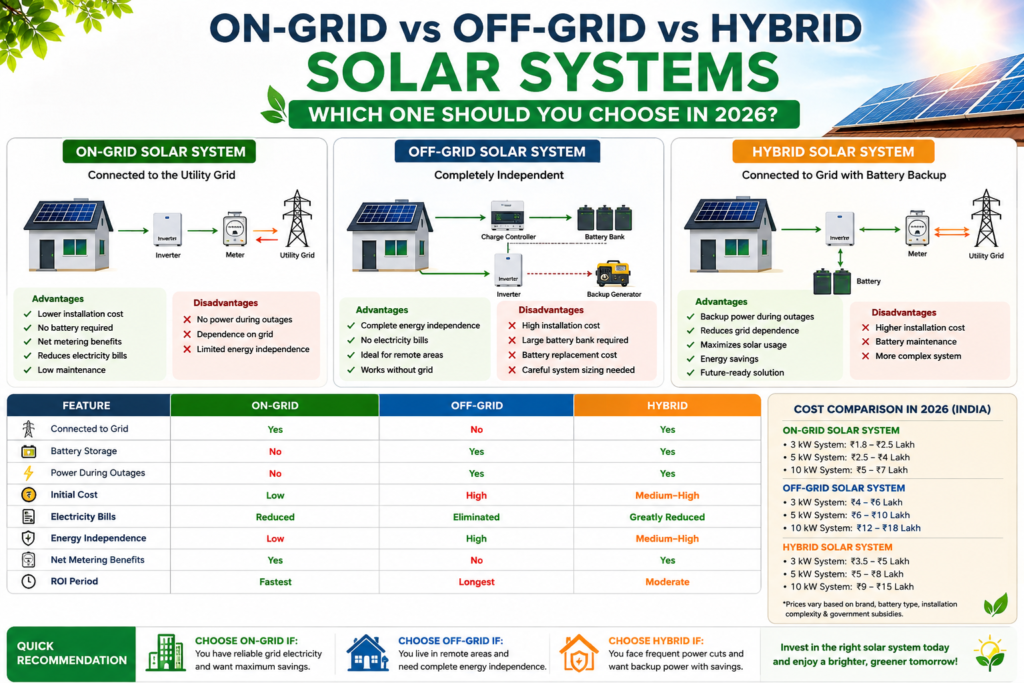
Because there is no connection to the grid, batteries become an essential part of the system. Excess solar energy generated during the day is stored and used at night or during periods of low sunlight.
Benefits of Off-Grid Solar Systems
✔ Total energy independence
✔ No monthly electricity bills
✔ Perfect for remote locations
✔ Reliable power where grid access is unavailable
Challenges of Off-Grid Systems
While off-grid systems provide freedom, they also require a larger investment.
You’ll need sufficient battery storage, and batteries eventually need replacement after several years of use.
Proper system sizing is critical because there is no utility grid available as a backup source.
Best For
- Farms and agricultural properties
- Remote villages
- Mountain cabins
- Rural homes with unreliable electricity access
Hybrid Solar Systems: The Best of Both Worlds
Hybrid Solar Systems are becoming one of the fastest-growing solar solutions in 2026.
A hybrid system combines an on-grid connection with battery storage. This means you can store excess solar energy for later use while still remaining connected to the utility grid.
During the day, your home uses solar power first. Extra energy charges the batteries. If the batteries become fully charged, the remaining electricity can be exported to the grid.
When a power outage occurs, the batteries automatically provide backup power.
Why Hybrid Systems Are Gaining Popularity
Many homeowners today want more than just lower electricity bills. They want energy security.
With rising electricity prices and increasing concerns about grid reliability, hybrid systems offer a balance between savings and independence.
Benefits of Hybrid Solar Systems
✔ Backup power during blackouts
✔ Lower electricity bills
✔ Greater energy independence
✔ Better use of solar-generated electricity
✔ Future-ready energy solution
Things to Consider
Hybrid systems cost more than traditional on-grid installations because batteries add to the overall investment.
However, many homeowners see this extra cost as an investment in energy security and long-term savings.
Best For
- Homes experiencing frequent power cuts
- Work-from-home professionals
- Businesses requiring uninterrupted power
- Homeowners planning for future battery expansion
Which Solar System Saves the Most Money?
If your primary goal is maximizing financial savings, an On-Grid Solar System usually offers the quickest return on investment.
If your goal is complete independence from utility companies, an Off-Grid Solar System is the clear winner.
If you want a balance between savings, backup power, and long-term flexibility, a Hybrid Solar System provides the most well-rounded solution.
Which Solar System Should You Choose in 2026?
There isn’t a single answer that works for everyone.
Choose an On-Grid Solar System if you want the lowest installation cost and the highest financial return.
Choose an Off-Grid Solar System if you live in a remote location or want complete energy independence.
Choose a Hybrid Solar System if you want lower electricity bills while also protecting your home from power outages.
For most homeowners in 2026, hybrid systems are becoming the preferred option because they combine energy savings, battery backup, and future flexibility in one package.
Final Thoughts
Solar energy is no longer just about reducing electricity bills. It’s about taking control of how your home produces, stores, and uses power.
Whether you choose an On-Grid, Off-Grid, or Hybrid Solar System, investing in solar can help lower energy costs, increase property value, and reduce your dependence on traditional electricity sources.
The best solar system isn’t necessarily the most expensive one—it’s the one that matches your lifestyle, energy needs, and long-term goals.
Before making a decision, evaluate your electricity consumption, local grid reliability, available budget, and future energy plans. Doing so will help ensure your solar investment delivers the maximum benefit for years to come.
- Solar system comparison
- Hybrid solar system benefits
- On-grid solar system advantages
- Off-grid solar system cost
- Best solar system for home
- Solar power system types
- Grid-tied solar system
- Hybrid solar battery storage
- Residential solar systems
- Solar energy solutions SolarEnergy
- SolarPanels
- HybridSolarSystem
- OnGridSolar
- OffGridSolar
- SolarBatteryStorage
- RenewableEnergy
- GreenEnergy
- SolarPower
- SolarInstallation
- PMSuryaGhar
- SolarSubsidy
- CleanEnergy
- EnergySavings
- SolarSystemComparison