
Introduction
Floating Solar Farms: https://blurase.com
As the world accelerates its transition toward clean energy, solar power continues to play a critical role in reducing greenhouse gas emissions and dependence on fossil fuels. However, traditional ground-mounted solar farms require vast amounts of land, creating challenges in densely populated regions and areas with competing land-use demands.
To address this issue, a new innovation is rapidly gaining attention: Floating Solar Farms, also known as Floating Photovoltaics (FPV). These systems place solar panels on lakes, reservoirs, dams, quarry ponds, and other bodies of water, transforming unused water surfaces into renewable energy powerhouses.
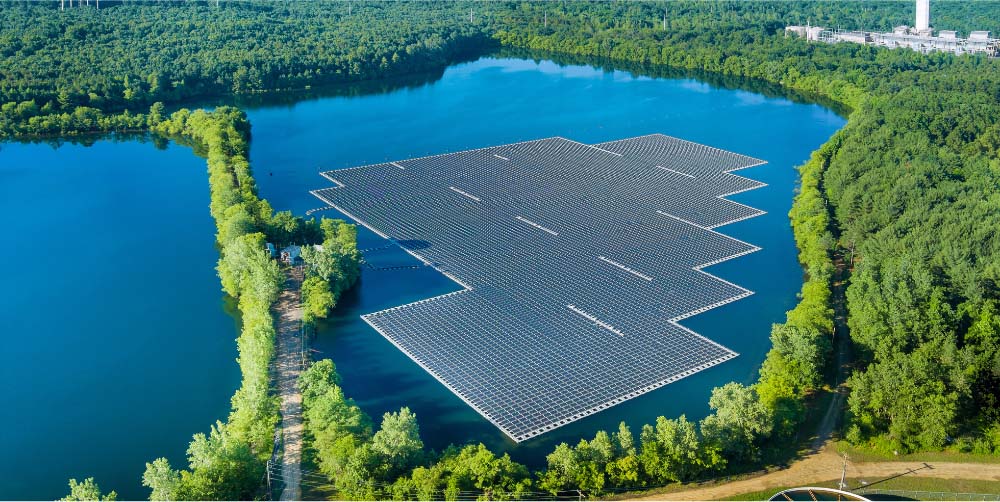
Floating solar technology is expanding across Asia, Europe, North America, and the Middle East, offering higher efficiency, reduced land usage, and significant environmental benefits. Many experts believe floating solar could become one of the fastest-growing segments of the global renewable energy industry over the next decade.
This guide explores how floating solar farms work, their advantages, installation methods, major projects worldwide, environmental impacts, challenges, and future growth potential.
What Are Floating Solar Farms?
Floating solar farms are photovoltaic power systems installed on water rather than land. Solar panels are mounted on buoyant structures that float on the surface of lakes, reservoirs, irrigation ponds, hydropower dams, and industrial water bodies.
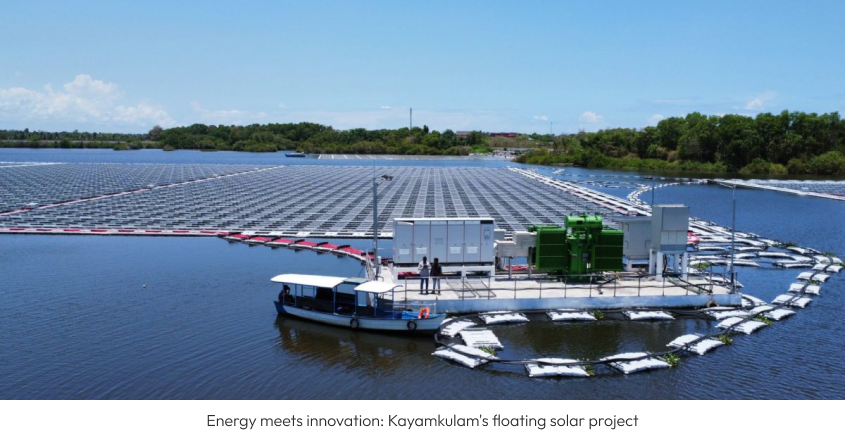
The generated electricity is transmitted through underwater cables or floating electrical systems to nearby substations and power grids.
The concept combines traditional solar technology with specialized floating platforms designed to withstand water movement, changing weather conditions, and long-term exposure to moisture.
How Floating Solar Farms Work
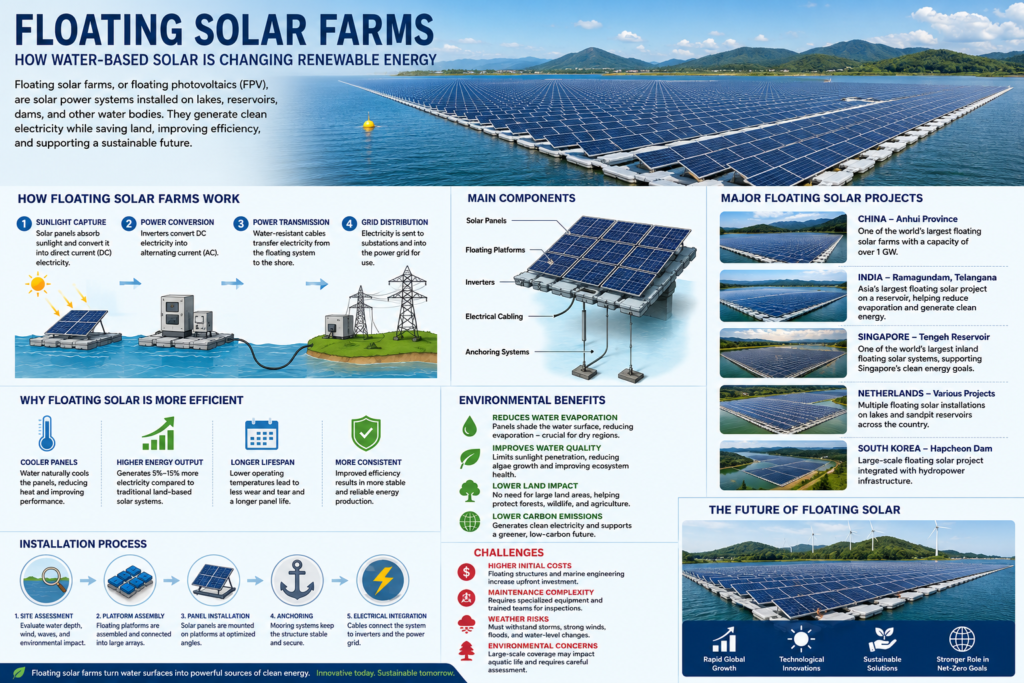
The basic operation is similar to conventional solar power systems.
Step 1: Sunlight Hits Solar Panels
Photovoltaic cells absorb sunlight and convert it into direct current (DC) electricity.
Step 2: Electricity Conversion
Inverters convert DC electricity into alternating current (AC), making it suitable for homes, businesses, and utility grids.
Step 3: Power Transmission
Electrical cables transfer power from floating structures to shore-based substations.
Step 4: Grid Distribution
The electricity enters local or national grids for consumption.
Main Components of a Floating Solar System
1. Solar Panels
High-efficiency photovoltaic modules generate electricity from sunlight.
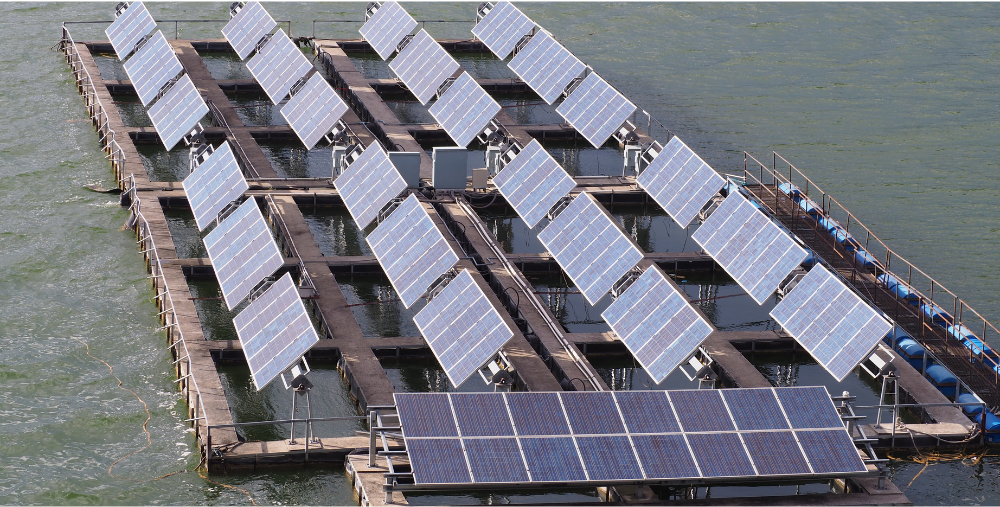
2. Floating Platforms
Specialized buoyant structures support solar panels above water.
These platforms are usually made from:
- High-density polyethylene (HDPE)
- UV-resistant polymers
- Corrosion-resistant materials
3. Anchoring Systems
Anchors prevent movement caused by:
- Wind
- Waves
- Water-level changes
- Currents
4. Inverters
Convert generated DC power into usable AC electricity.
5. Electrical Cabling
Water-resistant cables safely transport power to land-based infrastructure.
Why Floating Solar Is More Efficient
One of the biggest advantages of floating solar farms is increased efficiency.
Traditional solar panels lose performance as temperatures rise.
Water naturally cools floating solar panels, reducing heat buildup and improving electrical output.
Efficiency Benefits
- Lower operating temperatures
- Reduced energy losses
- Improved panel lifespan
- Higher electricity generation
Studies have shown floating solar systems can generate 5%–15% more electricity compared to similar land-based installations.
Advantages of Floating Solar Farms
1. No Land Requirement
Land acquisition is one of the biggest challenges for utility-scale solar projects.
Floating solar eliminates this issue by utilizing existing water bodies.
This is especially beneficial in:
- Urban regions
- Agricultural areas
- Island nations
- Land-constrained countries
2. Higher Energy Production
Water cooling improves panel efficiency and increases annual energy yields.
Benefits include:
- Lower thermal degradation
- More consistent output
- Better performance during hot summers
3. Reduced Water Evaporation
Solar panels shade water surfaces.
This can significantly reduce evaporation in:
- Reservoirs
- Irrigation ponds
- Drinking water supplies
For drought-prone regions, this creates an additional environmental benefit.
4. Improved Water Quality
Reduced sunlight penetration may help limit:
- Excessive algae growth
- Harmful algal blooms
- Water temperature increases
This can contribute to healthier aquatic ecosystems.
5. Integration with Hydropower
Floating solar is increasingly being paired with hydroelectric dams.
Benefits include:
- Shared grid infrastructure
- Improved renewable energy output
- Better power balancing
- Reduced transmission costs
These hybrid systems are becoming popular worldwide.
Major Floating Solar Projects Around the World
China
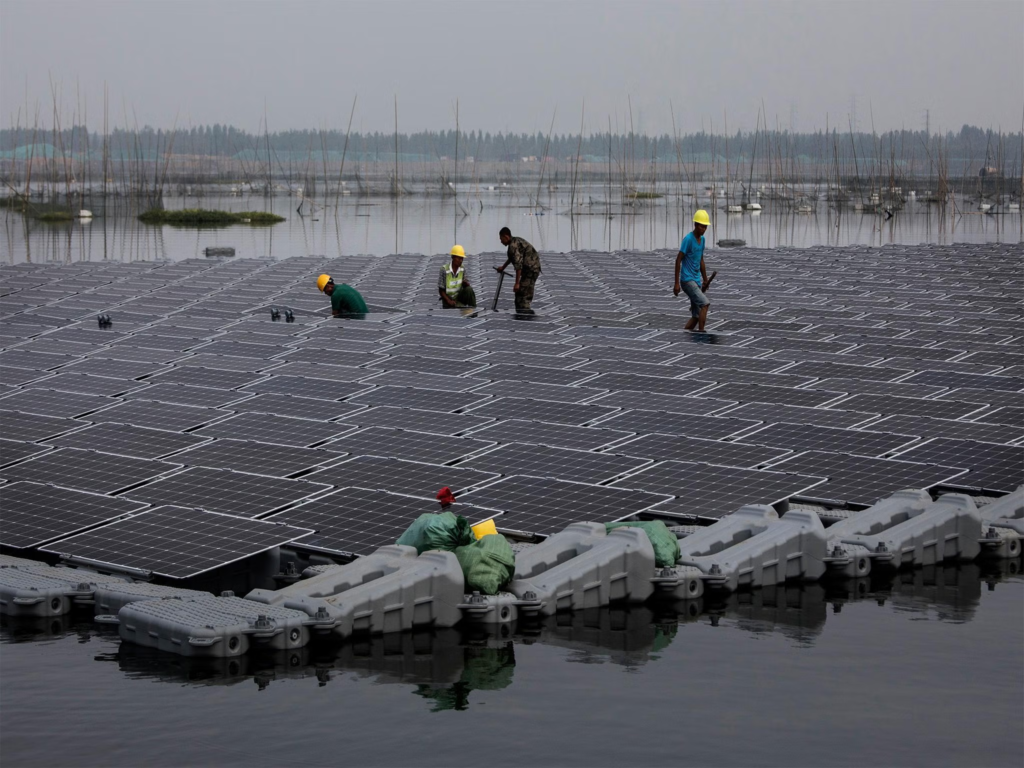
China leads the world in floating solar deployment.
Large projects have been built on former coal mining lakes and reservoirs.
Several facilities exceed hundreds of megawatts in capacity.
India
India is investing heavily in floating solar to meet growing electricity demand while preserving agricultural land.
Major projects are located in:
- Kerala
- Telangana
- Madhya Pradesh
- Andhra Pradesh
India’s hydropower reservoirs offer enormous floating solar potential.
Singapore
Singapore has become a global leader despite limited land availability.
Its floating solar installations help diversify energy production while maximizing scarce resources.
Netherlands
The Netherlands has developed numerous floating solar systems on lakes and sandpit reservoirs.
These projects support national decarbonization goals and innovative renewable energy strategies.
South Korea
South Korea plans large-scale floating solar deployments to achieve carbon neutrality and reduce fossil fuel dependence.
Installation Methods
Floating solar projects require specialized engineering.
Site Assessment
Developers evaluate:
- Water depth
- Wind conditions
- Wave activity
- Water-level fluctuations
- Environmental impacts
Platform Assembly
Floating structures are assembled and connected into large modular arrays.
Solar Module Installation
Panels are mounted onto floating platforms at optimized angles.
Anchoring and Mooring
Systems are secured using:
- Shore anchors
- Bottom anchors
- Mooring lines
This prevents drift and maintains stability.
Electrical Integration
Power cables connect floating arrays to:
- Inverters
- Transformers
- Grid infrastructure
Environmental Benefits
Floating solar offers several sustainability advantages.
Lower Carbon Emissions
Electricity generated by floating solar displaces fossil-fuel-based generation.
Water Conservation
Shading can reduce water evaporation by up to significant levels depending on climate conditions.
This is especially valuable in arid and drought-prone regions.
Reduced Land Disturbance
Unlike large ground-mounted solar farms, floating systems avoid:
- Deforestation
- Habitat fragmentation
- Agricultural land conversion
Enhanced Renewable Energy Capacity
Countries can dramatically expand solar generation without requiring additional land.
Challenges of Floating Solar Farms
Despite their benefits, floating solar systems face several challenges.
Higher Initial Costs
Floating structures increase capital expenditures compared to conventional solar farms.
Additional costs include:
- Anchoring systems
- Specialized cables
- Marine engineering
Maintenance Complexity
Water-based installations require:
- Specialized inspections
- Corrosion monitoring
- Safety procedures
Maintenance can be more challenging than land-based systems.
Extreme Weather Risks
Projects must withstand:
- Storms
- Strong winds
- Floods
- Wave action
Engineering designs must account for local climate conditions.
Environmental Considerations
Large-scale coverage of water surfaces may affect:
- Aquatic ecosystems
- Oxygen levels
- Fish habitats
Environmental assessments are essential before construction.
Floating Solar vs Traditional Solar Farms
| Feature | Floating Solar | Ground-Mounted Solar |
|---|---|---|
| Land Requirement | Minimal | High |
| Cooling Effect | Natural Water Cooling | Limited |
| Energy Efficiency | Higher | Standard |
| Water Conservation | Yes | No |
| Installation Cost | Higher | Lower |
| Maintenance Complexity | Moderate | Lower |
| Environmental Footprint | Lower Land Impact | Higher Land Use |
Future Growth of Floating Solar
The future of floating solar appears extremely promising.
Industry analysts project substantial global growth over the next decade as governments seek innovative ways to expand renewable energy capacity.
Growth drivers include:
- Rising electricity demand
- Limited available land
- Falling solar costs
- Climate commitments
- Water conservation needs
- Renewable energy targets
Emerging technologies such as AI-based monitoring, advanced floating platforms, and hybrid hydro-solar systems are expected to improve performance and reduce costs.
Some experts estimate that covering even a small percentage of the world’s reservoirs with floating solar panels could generate thousands of gigawatts of clean electricity.
The Role of Floating Solar in Net-Zero Goals
Achieving global net-zero emissions requires rapid deployment of renewable energy technologies.
Floating solar contributes by:
- Expanding solar capacity without consuming land
- Increasing renewable electricity generation
- Supporting grid decarbonization
- Enhancing energy security
- Conserving water resources
As countries invest in cleaner energy systems, floating solar farms are expected to become a major component of future power infrastructure.
Conclusion
Floating solar farms represent one of the most innovative developments in renewable energy today. By transforming lakes, reservoirs, and other water bodies into clean electricity generators, floating photovoltaics solve one of the biggest challenges facing traditional solar power: land availability.
With higher efficiency, reduced evaporation, improved sustainability, and growing global adoption, floating solar is poised for significant expansion in the coming years. Although challenges remain in terms of cost, maintenance, and environmental management, technological improvements are steadily making floating solar more attractive and economically viable.
As nations work toward carbon neutrality and energy independence, floating solar farms could become a cornerstone of the global clean energy transition, helping deliver reliable, affordable, and sustainable electricity for generations to come.