
The Carbon Border Adjustment Mechanism (CBAM) is one of the most important new climate and trade policies affecting global industry.
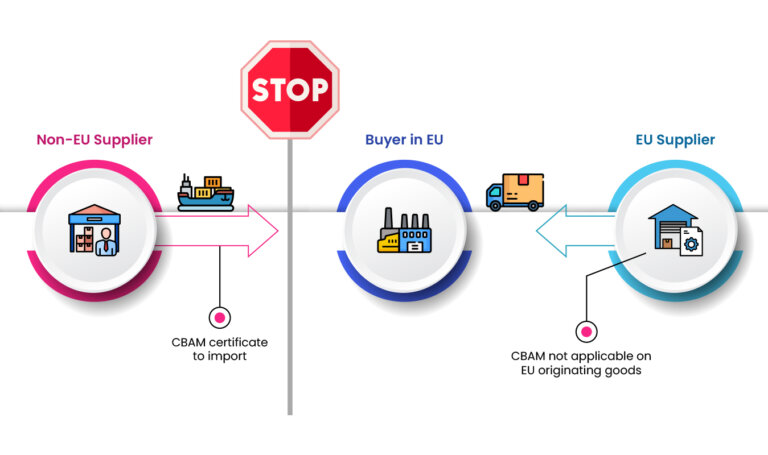
The European Union’s CBAM entered its definitive regime on 1 January 2026, moving beyond the reporting-only transitional period that ran from 2023 through 2025. The system puts a carbon cost on certain carbon-intensive goods imported into the EU, helping bring the carbon cost of imports closer to the cost faced by European producers under the EU Emissions Trading System (EU ETS). Taxation and Customs Union
This matters far beyond Europe.
Steel producers in India, aluminium manufacturers in China, fertiliser companies in other countries and exporters of hydrogen or electricity can all face new reporting, verification and financial requirements when selling covered products into the EU.
At the same time, CBAM is intended to encourage manufacturers around the world to use cleaner electricity, renewable energy, low-carbon fuels and less carbon-intensive production technologies.
So, is CBAM simply an EU carbon tax on imports?
Not exactly.
It is better understood as a carbon-pricing adjustment at the EU border designed to address a problem called carbon leakage.
Let’s break it down.
%20Explained%3A%20EU%20Carbon%20Tax%20on%20Imports%20in%202026&imgurl=https%3A%2F%2Fcdn.cseindia.org%2Flarge%2F2024-07-09%2F0.32376600_1720495570_carbon-border.jpg&imgrefurl=https%3A%2F%2Fwww.cseindia.org%2Funderstanding-the-eu-s-carbon-border-adjustment-mechanism-cbam--12265&docid=dw-hRo26E3RJhM&tbnid=0bADmcirpPq_eM&vet=12ahUKEwjWhsCRoaiXAxWETmwGHYwsMd4QnPAOegQINhAA..i&w=1024&h=973&hcb=2&ved=2ahUKEwjWhsCRoaiXAxWETmwGHYwsMd4QnPAOegQINhAA)
What Is the Carbon Border Adjustment Mechanism?
The Carbon Border Adjustment Mechanism (CBAM) is the European Union’s system for putting a carbon price on the embedded emissions of certain goods imported from outside the EU.
The basic idea is straightforward:
CBAM, Carbon Border Adjustment Mechanism, EU carbon tax, EU CBAM 2026, carbon tax imports, clean energy, green manufacturing, carbon leakage, EU climate policy
If producing a particular material in Europe has a carbon cost, importing the same type of carbon-intensive material from another country should not completely avoid that carbon cost.
Under CBAM, EU importers of covered products must account for the greenhouse-gas emissions associated with producing those goods and, where required, purchase and surrender CBAM certificates.
The certificate price is linked to the EU ETS carbon price. In 2026, the CBAM certificate price is calculated using quarterly averages of EU ETS allowance auction prices; from 2027, the calculation moves to weekly averages. Taxation and Customs Union
Importers can also receive a deduction where they can demonstrate that a carbon price has already been paid in the country where the goods were produced. Taxation and Customs Union
In simple terms
Think of CBAM like this:
Carbon-intensive production → emissions calculated → EU importer declares emissions → CBAM certificates are required → carbon cost is applied
The objective isn’t to ban imported products.
Instead, the EU wants the carbon cost of covered imports to better reflect the carbon cost associated with comparable production inside Europe.
Why Was CBAM Created?
The main reason is carbon leakage.
What is carbon leakage?
Carbon leakage happens when climate policies in one country or region encourage carbon-intensive production to move somewhere with weaker climate rules.
For example, imagine:
- A European steelmaker faces a significant carbon cost.
- Producing steel in Europe becomes more expensive.
- A company moves production to a country with cheaper, more carbon-intensive electricity.
- The steel is then imported back into Europe.
- Global emissions may not fall — production has simply moved.
Another possibility is that European manufacturers lose market share to imported products that don’t face an equivalent carbon cost.
The European Commission says CBAM is designed to reduce this risk by ensuring that a carbon price is paid on the embedded emissions of certain imports. Taxation and Customs Union
This is particularly important as the EU gradually reduces free allocation of EU ETS allowances for industries covered by CBAM.
How Does CBAM Work?
CBAM can look complicated, but the basic process is easier to understand when broken into steps.
Step 1: A covered product is imported
A company imports a CBAM-covered product into the European Union.
Examples include certain:
- Steel products
- Aluminium products
- Cement
- Fertilisers
- Hydrogen
- Electricity
The EU currently lists these as its six CBAM sectors. Taxation and Customs Union
Step 2: The embedded emissions are calculated
The importer needs information about the greenhouse-gas emissions associated with producing the imported product.
This is known as its embedded emissions.
For example, producing one tonne of steel using a coal-intensive production process can generate significantly more emissions than producing steel using a lower-carbon process powered by cleaner electricity.
The CBAM system therefore creates an economic reason for producers to improve emissions measurement and reduce the carbon intensity of their products.
Step 3: The emissions are reported
EU importers must declare information including the quantity of covered goods and their embedded emissions.
Companies can use actual emissions data where the required information and verification are available, or applicable default values supplied by the European Commission. Taxation and Customs Union
This makes emissions data increasingly important for exporters.
A manufacturer that can accurately demonstrate that its product has a lower carbon footprint may be in a better position than one relying on a higher default value.
Step 4: CBAM certificates are purchased
For covered imports, authorised CBAM declarants purchase certificates corresponding to the applicable embedded emissions.
The certificate price is connected to the EU ETS carbon price. Taxation and Customs Union
This means CBAM isn’t simply a fixed percentage tariff.
The financial impact can change as carbon prices change and as the emissions intensity of the imported product changes.
Step 5: Any carbon price already paid can be taken into account
If a producer has already paid a carbon price in its home country, the corresponding amount can be deducted under the CBAM rules, subject to the applicable requirements and evidence. Taxation and Customs Union
This is important because the system is intended to account for carbon pricing that has already occurred rather than automatically charging the full amount again.
Is CBAM a Carbon Tax?
This is one of the most common questions.
People often call CBAM an “EU carbon tax on imports.”
That description is useful for understanding the concept, but technically CBAM is not simply a conventional import tariff.
The system uses CBAM certificates whose price is linked to the EU ETS carbon price.
So a more accurate description is:
CBAM = a carbon-pricing adjustment applied to certain imports based on their embedded emissions.
This distinction matters because the financial amount depends on factors such as:
- The quantity imported
- The emissions embedded in the goods
- The EU carbon price
- Any applicable deductions
- The relevant CBAM rules and benchmarks
Which Industries Are Covered by CBAM in 2026?
As of the definitive regime, CBAM covers six main sectors.
| Sector | Why It Matters |
|---|---|
| Iron & steel | Steelmaking can be highly carbon-intensive, particularly when coal-based processes are used |
| Aluminium | Electricity consumption is a major factor in aluminium production |
| Cement | Cement production generates substantial process and energy emissions |
| Fertilisers | Fertiliser production can have significant energy and process emissions |
| Hydrogen | The carbon intensity of hydrogen depends heavily on how it is produced |
| Electricity | Imported electricity can carry emissions associated with its generation |
The European Commission’s current CBAM framework specifically identifies these six sectors. Taxation and Customs Union
Important correction
Some discussions of CBAM mention only steel, cement, aluminium, fertilisers and electricity.
However, hydrogen is also currently covered.
That is especially relevant to the clean-energy transition because hydrogen produced from fossil fuels and low-carbon or renewable hydrogen can have very different emissions profiles.
CBAM and the Clean Energy Transition
This is where CBAM becomes particularly interesting.
CBAM isn’t only a trade policy.
It can also influence investment decisions in energy and industrial infrastructure.
A manufacturer exporting to Europe has a growing reason to ask:
“How can we reduce the carbon intensity of our products?”
That question can lead to investment in:
- Renewable electricity
- Solar power
- Wind power
- Green hydrogen
- Energy efficiency
- Electric furnaces
- Electric boilers
- Waste-heat recovery
- Low-carbon cement technologies
- Green steel
- Recycling
- Carbon capture
- Cleaner industrial processes
In other words, carbon pricing can turn emissions reduction into a competitive issue.
Why Renewable Energy Matters Under CBAM
Electricity is one of the most important inputs for modern industry.
Consider aluminium.
Aluminium production requires substantial amounts of electricity. If that electricity comes largely from coal, the resulting product can have a higher carbon footprint.
If the same industrial facility uses electricity from renewable sources such as solar and wind, its emissions profile can potentially be lower.
That creates an important connection:
Renewable electricity → lower industrial emissions → lower embedded carbon → potentially lower CBAM exposure
The exact CBAM calculation is more complicated than simply adding up a company’s renewable electricity consumption, and sector-specific rules determine which emissions are included.
Nevertheless, the economic signal is important.
CBAM can make clean energy increasingly relevant to international manufacturing competitiveness.
What Does CBAM Mean for India?
India is one of the countries for which CBAM is particularly important.
India has major industrial exports to Europe, including steel and other products potentially affected by carbon-related trade rules.
The Indian government has previously highlighted concerns that CBAM could increase the compliance burden for Indian steel exports to the EU. Government data also show substantial Indian finished-steel exports to the EU. Press Information Bureau
The impact isn’t simply about paying more money.
Indian exporters also need reliable systems for:
- Measuring emissions
- Collecting production data
- Reporting emissions
- Verifying emissions
- Demonstrating lower-carbon production
- Understanding EU CBAM requirements
In August 2026, India’s Department of Commerce held an awareness session for exporters specifically addressing CBAM obligations, embedded emissions, reporting, accreditation and verification. Press Information Bureau
India and the EU have also incorporated carbon-border-measures cooperation into their 2026 trade framework. India’s Commerce Ministry says the relevant annex establishes a technical dialogue covering issues including product scope and embedded-emissions coverage. Commerce Ministry
What could Indian companies do?
Indian manufacturers exporting covered products to Europe can increasingly benefit from:
- Renewable power procurement
- Energy-efficiency improvements
- Lower-carbon steelmaking
- Greater use of electric technologies
- Green hydrogen where commercially viable
- Better emissions monitoring
- Independent verification
- Product-level carbon accounting
This could turn CBAM from simply a compliance challenge into a reason to modernise industrial production.
What Does CBAM Mean for China?
China is another major manufacturing economy affected by CBAM because it exports large volumes of industrial goods to global markets.
The immediate impact depends heavily on:
- What products are exported
- Whether they fall within the CBAM product codes
- Their embedded emissions
- The production technology used
- The carbon price already paid, if applicable
For Chinese manufacturers, cleaner production could become increasingly valuable when competing for access to the European market.
This could encourage investment in:
- Renewable electricity
- Energy-efficient factories
- Low-carbon steel
- Aluminium produced with cleaner electricity
- Better emissions measurement
- Industrial electrification
CBAM therefore creates an incentive that extends beyond Europe’s borders.
What Does CBAM Mean for the United States?
US companies are not automatically subject to a general CBAM charge simply because they are American.
The key question is whether the specific product being exported to the EU falls within CBAM’s scope.
US manufacturers producing covered goods may therefore need to provide emissions information and meet applicable CBAM requirements when those products enter the EU.
The effect can vary significantly between companies.
A manufacturer operating an energy-efficient plant with relatively low-carbon electricity could face a different carbon-cost exposure from a producer using a highly carbon-intensive production process.
For US companies, CBAM is therefore another reason to pay attention to the carbon intensity of internationally traded industrial products.
Why CBAM Could Change Global Manufacturing
The most important long-term effect of CBAM may not be the money collected at the EU border.
It could be the investment signal it creates.
Imagine two steel factories.
Factory A
- Uses coal-intensive production
- Has high emissions per tonne
- Has limited emissions data
- Depends heavily on fossil fuels
Factory B
- Uses more efficient technology
- Purchases renewable electricity
- Uses lower-carbon production methods
- Measures and verifies emissions accurately
If both factories want to sell into the EU, Factory B may increasingly have a commercial advantage.
That creates a powerful incentive:
Lower carbon intensity can become part of export competitiveness.
This is one reason CBAM is important for clean energy.
CBAM and Green Steel
Steel is likely to remain one of the most visible examples of how CBAM can influence industrial decarbonisation.
Traditional steelmaking can rely heavily on coal and coke.
Newer pathways can use technologies such as:
- Electric arc furnaces
- Increased scrap recycling
- Renewable electricity
- Direct reduced iron
- Green hydrogen
- Low-carbon ironmaking
Green hydrogen is particularly interesting.
Instead of using fossil-fuel-based reducing agents in certain steelmaking pathways, hydrogen can potentially be used as a reducing agent, with water rather than CO₂ as the direct reaction product.
If the hydrogen itself is produced using renewable electricity, the potential carbon reduction becomes even greater.
CBAM does not mandate that companies use green hydrogen.
But by placing greater economic importance on embedded carbon, it can strengthen the business case for lower-carbon production.
CBAM and Green Aluminium
Aluminium provides another important example.
The production of primary aluminium is extremely electricity-intensive.
That means the source of electricity matters.
An aluminium producer using carbon-intensive electricity can have a considerably different emissions profile from a producer using low-carbon electricity.
This creates an important link between:
Solar + wind + clean electricity + industrial production + international trade
As renewable electricity becomes cheaper and more available, manufacturers may increasingly see clean power as both an energy source and a trade-competitiveness tool.
CBAM and Cement
Cement is harder to decarbonise.
That is because some cement emissions are not simply caused by burning fossil fuels.
During cement production, limestone is heated and chemically transformed, releasing CO₂.
Possible strategies for reducing cement emissions include:
- Alternative fuels
- Energy efficiency
- Lower-clinker cement
- Supplementary cementitious materials
- Electrification
- Carbon capture and storage
- Alternative binders
CBAM can therefore encourage innovation in one of the world’s most difficult industrial sectors to decarbonise.
What Happens to Small Importers?
The EU introduced a 50-tonne single mass-based de minimis threshold for covered CBAM goods, simplifying obligations for smaller importers.
The European Commission’s September 2026 assessment found that the 50-tonne threshold would exempt about 0.87% of embedded emissions, remaining below the 1% benchmark used for the assessment. Taxation and Customs Union
However, electricity and hydrogen have specific rules, so companies should not assume the 50-tonne threshold applies identically to every category.
When Do Companies Actually Need to Pay?
A common misunderstanding is that importers began buying CBAM certificates on the first day of 2026 and immediately paying a carbon bill for every shipment.
The compliance process is more structured.
The definitive regime began on 1 January 2026, while the first annual CBAM declaration covering 2026 imports is due in 2027.
The European Commission says the first declaration and corresponding certificate surrender for 2026 imports are due by 30 September 2027. Taxation and Customs Union
This means companies need to establish their emissions-monitoring and documentation systems now rather than waiting until the payment deadline.
Will CBAM Expand to More Products?
Very likely, and this is an important development to watch.
The initial CBAM system focuses on basic carbon-intensive goods.
But the EU has already moved toward extending the mechanism to certain downstream steel- and aluminium-intensive products.
In June 2026, the European Commission welcomed a Council agreement supporting an extension to specific downstream goods and stronger anti-circumvention safeguards. Taxation and Customs Union
The Commission’s December 2025 proposal envisaged extending CBAM from 2028 to around 180 steel- and aluminium-intensive downstream products, including certain machinery and appliances. European Commission
Potential future expansion is therefore one of the most important areas for exporters to monitor.
The EU has also been reviewing whether CBAM could eventually cover additional areas of the economy, including other ETS sectors and further downstream products. Taxation and Customs Union
CBAM Timeline
| Year | Development |
|---|---|
| 2023 | CBAM transitional phase begins |
| 2024–2025 | Importers report embedded emissions |
| 31 Dec 2025 | Transitional period ends |
| 1 Jan 2026 | Definitive CBAM regime begins |
| 2026 | Monitoring, reporting, verification and compliance systems become operational |
| 2027 | First CBAM declaration and certificate surrender for 2026 imports |
| 2028 | Planned expansion to certain downstream steel/aluminium-intensive goods under the EU’s strengthening proposal |
| 2034 | CBAM reaches full phase-in alongside the EU ETS free-allocation transition |
The transitional phase ran from October 2023 through December 2025, while the definitive regime started on 1 January 2026. Taxation and Customs Union
CBAM: Advantages and Challenges
Potential Advantages
1. Reduces carbon leakage
CBAM is designed to prevent production from simply moving to jurisdictions with weaker climate policies. Taxation and Customs Union
2. Encourages cleaner manufacturing
Lower-carbon production can become more commercially attractive for companies that want access to the European market.
3. Supports renewable energy
Industrial companies have an additional reason to reduce the carbon intensity of their electricity supply.
4. Improves emissions transparency
Companies increasingly need reliable data about the emissions associated with their products.
5. Creates a global decarbonisation signal
Because Europe is a major trading market, EU rules can influence production decisions outside Europe.
Potential Challenges
1. Higher compliance costs
Companies need systems for monitoring, reporting and verifying emissions.
2. Complexity
CBAM calculations differ by sector and product.
3. Impact on developing-country exporters
Smaller manufacturers may find emissions accounting and verification more difficult.
4. Trade tensions
Some countries have questioned whether border carbon measures could act like trade restrictions.
5. Carbon-data quality
Exporters need accurate and verifiable production information.
6. Risk of shifting trade
Companies may try to redirect products toward markets without similar carbon requirements, potentially changing global trade patterns.
Is CBAM Good or Bad for Clean Energy?
The answer is potentially very positive for clean energy, but implementation matters.
CBAM creates an economic reason for industrial companies to reduce the carbon intensity of their products.
That could increase demand for:
- Renewable electricity
- Solar power
- Wind power
- Battery storage
- Green hydrogen
- Energy-efficiency technologies
- Low-carbon industrial equipment
- Carbon accounting software
- Industrial electrification
- Green steel
- Low-carbon aluminium
However, CBAM alone cannot decarbonise global industry.
Clean technologies also need to become affordable, reliable and scalable.
For example, a steel producer may want to switch to cleaner electricity, but it also needs sufficient renewable generation, transmission capacity, storage and suitable industrial equipment.
That is why CBAM should be viewed as one piece of a much larger clean-industrial transition.
What Should Exporters Do About CBAM?
Companies exporting covered products to Europe should not wait until the financial compliance deadline.
A practical CBAM preparation strategy includes:
1. Identify affected products
Determine which products fall under CBAM’s relevant customs classifications.
2. Measure emissions
Develop systems for calculating embedded emissions at the facility and product level.
3. Improve data collection
Track energy consumption, fuels, production volumes and process emissions.
4. Examine renewable-energy options
Solar, wind, renewable electricity contracts and other clean-energy strategies may help reduce emissions depending on the production process.
5. Prepare verification systems
Actual emissions data may require appropriate verification.
6. Compare technologies
Calculate whether investments in energy efficiency, electrification or low-carbon production can reduce long-term carbon exposure.
7. Monitor EU regulatory changes
CBAM is evolving, including proposed and agreed changes affecting downstream products and anti-circumvention rules.
The European Commission published additional CBAM implementation guidance for non-EU producers in August 2026, including sector-specific guidance for steel, aluminium, cement, fertilisers, hydrogen and electricity. Taxation and Customs Union
The Bigger Picture: CBAM Could Make Carbon a Global Trade Issue
For decades, companies competing internationally have primarily compared:
- Labour costs
- Energy costs
- Raw-material costs
- Transport costs
- Taxes
- Technology
- Productivity
CBAM adds another factor:
Carbon intensity.
That could fundamentally change how industrial products are traded.
In the future, buyers may increasingly ask:
How much CO₂ was emitted to manufacture this tonne of steel?
How much carbon was associated with this aluminium?
Was renewable electricity used?
Can the emissions data be independently verified?
This means the carbon footprint of a product could become almost as important as its financial cost.
Frequently Asked Questions About CBAM
What does CBAM stand for?
CBAM stands for Carbon Border Adjustment Mechanism. It is the EU’s system for addressing the carbon emissions embedded in certain imported goods.
When did CBAM fully come into effect?
The EU’s definitive CBAM regime began on 1 January 2026. The previous transitional reporting phase ran from 2023 through 2025. Taxation and Customs Union
Is CBAM an EU carbon tax?
CBAM is commonly described as an EU carbon tax on imports, but technically it operates through CBAM certificates linked to the EU ETS carbon price, rather than as a conventional customs tariff.
Which products are covered by CBAM?
The current six sectors are iron and steel, aluminium, cement, fertilisers, electricity and hydrogen. Taxation and Customs Union
Does CBAM apply to India?
Yes. Indian exporters of covered products selling into the EU can be affected by CBAM requirements.
Does CBAM apply to China?
Yes, Chinese exporters can be affected when exporting covered CBAM products to the European Union.
Does CBAM apply to US companies?
US companies exporting covered products to the EU can be subject to the applicable CBAM rules. The impact depends on the product, emissions and other factors.
Why was CBAM introduced?
The main purpose is to reduce the risk of carbon leakage and ensure that imported carbon-intensive products face a carbon cost reflecting their embedded emissions. Taxation and Customs Union
Can companies reduce their CBAM exposure?
Potentially. Reducing the embedded emissions of covered products, maintaining accurate emissions data and demonstrating any carbon price already paid can affect the applicable CBAM liability.
Does CBAM encourage renewable energy?
Indirectly, yes. Renewable electricity can help lower the emissions intensity of many industrial processes, potentially improving the carbon profile of exported products.
Will CBAM cover more products?
The EU is moving toward expanding CBAM to certain downstream steel- and aluminium-intensive products, with changes planned from 2028 under the current legislative process. Taxation and Customs Union
When is the first CBAM declaration due?
The first annual declaration covering 2026 imports is due by 30 September 2027, together with the corresponding certificate surrender. Taxation and Customs Union
Final Takeaway
The Carbon Border Adjustment Mechanism (CBAM) represents a major change in the relationship between climate policy and international trade.
Since 1 January 2026, the EU’s definitive CBAM system has applied to selected imports in the steel, aluminium, cement, fertiliser, electricity and hydrogen sectors. Taxation and Customs Union
For exporters, carbon emissions are becoming a commercial consideration.
For manufacturers, cleaner production could become increasingly valuable.
For countries such as India, China and the United States, CBAM means that companies selling covered industrial products into Europe need to understand emissions measurement, verification and carbon costs.
And for the clean-energy industry, CBAM could provide another reason for factories to invest in renewable electricity, energy efficiency, electrification, green hydrogen and low-carbon manufacturing.
The bigger message is simple:
Carbon is becoming part of the price of doing business internationally.
As more countries introduce carbon-pricing systems and climate-related trade measures, companies that can produce goods with lower emissions, cleaner energy and reliable carbon data may have an increasingly important competitive advantage.
For that reason, CBAM is not just an EU trade rule. It could become one of the forces shaping the next generation of global clean manufacturing.
SEO Publishing Checklist
- Focus keyword: carbon border adjustment mechanism
- Secondary keywords: CBAM explained, EU carbon tax imports, EU CBAM 2026, CBAM India, CBAM China, CBAM steel, carbon leakage, CBAM clean energy
- SEO title: Carbon Border Adjustment Mechanism (CBAM) Explained: EU Carbon Tax on Imports in 2026
- Slug:
carbon-border-adjustment-mechanism-cbam-explained - Meta description: Learn what the Carbon Border Adjustment Mechanism (CBAM) is, how the EU carbon tax on imports works, which industries are affected, and what CBAM means for India, China, the US and clean energy.
- Suggested category: Clean Energy / Climate Policy / Renewable Energy
- Search intent: Informational
- Content type: Beginner-friendly explainer
- Recommended internal links: Green Steel, Green Hydrogen, Renewable Energy for AI Data Centers, Solar Energy, Carbon Capture, Long-Duration Energy Storage
Accuracy note: I have deliberately included hydrogen in the current CBAM sectors and distinguished CBAM from a conventional “EU carbon tax,” because those details are important for an accurate 2026 article. The article reflects EU Commission material available in October 2026, including the current 50-tonne threshold and developments around downstream-product expansion. Taxation and Customs Union