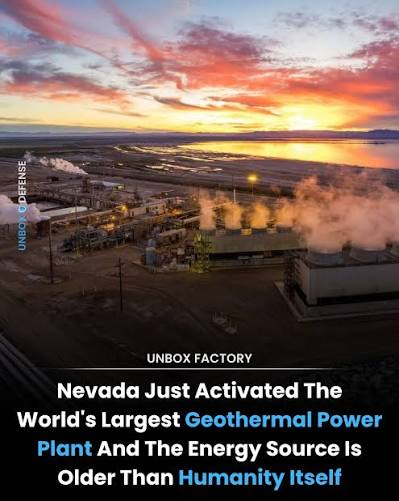
Discover how Enhanced Geothermal Systems (EGS) work, their benefits, challenges, global projects, and why Google, Meta, and Microsoft are investing in this game-changing renewable energy technology.
As countries race toward a cleaner energy future, solar panels and wind turbines often dominate the conversation. Yet beneath our feet lies one of the most promising renewable energy resources on Earth: geothermal energy. Renewable Energy
Traditional geothermal power has been limited to regions with naturally occurring underground heat reservoirs. However, a breakthrough technology known as Enhanced Geothermal Systems (EGS) is changing that reality.
Many energy experts believe EGS could become one of the most important clean energy technologies of the next decade, providing reliable, carbon-free electricity around the clock.
In this guide, we’ll explore how Enhanced Geothermal Systems work, their advantages and challenges, major projects worldwide, investments from technology giants, and why EGS could play a critical role in achieving global net-zero emissions targets. Renewable Energy
What Are Enhanced Geothermal Systems (EGS)?
Enhanced Geothermal Systems (EGS) are advanced geothermal energy technologies that create artificial underground reservoirs capable of producing heat for electricity generation.
Unlike conventional geothermal plants, which require naturally occurring hot water and steam reservoirs, EGS can be developed in areas where hot rock exists but natural permeability is insufficient. Renewable Energy
The basic concept is simple:
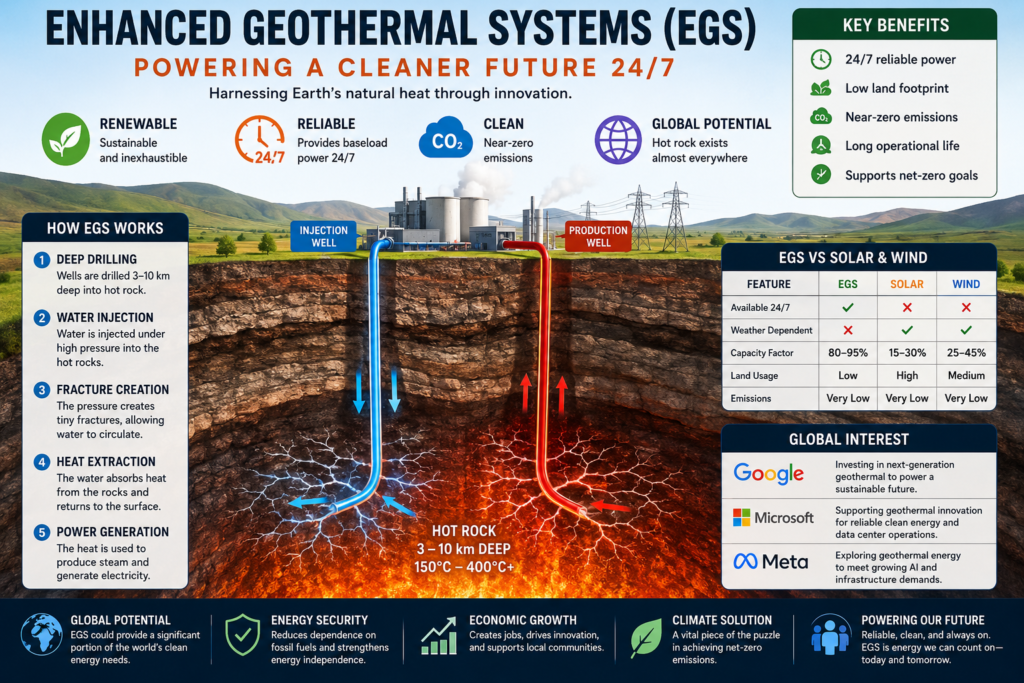
- Drill deep underground into hot rock formations.
- Inject water into the rock.
- Create fractures that allow water circulation.
- Recover heated water through production wells.
- Use the heat to generate electricity.
- Renewable Energy
This process dramatically expands the geographical areas where geothermal power can be developed.
How Enhanced Geothermal Systems Work
Step 1: Deep Drilling
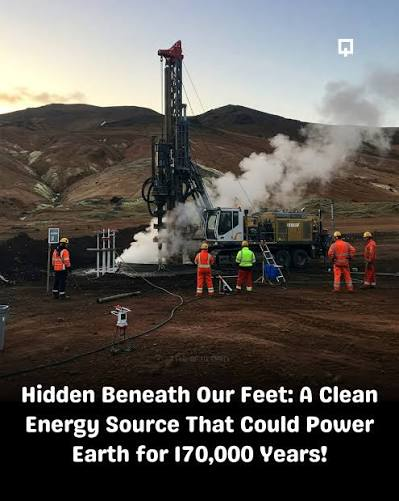
Engineers drill wells between 3 and 10 kilometers below the Earth’s surface, reaching temperatures ranging from:
- 150°C to 400°C
- Sometimes even higher in volcanic regions
Step 2: Reservoir Creation ansRenewable Energy
Water is injected under controlled pressure into the hot rock formations.
This creates tiny fractures that improve permeability and allow water to circulate effectively.
Step 3: Heat Extraction
As water flows through the hot rocks, it absorbs geothermal heat.
The heated water returns to the surface through production wells.
Step 4: Electricity Generation
The thermal energy is used to:
- Produce steam
- Drive turbines
- Generate electricity
Afterward, the water is recycled back underground, creating a closed-loop system.
Why EGS Matters for Renewable Energy
Most renewable energy sources face intermittency challenges:
| Energy Source | Availability |
|---|---|
| Solar | Daytime only |
| Wind | Weather dependent |
| Hydropower | Seasonal variations |
| EGS | 24/7 continuous |
This makes Enhanced Geothermal Systems a valuable source of baseload renewable power, capable of supplying electricity around the clock.
Key Benefits of Enhanced Geothermal Systems
1. Reliable 24/7 Power Generation
Unlike solar and wind energy, geothermal systems operate continuously regardless of weather conditions.
This reliability reduces dependence on battery storage systems.
2. Massive Global Potential
Studies suggest geothermal energy could provide a significant percentage of global electricity demand if EGS technology scales successfully.
Hot rock formations exist almost everywhere beneath the Earth’s surface.
3. Near-Zero Carbon Emissions
EGS plants emit extremely low greenhouse gases compared to fossil fuels.
This supports climate goals and decarbonization strategies.
4. Small Land Footprint
Compared with large solar farms and wind installations, geothermal facilities require significantly less land area.
5. Long Operational Lifespan
Many geothermal projects can operate for decades with proper reservoir management.
Challenges Facing Enhanced Geothermal Systems
Despite enormous potential, EGS still faces several obstacles. Contact Us
High Upfront Costs
Deep drilling remains expensive.
Initial project costs often exceed hundreds of millions of dollars.
Geological Risks
Not every location contains suitable underground conditions.
Extensive geological surveys are required.
Induced Seismic Activity
Creating fractures underground may trigger small earthquakes.
Modern monitoring systems help reduce these risks.
Technology Maturity
Although advancing rapidly, EGS remains less mature than solar and wind industries.
Major Enhanced Geothermal Projects Worldwide EnhancedGeothermalSystems
United States
The United States leads global EGS research and development.
Notable projects include:
Utah FORGE
The Frontier Observatory for Research in Geothermal Energy (FORGE) serves as a major testing facility for advanced geothermal technologies.
Nevada Geothermal Projects
Several commercial-scale projects are exploring next-generation geothermal solutions.
Australia
Australia’s hot dry rock resources offer substantial EGS potential.
Research projects continue evaluating commercial viability.
Germany
Germany has invested heavily in geothermal development, particularly in Bavaria, where favorable geological conditions exist.
Japan
Following its energy transition efforts, Japan is increasingly exploring geothermal resources due to its volcanic geography.
Iceland
Although rich in conventional geothermal energy, Iceland also contributes valuable EGS research and innovation.
Big Tech’s Growing Interest in Geothermal Energy
Technology companies require enormous amounts of electricity to power AI systems and data centers.
As a result, major tech firms are investing in geothermal technologies.
Google has partnered with geothermal developers to support advanced geothermal projects.
The company views geothermal energy as a reliable source of carbon-free electricity for its operations.
Microsoft
Microsoft continues expanding investments in clean energy technologies to achieve its ambitious sustainability goals.
Geothermal power is considered a promising solution for future data center energy needs.
Meta
Meta is actively pursuing renewable energy procurement strategies to support growing infrastructure demands.
Reliable geothermal power aligns well with the company’s long-term clean energy objectives.
Enhanced Geothermal Systems vs Solar and Wind Energy Renewable Energy
| Feature | EGS | Solar | Wind |
|---|---|---|---|
| Available 24/7 | Yes | No | No |
| Weather Dependent | No | Yes | Yes |
| Land Requirement | Low | High | Medium |
| Carbon Emissions | Very Low | Very Low | Very Low |
| Scalability | High | Very High | Very High |
| Capacity Factor | 80-95% | 15-30% | 25-45% |
EGS offers a significant advantage in reliability and consistency.
The Role of EGS in Achieving Net-Zero Emissions
Many countries have committed to net-zero carbon emissions by 2050.
Achieving this goal requires:
- Decarbonizing electricity generation
- Replacing fossil fuel baseload power
- Supporting grid stability
Enhanced Geothermal Systems can help address all three challenges.
Energy analysts increasingly view EGS as a crucial complement to solar, wind, battery storage, and nuclear energy.
Future Trends in Enhanced Geothermal Systems Renewable Energy
Several emerging trends could accelerate EGS adoption.
Advanced Drilling Technologies
Innovations borrowed from the oil and gas sector are reducing drilling costs.
AI-Powered Reservoir Management
Artificial intelligence is improving geothermal exploration and performance optimization.
Closed-Loop Geothermal Systems
New designs eliminate many geological risks while improving efficiency.
Increased Government Support
Many nations are introducing funding programs and incentives for geothermal development.
Corporate Clean Energy Demand
Growing electricity consumption from AI data centers could significantly increase geothermal investments.
EGS Market Forecast Through 2035
Experts predict:
- Rapid growth in geothermal investments
- Declining drilling costs
- Expansion beyond traditional geothermal regions
- Increased integration with smart grids
- Greater participation from private-sector investors
By 2035, EGS could become one of the fastest-growing clean energy technologies globally.
Frequently Asked Questions (FAQs)
What is an Enhanced Geothermal System?
An Enhanced Geothermal System is a technology that creates artificial underground reservoirs in hot rock formations to generate renewable electricity.
Is EGS renewable?
Yes. Earth’s internal heat is continuously replenished, making geothermal energy a renewable resource.
How deep are EGS wells?
Most EGS wells range from 3 to 10 kilometers deep, depending on geological conditions.
Does EGS cause earthquakes?
Small induced seismic events can occur during reservoir creation, but monitoring systems help minimize risks.
How does EGS compare to solar energy?
Unlike solar power, EGS can generate electricity 24 hours a day regardless of weather or sunlight conditions.
Why are Google, Meta, and Microsoft interested in geothermal energy?
These companies need reliable carbon-free electricity for data centers and AI infrastructure. Geothermal power provides continuous clean energy.
Can EGS help achieve net-zero emissions?
Yes. EGS can replace fossil fuel-based electricity generation while supporting grid stability and renewable energy integration.
Final Thoughts
Enhanced Geothermal Systems may be one of the most underrated renewable energy technologies today. While solar and wind continue expanding worldwide, EGS offers something equally valuable: reliable, carbon-free electricity available 24 hours a day, 365 days a year.
As drilling technologies improve and investment from governments and major corporations increases, Enhanced Geothermal Systems could unlock vast clean energy resources hidden beneath our feet. If successful, EGS may become a cornerstone of the global transition toward a sustainable, net-zero future.
geothermal energy technology
- renewable energy innovation
- next generation geothermal
- clean energy solutions
- baseload renewable power
- geothermal power plants
- sustainable energy future
- carbon-free electricity
- geothermal drilling technology
- net zero emissions energy