
Introduction : White Hydrogen
For decades, hydrogen has been hailed as the fuel of the future. Governments, energy companies, and researchers worldwide have invested billions into producing hydrogen from renewable electricity, natural gas, and other sources. But what if vast amounts of hydrogen already existed naturally beneath our feet? FOLLOW FOR MORE
Enter White Hydrogen, a naturally occurring form of hydrogen gas found underground in geological formations around the world. Unlike green hydrogen, which requires renewable electricity for production, or blue and grey hydrogen, which rely on fossil fuels, white hydrogen is generated naturally by geological processes and can potentially http://blurase.com/http://blurase.com/be extracted directly from the Earth.
Recent discoveries in countries such as France, Australia, Mali, the United States, and Canada have sparked excitement among scientists and investors. Some experts believe white hydrogen could become one of the most significant clean energy discoveries of the 21st century.
In this article, we’ll explore what white hydrogen is, where it’s found, how it forms, extraction technologies, economic opportunities, environmental impacts, and how it compares with other hydrogen types.
What Is White Hydrogen?
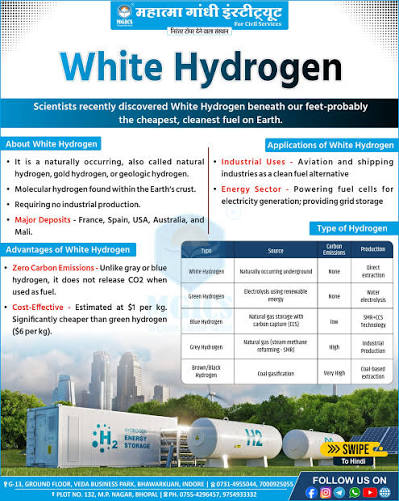
White hydrogen, also called natural hydrogen, geologic hydrogen, or gold hydrogen, is hydrogen gas that occurs naturally underground without human intervention.
Unlike manufactured hydrogen, white hydrogen is continuously generated through geological processes within the Earth’s crust and mantle.
Scientists have known about natural hydrogen seeps for decades, but they were largely overlooked because hydrogen was considered too difficult and expensive to store and transport. However, as the global demand for clean energy grows, natural hydrogen reserves are receiving unprecedented attention.
White hydrogen can accumulate in underground reservoirs similarly to natural gas, making it possible to drill wells and extract it for commercial use.

White Hydrogen
How White Hydrogen Forms Naturally
Several geological processes can generate hydrogen underground.
1. Serpentinization
The most important process is serpentinization.
This occurs when iron-rich rocks from the Earth’s mantle react with water.
The chemical reaction produces:
- Hydrogen gas (H₂)
- Serpentine minerals
- Heat
This process can continue for millions of years and constantly generate new hydrogen.
2. Water-Rock Reactions | White Hydrogen
Certain minerals containing iron can split water molecules into hydrogen and oxygen under high temperatures and pressures.
These reactions occur deep underground and contribute significantly to natural hydrogen generation.
3. Radiolysis
Natural radioactive elements such as uranium, thorium, and potassium can break apart water molecules through radiation.
This process releases hydrogen over long geological timescales.
4. Magmatic Activity
Hydrogen can also form during volcanic and magmatic processes.
Deep mantle gases may migrate upward through faults and fractures, accumulating in underground traps.
Where Is White Hydrogen Found?
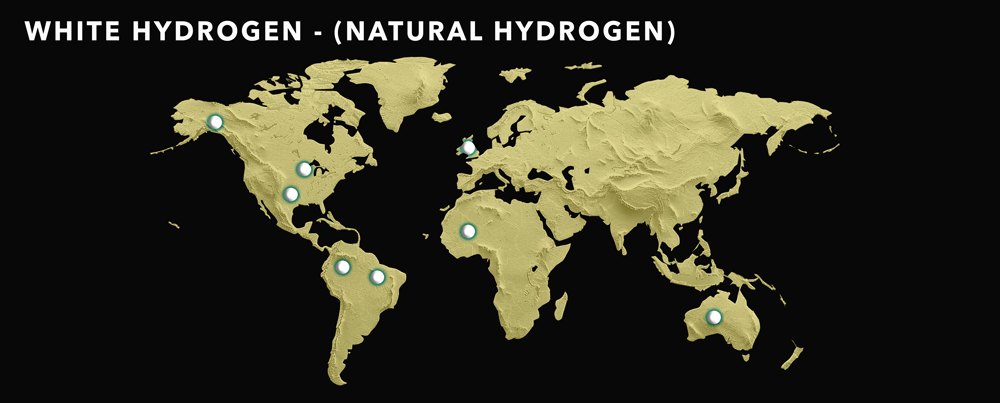
Scientists have identified natural hydrogen occurrences across multiple continents.
Mali
One of the world’s most famous white hydrogen discoveries occurred in Bourakébougou, Mali.
A well drilled in the 1980s unexpectedly encountered nearly pure hydrogen gas.
Researchers later found that:
- The hydrogen concentration exceeded 98%.
- The reservoir continuously replenished itself.
- The gas successfully powered a local electricity plant.
This discovery demonstrated that natural hydrogen could be commercially useful.
France
In 2023 and 2024, researchers discovered large natural hydrogen accumulations in northeastern France.
Preliminary estimates suggested the deposits could contain millions of tons of hydrogen.
The discovery generated significant interest from European energy companies.
Australia
Australia has become a major hotspot for natural hydrogen exploration.
Several companies have acquired exploration licenses targeting:
- South Australia
- Western Australia
- Northern Territory
Geological surveys indicate favorable rock formations capable of generating hydrogen continuously.
United States
Natural hydrogen seeps have been identified in:
- Kansas
- Nebraska
- California
- Midwestern geological basins
Government agencies and private firms are actively evaluating commercial potential.
Canada
Canada’s ancient crystalline rock formations are believed to contain substantial natural hydrogen resources.
Several exploration programs are underway across the country.
Other Regions
Researchers have reported hydrogen occurrences in:
- Brazil
- Spain
- Russia
- Oman
- Iceland
- Albania
- New Zealand
The growing list suggests natural hydrogen may be far more widespread than previously thought.
How White Hydrogen Is Extracted
The extraction process resembles natural gas production but with some unique challenges.
Exploration
Geologists first identify promising formations using:
- Satellite imaging
- Geological mapping
- Seismic surveys
- Soil gas measurements
Drilling
Exploration wells are drilled to confirm hydrogen concentrations.
Hydrogen reservoirs may exist at depths ranging from a few hundred meters to several kilometers.
Production Wells
Once commercial quantities are confirmed, production wells are installed.
The gas is collected and transported for:
- Electricity generation
- Industrial use
- Hydrogen fuel production
- Transportation applications
Purification
Hydrogen may be mixed with:
- Nitrogen
- Methane
- Helium
- Carbon dioxide
Processing facilities remove impurities to achieve commercial-grade hydrogen. White Hydrogen
Why White Hydrogen Is Generating Massive Interest
Several factors are driving excitement.
Lower Production Costs
Green hydrogen requires:
- Solar farms
- Wind farms
- Electrolyzers
- Large electricity inputs
White hydrogen already exists underground, reducing production costs significantly.
Some studies suggest production costs could fall below:
$0.50–$1.50 per kilogram
This is substantially cheaper than many current hydrogen technologies.
Continuous Generation
Unlike oil and gas fields that deplete over time, some natural hydrogen reservoirs appear to replenish themselves.
This raises the possibility of a renewable geological hydrogen source.
Massive Resource Potential
Recent geological models suggest global natural hydrogen resources could be enormous.
Some estimates indicate there may be enough underground hydrogen to satisfy global energy demand for centuries.
Energy Security
Countries lacking oil and gas resources could potentially develop domestic hydrogen industries.
This could reduce dependence on imported fossil fuels.
Environmental Benefits of White Hydrogen
Near-Zero Carbon Emissions
White hydrogen extraction can potentially produce far fewer emissions than conventional hydrogen production.
No fossil fuel reforming is required.
Reduced Renewable Infrastructure Requirements
Unlike green hydrogen, white hydrogen does not require massive solar or wind installations to generate fuel.
Smaller Land Footprint
A drilling site may occupy significantly less land than large renewable energy projects producing equivalent hydrogen volumes.
Support for Decarbonization
Natural hydrogen could help decarbonize sectors such as:
- Steel manufacturing
- Chemicals
- Fertilizers
- Heavy transportation
- Aviation fuels
Environmental Challenges
Despite its promise, white hydrogen is not entirely impact-free.
Drilling Impacts
Exploration and production require:
- Land access
- Well construction
- Infrastructure development
These activities can affect local ecosystems.
Hydrogen Leakage
Hydrogen is a very small molecule and can escape through tiny openings.
Leakage may indirectly influence atmospheric chemistry and climate systems.
Groundwater Concerns
As with any subsurface resource extraction, careful management is necessary to protect groundwater resources.
White Hydrogen vs Other Hydrogen Types
White Hydrogen
- Naturally occurring underground
- Minimal processing required
- Potentially lowest production cost
- Very low emissions
Green Hydrogen
- Produced via electrolysis
- Powered by renewable energy
- Near-zero emissions
- Currently expensive
Blue Hydrogen
- Produced from natural gas
- Carbon captured and stored
- Lower emissions than grey hydrogen
- Still dependent on fossil fuels
Grey Hydrogen
- Produced from natural gas
- No carbon capture
- Highest emissions
- Dominates current hydrogen production
Economic Potential
White hydrogen could become a multi-trillion-dollar industry.
Potential opportunities include:
Energy Production
Hydrogen-fired power plants can provide dispatchable clean electricity.
Industrial Decarbonization
Industries seeking to reduce emissions may use natural hydrogen instead of fossil fuels.
Hydrogen Exports
Countries with large hydrogen reserves could become major exporters.
Job Creation : White Hydrogen
A new exploration and production industry could create:
- Geologists
- Engineers
- Drilling specialists
- Infrastructure workers
Investment Growth
Venture capital and major energy firms are increasingly funding natural hydrogen exploration companies.
Current Challenges to Commercialization
Several barriers remain.
Limited Geological Understanding
Scientists are still learning:
- Where hydrogen accumulates
- How quickly reservoirs replenish
- Which formations are most productive
Exploration Risk
Not every hydrogen prospect will prove commercially viable.
Exploration remains high-risk.
Infrastructure Requirements
Hydrogen transport and storage infrastructure is still underdeveloped in many countries.
Regulatory Frameworks
Most countries do not yet have specific regulations governing natural hydrogen extraction.
The Future of White Hydrogen
Many experts believe natural hydrogen could become a major pillar of the global clean energy transition.
Over the next decade, we can expect:
- More exploration programs
- Larger resource discoveries
- Lower extraction costs
- Improved drilling technologies
- Expanded hydrogen infrastructure
If commercial-scale deposits are successfully developed, white hydrogen could complement renewable energy sources such as solar, wind, geothermal, and hydropower.
Rather than replacing green hydrogen, natural hydrogen may provide an additional pathway toward achieving net-zero emissions while reducing costs and improving energy security.
Conclusion
White hydrogen is rapidly emerging as one of the most exciting developments in renewable energy and clean fuel technology. Naturally generated deep within the Earth, this “hidden” energy resource offers the potential for low-cost, low-carbon hydrogen production without the extensive infrastructure required for conventional hydrogen manufacturing.
While significant scientific and commercial challenges remain, discoveries across Africa, Europe, Australia, North America, and other regions suggest that natural hydrogen resources may be far more abundant than previously imagined.
As exploration accelerates and technology advances, white hydrogen could transform global energy markets and become a critical component of the world’s transition toward a cleaner, more sustainable future.
SEO Meta Description
Discover White Hydrogen, the naturally occurring clean fuel found underground. Learn where it is found, extraction methods, global discoveries, economic potential, environmental impact, and how it compares with green, blue, and grey hydrogen.
Focus Keyword
White Hydrogen
SEO Tags
white hydrogen, natural hydrogen, geologic hydrogen, gold hydrogen, hydrogen energy, clean fuel, renewable energy, hydrogen extraction, hydrogen reserves, natural hydrogen deposits, green hydrogen vs white hydrogen, hydrogen fuel future, sustainable energy, underground hydrogen, hydrogen economy, clean energy technology, net zero emissions, alternative fuels, hydrogen exploration, renewable energy trends
High-Ranking Keywords
- White Hydrogen
- Natural Hydrogen Energy
- Underground Hydrogen Deposits
- Clean Hydrogen Fuel
- Hydrogen Energy Future
- Geologic Hydrogen
- Hydrogen Exploration
- Sustainable Energy Solutions
- Renewable Hydrogen Sources
- Low Carbon Fuel