
Introduction
The steel industry is one of the largest contributors to global carbon emissions, responsible for approximately 7–9% of worldwide CO₂ emissions. As governments and industries race toward net-zero targets, steel manufacturers are seeking cleaner production methods that reduce environmental impact without sacrificing output.Green Steel Manufacturing. follow for more
One of the most promising solutions is green hydrogen-based steel manufacturing, often referred to as green steel. By replacing coal and coke with hydrogen produced from renewable energy, steelmakers can dramatically reduce emissions while maintaining high-quality production.
This technological shift has the potential to transform one of the world’s most carbon-intensive industries into a cornerstone of the clean energy economy.

What Is Green Steel?
Green steel refers to steel produced using low-carbon or carbon-free manufacturing processes. The most advanced approach uses green hydrogen instead of coal during iron ore reduction.
Traditional steelmaking relies heavily on blast furnaces fueled by metallurgical coal. These furnaces generate large amounts of carbon dioxide as they convert iron ore into iron.
Green steel production replaces this process with hydrogen, producing water vapor instead of carbon emissions.
Key Benefits
- Significant reduction in greenhouse gas emissions
- Reduced dependence on fossil fuels
- Supports global climate goals
- Creates demand for renewable energy
- Improves industrial sustainability
Why Traditional Steel Production Creates So Much Pollution
Most steel today is produced using the Blast Furnace-Basic Oxygen Furnace (BF-BOF) method.
Traditional Process
- Iron ore is mined.
- Coal is converted into coke.
- Coke reacts with iron ore inside blast furnaces.
- Carbon removes oxygen from the ore.
- Molten iron is converted into steel.
The Problem
During this process, large amounts of CO₂ are released because carbon acts as the reducing agent.
For every ton of steel produced:
- Approximately 1.8–2.3 tons of CO₂ may be emitted.
- Massive quantities of coal are consumed.
- Air pollutants such as sulfur oxides and nitrogen oxides are generated.
This makes steel production one of the most difficult industries to decarbonize.
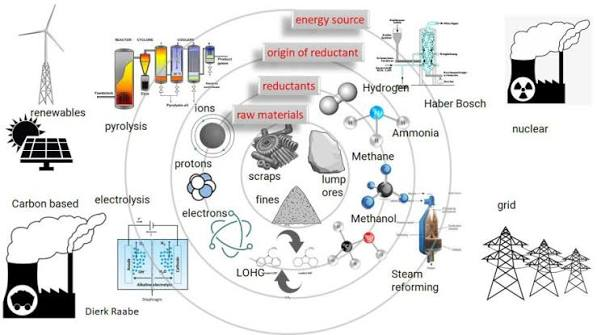
What Is Green Hydrogen?
Green hydrogen is hydrogen produced through electrolysis powered entirely by renewable energy sources such as:
- Solar power
- Wind energy
- Hydropower
- Geothermal energy
Electrolysis splits water into:
- Hydrogen (H₂)
- Oxygen (O₂)
Because renewable electricity powers the process, virtually no carbon emissions are generated.
How Green Hydrogen Produces Steel
The most common green steel route uses Direct Reduced Iron (DRI) technology.
Step 1: Hydrogen Production
Renewable electricity powers electrolyzers that produce green hydrogen from water.
Step 2: Iron Ore Reduction
Hydrogen is fed into a DRI furnace.
The hydrogen reacts with oxygen contained in iron ore:
Fe₂O₃ + 3H₂ → 2Fe + 3H₂O
Instead of carbon dioxide, the process produces water vapor.
Step 3: Electric Arc Furnace (EAF)
The resulting sponge iron is melted in an electric arc furnace powered by renewable electricity.
Step 4: Steel Production
The molten metal is refined and transformed into finished steel products.
Green Steel Manufacturing Process
Conventional Steel Route
Iron Ore → Coke → Blast Furnace → Steel
High CO₂ Emissions
Green Steel Route
Iron Ore → Hydrogen DRI → Electric Arc Furnace → Steel
Near-Zero Emissions
This alternative pathway can reduce steelmaking emissions by up to 95%.
Environmental Benefits of Hydrogen-Based Steel
Massive Emission Reductions
Green steel can eliminate millions of tons of CO₂ annually.
Cleaner Air
Hydrogen-based production reduces:
- Sulfur emissions
- Particulate matter
- Nitrogen oxides
Reduced Mining Impacts
Lower coal demand reduces environmental damage from mining operations.
Renewable Energy Integration
Green steel creates large-scale demand for renewable power projects.
Water Vapor Instead of Carbon
The primary byproduct is water rather than greenhouse gases.
Global Green Steel Projects Leading the Transition
HYBRIT Project (Sweden)
HYBRIT is one of the world’s most advanced green steel initiatives.
Developed by:
- SSAB
- LKAB
- Vattenfall
The project successfully produced fossil-free steel using hydrogen and aims for large-scale commercialization.
H2 Green Steel (Sweden)
This startup is building one of Europe’s largest green steel facilities powered by renewable energy and green hydrogen.
ArcelorMittal
The global steel giant is investing billions into hydrogen-ready DRI facilities across Europe.
Thyssenkrupp (Germany)
The company plans to replace coal-based blast furnaces with hydrogen-powered systems.
POSCO (South Korea)
POSCO is developing its HYREX technology for hydrogen steel production.
Tata Steel
Tata Steel is evaluating hydrogen-based steelmaking technologies to support future decarbonization goals.
Economic Advantages of Green Steel
Lower Carbon Costs
As carbon taxes increase globally, green steel becomes more competitive.
Premium Market Pricing
Many automakers and construction firms are willing to pay more for low-carbon steel.
New Employment Opportunities
Green steel projects create jobs in:
- Renewable energy
- Hydrogen production
- Infrastructure development
- Advanced manufacturing
Energy Security
Countries can reduce dependence on imported coal and fossil fuels.
Current Challenges
Despite its promise, green steel still faces several hurdles.
High Hydrogen Costs
Green hydrogen remains more expensive than coal-based alternatives.
Renewable Energy Demand
Large quantities of renewable electricity are required.
Infrastructure Requirements
Hydrogen transportation and storage systems must be expanded.
Technology Scale-Up
Commercial-scale hydrogen steel plants are still in early deployment stages.
Investment Needs
Billions of dollars in funding are required to transform existing steel facilities.
Cost Comparison
Traditional Steel
- Lower production costs today
- Mature infrastructure
- Established global supply chains
Green Steel
- Higher initial capital investment
- Falling renewable energy costs
- Expected cost reductions as hydrogen scales
Industry analysts predict green steel will become increasingly competitive during the 2030s.
Industries Driving Green Steel Demand
Automotive Manufacturing Green Steel Manufacturing
Major vehicle manufacturers seek low-carbon materials for EV production.
Construction
Builders increasingly require sustainable materials for green buildings.
Infrastructure Projects
Governments are introducing low-carbon procurement standards.
Consumer Products
Appliances and electronics manufacturers are exploring green steel sourcing.
The Future of Green Hydrogen in Steelmaking : Green Steel Manufacturing
The future looks promising as:
- Renewable electricity prices continue to decline.
- Electrolyzer technology becomes cheaper.
- Carbon pricing expands globally.
- Governments offer incentives for industrial decarbonization.
- Corporate sustainability commitments grow stronger.
Experts expect hydrogen-based steel production to become a major segment of the global steel market by 2040.
Countries with abundant renewable energy resources may emerge as leaders in green steel exports.
Conclusion
Green hydrogen is revolutionizing steel manufacturing by replacing coal with a clean alternative that dramatically reduces carbon emissions. Through hydrogen-based direct reduced iron processes and renewable-powered electric arc furnaces, the steel industry has a realistic pathway toward near-zero emissions.Green Steel Manufacturing
Although challenges such as cost, infrastructure, and hydrogen supply remain, rapid technological progress and growing demand for sustainable materials are accelerating adoption worldwide. As investments continue and renewable energy becomes more affordable, green steel could become one of the most important industrial innovations in the global transition to a low-carbon economy.Green Steel Manufacturing
The transformation of steel production is no longer a distant vision—it is already underway, powered by green hydrogen and driven by the urgent need for a cleaner future. Green Steel Manufacturing