
How Clean Energy Is Transforming AI Data Centers
Artificial Intelligence (AI) is rapidly becoming one of the world’s most powerful technologies, driving innovations in healthcare, finance, transportation, education, and scientific research. However, behind every AI-powered chatbot, image generator, recommendation engine, and autonomous system lies an enormous network of data centers that require vast amounts of electricity. follow for more
As AI models become larger and more computationally intensive, concerns are growing about their environmental impact. Training advanced AI models can consume millions of kilowatt-hours of electricity, while operating AI services around the clock requires thousands of high-performance servers running continuously. Renewable Energy for AI Data Centers
This has sparked an important question:
Can renewable energy power the AI revolution while keeping carbon emissions under control?
The answer is increasingly yes—but it comes with significant technical and economic challenges.
What Are AI Data Centers?
AI data centers are specialized facilities designed to train and run artificial intelligence models.
Unlike traditional cloud servers, AI data centers contain thousands—or even hundreds of thousands—of powerful GPUs and AI accelerators connected through ultra-fast networking systems.
A typical AI data center includes:
- GPU clusters
- High-speed storage
- AI networking infrastructure
- Cooling systems
- Backup power
- Massive electrical distribution equipment
These facilities operate 24/7, consuming electricity comparable to small cities.
Why AI Requires So Much Electricity
Modern AI workloads are far more demanding than traditional computing.
Renewable Energy for AI Data Centers
Energy consumption comes from several sources:
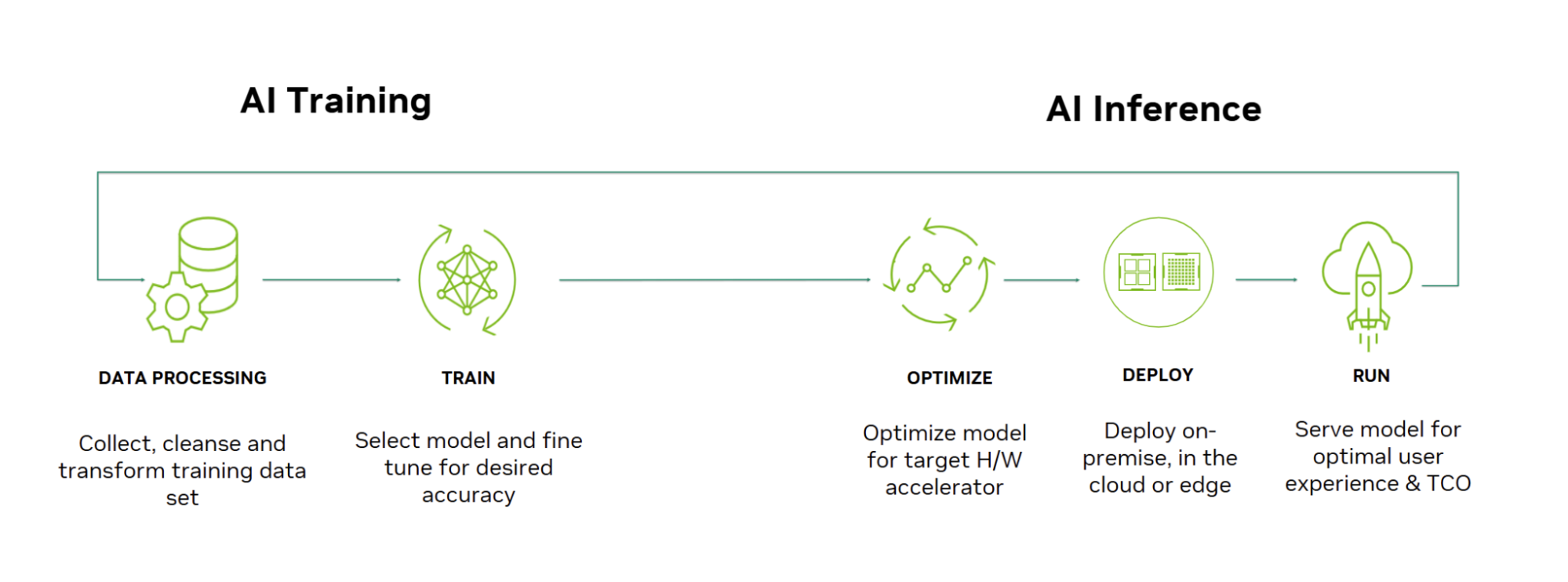
1. AI Model Training
Training large language models involves processing trillions of parameters over weeks or months.
Examples include:
- Large Language Models (LLMs)
- Image generation models
- Video generation systems
- Scientific AI simulations
Training requires thousands of GPUs operating continuously.
2. AI Inference
Renewable Energy for AI Data Centers
After training, millions of users interact with AI every day.
Each request requires GPU processing.
Popular AI applications include:
- Chatbots
- Search engines
- AI assistants
- Translation
- Code generation
- Image generation
Inference now represents one of the fastest-growing electricity demands.
3. Cooling Systems
GPUs generate enormous amounts of heat.
Data centers rely on:
- Air cooling
- Liquid cooling
- Immersion cooling
- Chilled water systems
Cooling alone may consume 30–40% of a facility’s total electricity.
4. Storage Infrastructure
AI requires:
- Petabytes of storage
- High-speed SSD arrays
- Backup systems
- Data replication
Storage systems also consume continuous power.
Referenced Symbols
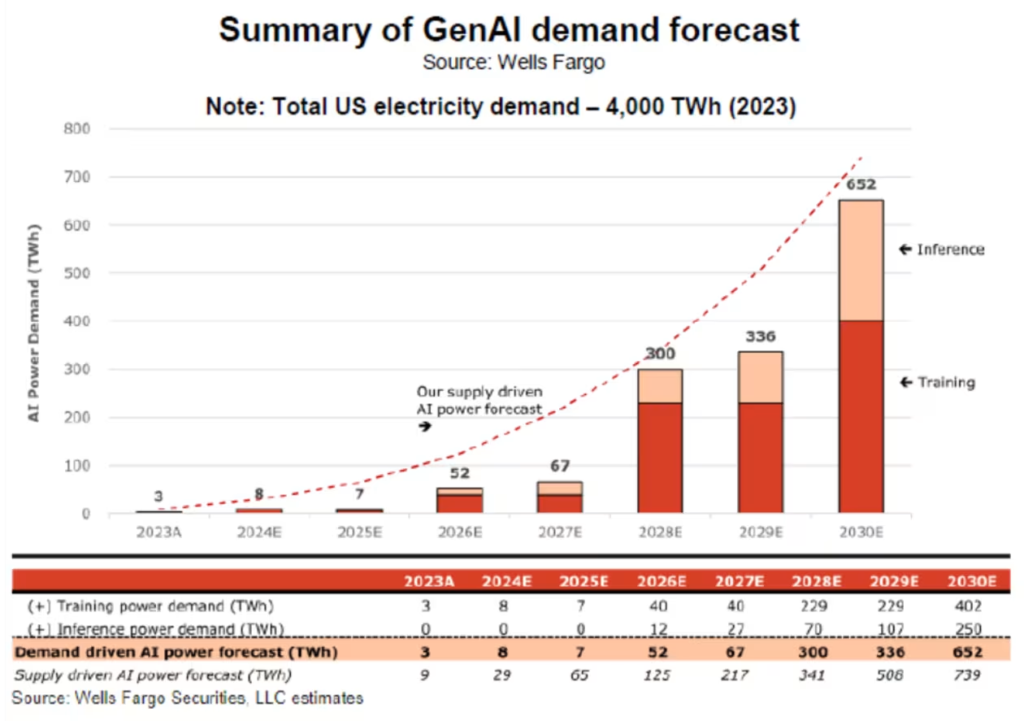
While you might be trying to use less electricity in order to save money, developers of artificial-intelligence tools are heading in the other direction.
The chart above shows how AI is expected to require much more energy in the years ahead. Demand is estimated to ramp up from 8 terrawatt-hours this year to 652 terrawatt-hours in 2030. A terrawatt-hour is equivalent to consuming 1 trillion watts of power for an hour.
The interim CEO for American Electric Power Co.
, Ben Fowke, offered the chart Tuesday as part of his prepared testimony for a hearing held by the Senate Energy and Natural Resources Committee.
The Growing Energy Demand of AI
Industry analysts estimate that AI-driven electricity demand could more than double data center energy consumption over the next decade.Renewable Energy for AI Data Centers.Renewable Energy for AI Data Centers
Factors driving growth include:
- Larger AI models
- More AI users
- Enterprise AI adoption
- Autonomous vehicles
- Robotics
- Scientific computing
- AI-powered search
Without cleaner energy, AI could significantly increase global carbon emissions.
Why Renewable Energy Matters
Renewable energy offers a path to sustainable AI growth by reducing dependence on fossil fuels. Renewable Energy for AI Data Centers
Major renewable sources include:
Solar Energy
Solar farms provide clean daytime electricity.
Benefits include:
- Zero operational emissions
- Rapid deployment
- Falling installation costs
Challenge:
Solar only generates power during daylight hours.
Renewable Energy for AI Data Centers
Wind Energy
Wind power complements solar generation.
Advantages:
- High energy output
- Low operating costs
- Nighttime generation
Challenge:
Electricity production varies with wind conditions.
Hydropower
Hydroelectric plants offer reliable renewable electricity.
Benefits:
- Stable power generation
- Long operating life
- High efficiency
Limitation:
Suitable only in regions with adequate water resources.
Renewable Energy Partnerships
Major technology companies are investing billions in renewable energy to power AI infrastructure.
Common strategies include:
Long-Term Power Purchase Agreements (PPAs)
Technology companies purchase renewable electricity directly from solar and wind farms through long-term contracts.
Benefits include:
- Stable electricity pricing
- Reduced carbon footprint
- Financing for new renewable projects
Dedicated Renewable Projects
Some AI companies fund the construction of renewable power plants specifically for their data centers.
Examples include:
- Solar farms
- Wind farms
- Battery storage systems
On-Site Solar Installations
Large campuses increasingly install rooftop solar panels and parking-lot solar canopies to offset part of their energy demand.
Battery Energy Storage
Renewables are intermittent.
Battery storage helps by:
- Storing excess solar energy
- Providing nighttime electricity
- Stabilizing grid supply
- Reducing peak electricity costs
Lithium-ion batteries are currently the most common technology, while long-duration storage solutions are under active development.
Why Nuclear Energy Is Returning
Renewables alone cannot always provide uninterrupted electricity for AI data centers.
This has renewed interest in nuclear energy.
Advantages include:
- 24/7 electricity generation
- Near-zero carbon emissions
- High reliability
- Small land footprint
New technologies include:
- Small Modular Reactors (SMRs)
- Advanced reactor designs
- Improved safety systems
Several technology companies are exploring partnerships with nuclear energy providers to secure long-term, carbon-free power.
Geothermal Energy for AI
Geothermal energy generates electricity using heat from beneath the Earth’s surface.
Benefits:
- Continuous power
- Weather-independent generation
- Very low emissions
- High reliability
Enhanced Geothermal Systems (EGS) could significantly expand geothermal availability beyond traditional volcanic regions.
For AI operators, geothermal offers an attractive source of clean baseload power.
Hybrid Energy Solutions
Future AI data centers will likely combine multiple clean energy sources.
Example energy mix:
- Solar
- Wind
- Battery storage
- Nuclear
- Geothermal
- Grid electricity
This diversified approach improves reliability while reducing emissions.
Improving Data Center Efficiency
Power generation is only part of the solution.
Companies are also improving efficiency through:
AI-Optimized Chips
Modern AI accelerators perform more computations while consuming less electricity.
Liquid Cooling
Liquid cooling removes heat more efficiently than air cooling.
Benefits include:
- Lower electricity use
- Higher computing density
- Better GPU performance
Smart Energy Management
AI itself helps optimize:
- Cooling systems
- Workload scheduling
- Electricity consumption
- Grid interaction
This reduces waste and operating costs.
Challenges Ahead
Despite rapid progress, several obstacles remain.
Renewable Intermittency
Solar and wind depend on weather conditions.
Reliable backup systems remain necessary.
Grid Capacity
Many regions lack sufficient electrical infrastructure to support rapidly expanding AI campuses.
Grid upgrades require significant investment.
Land Requirements
Large renewable projects require substantial land, creating competition with agriculture and urban development in some areas.
Water Consumption
Cooling systems can require significant water resources, especially in hot climates.
New cooling technologies aim to reduce water usage.
Rising Electricity Demand
Global electricity demand from AI is increasing faster than many utilities anticipated.
Balancing economic growth with sustainability will require coordinated planning.
Future Outlook
The future of AI depends not only on smarter algorithms but also on cleaner electricity.
Key trends expected over the next decade include:
- Expansion of renewable-powered AI campuses
- Greater use of nuclear and geothermal energy
- Larger battery storage deployments
- Smarter, energy-efficient AI hardware
- AI-driven optimization of electrical grids
- Increased investment in carbon-free infrastructure
The combination of renewable energy, advanced storage, nuclear power, and geothermal resources could make AI one of the largest drivers of clean energy investment worldwide.
Conclusion
Artificial intelligence is reshaping nearly every industry, but its rapid growth comes with a substantial increase in electricity demand. Renewable energy—including solar, wind, hydropower, geothermal, and nuclear power—will play a vital role in ensuring AI can scale sustainably.
No single energy source can meet every requirement. Instead, the future of AI data centers will depend on a balanced mix of clean energy technologies, advanced storage systems, efficient hardware, and intelligent power management. As governments, utilities, and technology companies continue investing in carbon-free infrastructure, renewable energy has the potential to power the AI revolution while significantly reducing its environmental impact.
Frequently Asked Questions (FAQs)
Can renewable energy fully power AI data centers?
Yes, but most facilities will rely on a combination of renewable energy, battery storage, grid electricity, and other low-carbon sources like nuclear and geothermal to ensure continuous operation.
Why do AI data centers use so much electricity?
AI workloads require thousands of high-performance GPUs, extensive cooling systems, high-speed storage, and round-the-clock operations, making them far more energy-intensive than traditional data centers.
What renewable energy sources are best for AI?
Solar and wind provide cost-effective clean power, while hydropower, geothermal, and nuclear offer reliable 24/7 electricity to complement intermittent renewables.
Why are tech companies investing in nuclear energy?
Nuclear power delivers stable, carbon-free electricity around the clock, making it well-suited for AI data centers that need uninterrupted power.
What is the biggest challenge in powering AI sustainably?
The main challenges include rapidly growing electricity demand, renewable intermittency, limited grid capacity, cooling requirements, and the need for large-scale energy storage.
Renewable Energy for AI Data Centers,Renewable Energy for AI Data Centers,Renewable Energy for AI Data Centers,Renewable Energy for AI Data Centers,Renewable Energy for AI Data Centers,Renewable Energy for AI Data Centers