
Grid Connection Requirements for Rooftop Solar in India: A 2026 Compliance Guide
Who this applies to, and why it matters right now
This guide is for three groups: homeowners evaluating rooftop solar, installers/EPC vendors managing DISCOM paperwork on behalf of clients, and commercial/industrial developers sizing systems against sanctioned load. If you intend to connect a solar PV system to the public electricity grid anywhere in India — whether a 1 kW residential setup or a 500 kW commercial installation — you fall under a layered framework: central technical rules set by the Central Electricity Authority (CEA), a central subsidy scheme administered by the Ministry of New and Renewable Energy (MNRE), and net metering regulations issued separately by each State Electricity Regulatory Commission (SERC).
As of mid-2026, the operative central subsidy programme is PM Surya Ghar: Muft Bijli Yojana, launched 13 February 2024 with a total outlay of ₹75,021 crore, targeting 1 crore households by FY 2026–27. As of May 2026, the scheme has benefited over 32 lakh households, with ₹14,771 crore disbursed as Central Financial Assistance through December 2025. The technical backbone governing how any solar system physically connects to the grid remains the CEA (Technical Standards for Connectivity of the Distributed Generation Resources) Regulations, 2013, supplemented by the CEA (Installation and Operation of Meters) Regulations, 2006. Rooftop Solar
Flag for readers: State net metering regulations are amended frequently — Gujarat alone has issued a third (2022) and a draft fourth (2024) amendment to its rooftop solar net metering rules in recent years. Capacity slabs, settlement methods, and top-up subsidy amounts cited below were accurate at time of writing but must be verified on your state DISCOM’s or SERC’s official portal, and on pmsuryaghar.gov.in, before you apply or sign a vendor contract.
1. Eligibility
Central scheme (PM Surya Ghar) eligibility
- Applicant must be an Indian citizen and the legal owner of the residential property; tenants are not eligible.
- Property must have a valid electricity connection with an active consumer number from the local DISCOM.
- Roof must have adequate shadow-free space — roughly 100 sq ft per kW of capacity.
- The household must not already have a subsidised rooftop solar system installed.
- Only CAPEX-owned installations qualify for the central subsidy; RESCO/third-party-owned (PPA) models are explicitly excluded from CFA.
- Commercial and industrial consumers are not eligible for the residential CFA, though they can still install net-metered systems under state SERC regulations.
Grid connection eligibility (any consumer category)
- System size is practically capped by your sanctioned load — most SERCs will not approve a system larger than your sanctioned connection load, regardless of capacity you wish to install.
- Equipment must be on MNRE’s Approved List of Models and Manufacturers (ALMM) for modules; this list changes periodically, and using a delisted panel is the single most common cause of subsidy/connection rejection.
- Phase configuration must match: a single-phase inverter on a three-phase connection will typically be rejected during net metering approval.
2. Step-by-Step Process: Application to Commissioning
- Register on the national portal (pmsuryaghar.gov.in) with mobile number, electricity consumer number, and Aadhaar (for residential CFA applicants). Generate a national portal reference number.
- Submit the DISCOM application — many states (e.g., Tamil Nadu’s TANGEDCO) require a second registration on the state DISCOM’s own portal using the national reference number, along with the application fee.
- DISCOM feasibility check. The DISCOM evaluates feeder capacity, distribution transformer (DT) loading, and existing rooftop solar penetration in your area. Under the 2024 amendment applicable in several states, this feasibility check must be completed within 3 days of a complete application (Gujarat); other states allow up to 15–30 days. Most states provide deemed approval for rooftop solar systems up to 10 kW, consistent with the PM Surya Ghar framework.
- Select a vendor from the empanelled list shown on the portal; the consumer is free to negotiate rates directly (Phase III of the programme removed centralised rate discovery).
- Site survey and design by the vendor, followed by physical installation — typically completed in 2–5 days for residential systems.
- Commissioning tests. The installer verifies protection settings, anti-islanding function, earthing continuity, and insulation resistance, and submits documentation to the DISCOM.
- Net meter installation. The DISCOM (or an empanelled meter vendor) installs the bidirectional meter. In areas covered by the Revamped Distribution Sector Scheme (RDSS) smart metering rollout, installation must go through the designated Advanced Metering Infrastructure Service Provider (AMISP).
- DISCOM inspection and commissioning certificate. Once inspection is cleared, the DISCOM uploads the commissioning report to the national portal.
- Subsidy disbursement. The CFA is credited via Direct Benefit Transfer to the consumer’s bank account, generally 30–45 days after commissioning report upload.
3. Documentation Checklist
| Document | Purpose |
|---|---|
| Latest electricity bill (showing consumer number) | Identity/connection verification |
| Aadhaar card | Identity verification for CFA |
| Proof of property/roof ownership | Eligibility for CAPEX installation |
| Bank account details + cancelled cheque | Subsidy disbursement via DBT |
| Single Line Diagram (SLD) of proposed system | DISCOM technical feasibility review |
| Structural drawing (for non-standard mounting) | Safety/load-bearing verification |
| Vendor empanelment certificate | Confirms vendor is authorised |
| Test reports (protection, earthing, insulation) | Commissioning approval |
| Commissioning certificate from DISCOM/Chief Electrical Inspector | Final sign-off, triggers subsidy |
4. Timeline Overview
| Stage | Typical Duration |
|---|---|
| DISCOM feasibility approval | 3–30 days (varies by state) |
| Vendor site survey & system design | 2–7 days |
| Physical installation | 2–5 days |
| Net meter installation & synchronisation | 10 working days (e.g., Maharashtra’s MSEDCL norm for testing/commissioning, plus a further 10 working days for net meter sync) |
| DISCOM inspection & commissioning certificate | Varies; often bundled with meter installation |
| Subsidy disbursement after commissioning | 30–45 days |
DISCOM performance varies sharply by state. In Karnataka (BESCOM), Maharashtra (MSEDCL), and Gujarat, online portals and defined timelines make the process relatively predictable, while states with manual processing can see delays of 60–90 days for the same steps.
5. Cost Breakdown
| System size | Approximate pre-subsidy cost | Central subsidy (PM Surya Ghar) | Approximate net cost |
|---|---|---|---|
| 1 kW | ₹65,000–₹80,000 | ₹30,000 | ₹35,000–₹50,000 |
| 2 kW | ₹1.4–1.6 lakh | ₹60,000 | ₹80,000–₹1 lakh |
| 3 kW | ₹1.8–2.2 lakh | ₹78,000 (maximum central subsidy) | ₹1.1–1.4 lakh |
| 5 kW | ₹3–3.5 lakh | ₹78,000 (capped, no further increase beyond 3 kW) | ₹2.2–2.7 lakh |
Source: Solnce Energy cost comparison, 2026; subsidy figures per MNRE PM Surya Ghar guidelines. Additional costs to budget for: DISCOM application fee (₹500–₹1,000 for residential, higher for commercial), net meter cost (usually borne by DISCOM but occasionally charged to the consumer depending on state), and system strengthening charges if your local DT is near capacity — in Gujarat, for instance, strengthening charges for installations exceeding 6 kW are borne by the applicant based on per-kW rates approved by GERC.
6. Central Government Schemes (MNRE)
PM Surya Ghar: Muft Bijli Yojana (2024–FY2026-27)
- Subsidy structure: ₹30,000 per kW up to 2 kW (so ₹60,000 for a 2 kW system), with an additional ₹18,000 for capacity between 2 kW and 3 kW, capped at ₹78,000 total for systems of 3 kW or larger. The central subsidy does not increase beyond ₹78,000 regardless of installed capacity above 3 kW.
- Special category states (Uttarakhand, Himachal Pradesh, J&K, Ladakh, North-eastern states including Sikkim, and Andaman & Nicobar/Lakshadweep) receive an enhanced benchmark, with combined CFA reported up to ₹1,17,000 in some published guides — confirm current special-category rates on the national portal before quoting to clients.
- Group Housing Societies/RWAs: ₹18,000 per kW for common facilities, including EV charging, up to 500 kW capacity, at ₹3 per kW per house, with the upper limit inclusive of individual rooftop plants installed by residents.
- Loans: Collateral-free solar loans are available through public sector banks at rates linked to the RBI Repo Rate; confirm current rates on the JanSamarth Portal.
- Source: MNRE Order No. 318/17/2024-Grid Connected Rooftop, dated 16 March 2024, and subsequent guideline updates.
Earlier Phase II Rooftop Solar Programme (for context)
Before PM Surya Ghar, the Phase II Grid-Connected Rooftop Solar Programme used a different CFA slab structure: Rs. 14,588 per kW up to 3 kW, and Rs. 14,588 per kW for the first 3 kW thereafter plus Rs. 7,294 per kW for capacity above 3 kW and up to 10 kW. Applications under that structure closed for claims after October 2024; PM Surya Ghar now governs all fresh residential applications.
7. State-Level Policies: Net Metering Comparison
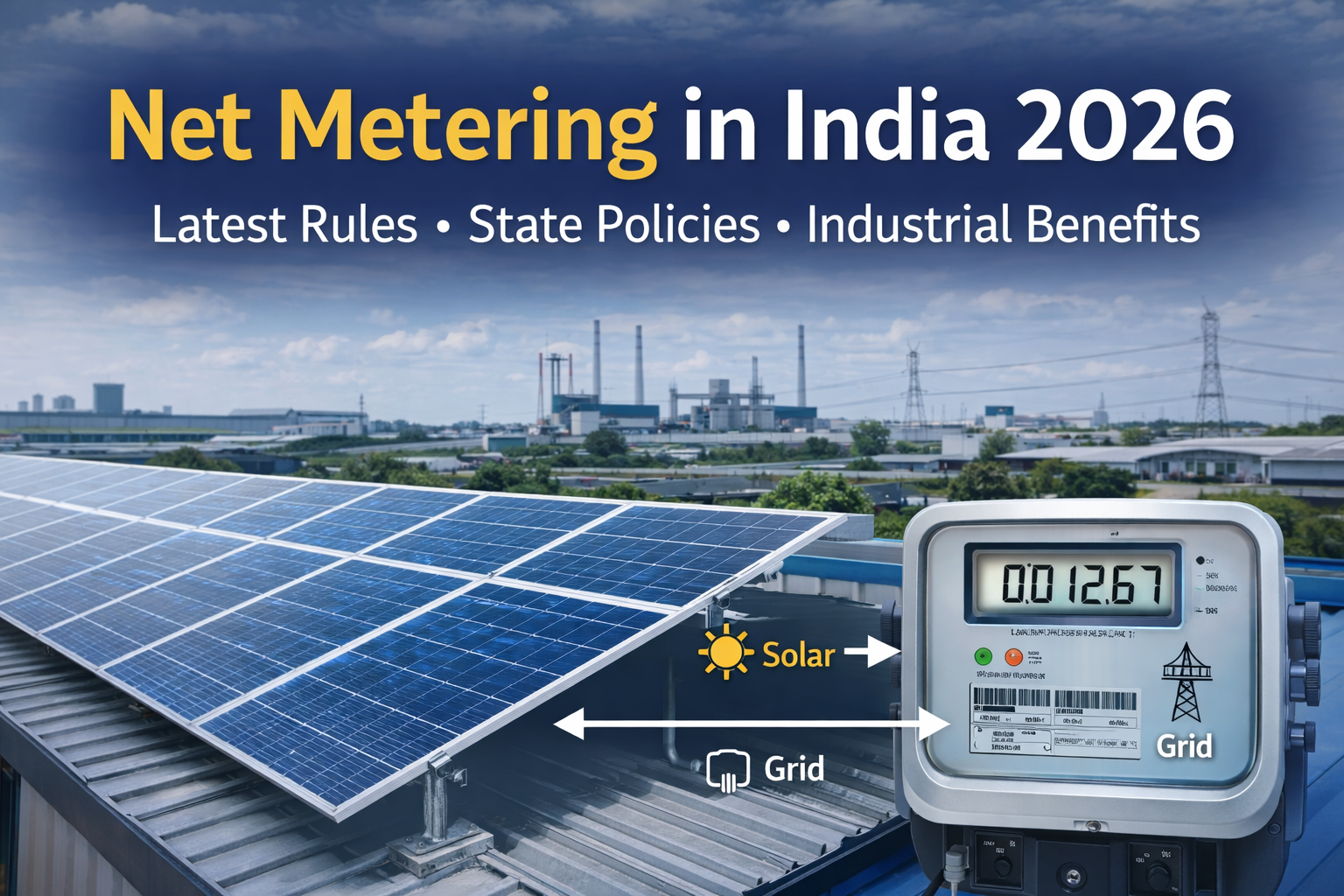
Net metering rules — capacity limits, settlement method, and compensation for surplus export — are set independently by each SERC, not by MNRE. This creates meaningful state-to-state variation even though the central subsidy is uniform.
| State | Net metering capacity limit | DT/feeder penetration cap | Settlement period | Surplus compensation basis | State top-up subsidy |
|---|---|---|---|---|---|
| Gujarat | 1 kW – 1 MW (GERC Third Amendment, 2022) | Strengthening charges borne by applicant above 6 kW | Aligned with billing cycle | APPC / discovered RE tariff | Surya Gujarat scheme; banking charges ₹1.50/unit (demand-based), ₹1.10/unit (MSME/non-demand) |
| Tamil Nadu | Net-billing up to 1 MW or sanctioned load, whichever is lower | 30% per-phase limit within overall DT cap (tighter than most states) | Monthly (net feed-in, post-March 2019 applications) | Tariff fixed by TNERC, credited and carried forward | Limited state-level top-up; relies primarily on central CFA |
| Karnataka | Up to 1 MW; residential capped at sanctioned load or 10 kW, whichever is lower | Exempt from certain charges where injection/withdrawal occur within the same DT or 11 kV feeder | Annual | Lowest solar/wind tariff discovered in preceding financial year | No separate residential subsidy; relies on central CFA |
| Maharashtra | Up to 1 MWp (with 5% variation); residential typically 8 kWp+ at 3-phase LT level | 40% of DT capacity (may extend after load study) | Annual | Average Power Purchase Cost (APPC) or Feed-in Tariff, whichever is lower | Grid support charges apply: 50 paise/kWh (first 300 units), ₹1/kWh thereafter |
| Rajasthan | Up to 1 MW | Standard DT-based limits | Annual | Lowest solar PPA/PSA tariff from preceding year | RREC top-up reported around ₹17,000 for residential systems (verify current rate) |
Sources: GERC Third Amendment Regulations, 2022, on net metering; cross-state regulatory comparison covering Tamil Nadu’s 30% per-phase DT limit, Maharashtra’s and Karnataka’s 500 kW–1 MW net metering ranges, and state-wise settlement and compensation methodologies; Maharashtra MSEDCL net metering policy on capacity slabs and DT penetration limits; Karnataka net metering capacity rules and December 2024 simplification directive for loads up to 10 kW; TNEB/TANGEDCO USRP FAQ on Tamil Nadu’s net feed-in billing method.
Key takeaway for installers operating across states: do not assume portability of process knowledge between states. A vendor experienced with Gujarat’s GEDA-routed registration will find Tamil Nadu’s dual national-portal-plus-USRP registration, or Maharashtra’s DT-penetration math, materially different — each requires separate compliance verification.
8. Compliance Checklist
- ✅ Confirm solar modules are on MNRE’s current ALMM (Approved List of Models and Manufacturers) — this list is updated periodically and delisted panels are the leading cause of subsidy rejection.
- ✅ Verify module compliance with IS 14086 (Bureau of Indian Standards specification for crystalline silicon PV modules, aligned with IEC 61215), mandatory under the BIS Quality Control Order, 2022.
- ✅ Confirm inverter and protection settings meet the CEA (Technical Standards for Connectivity of Distributed Generation Resources) Regulations, 2013 — covering voltage/frequency trip thresholds and mandatory anti-islanding protection.
- ✅ Ensure the net meter is bidirectional, with import/export recorded separately, per the CEA (Installation and Operation of Meters) Regulations, 2006, typically Class 1 or Class 0.5 accuracy.
- ✅ Use UV-stabilised, double-insulated DC cabling rated for outdoor rooftop exposure (standard PVC cable per IS 694/1554 is not adequate for this application).
- ✅ Match inverter phase configuration (single-phase vs three-phase) to your sanctioned connection type before procurement.
- ✅ Confirm mounting structure height and design meet the minimum elevation and wind-load safety provisions specified in your state’s net metering regulations.
- ✅ Retain commissioning test documentation — protection settings, anti-islanding function test, earthing continuity, insulation resistance — for DISCOM submission.
- ✅ Check whether your state mandates a licensed electrical contractor for the AC-side wiring; several states require this for net metering sign-off.
- ✅ For systems above 6–8 kW (varies by state), confirm whether system strengthening charges apply and budget accordingly.
9. Penalties and Risks of Non-Compliance
- Subsidy forfeiture: Installing non-ALMM-listed panels, or completing installation before DISCOM feasibility approval, can result in outright rejection of the CFA claim with no appeal route once installed.
- Net metering disconnection: Distribution licensees retain the right to disconnect a rooftop installation if it causes voltage/frequency excursions, safety hazards, or fails anti-islanding requirements — and are not liable for compensation for fatal or non-fatal accidents arising from the rooftop solar installation on the consumer’s premises.
- Unauthorised grid injection: Connecting a system without DISCOM sanction or operating outside the approved metering arrangement (net/gross/virtual) can attract penalties under the Electricity Act, 2003 and state SERC regulations, in addition to disconnection.
- RESCO/PPA disqualification: Attempting to claim central CFA for a third-party-owned (RESCO) system is explicitly disallowed and will be rejected during portal verification.
- Structural liability: Installing on a roof without verifying load-bearing capacity exposes the property owner (and potentially the installer) to liability for structural damage — this sits outside the electrical compliance framework but is a recurring real-world dispute trigger.

10. Disclaimer
Policy figures, capacity slabs, subsidy amounts, and timelines in this guide reflect publicly available information as of mid-2026 and are compiled from MNRE, CEA, SERC, and DISCOM sources cited above. Subsidy rates, ALMM listings, net metering capacity limits, and state top-up schemes change frequently and can vary by DISCOM even within the same state. Before signing a vendor contract, applying for net metering, or quoting a subsidy figure to a customer, verify current terms directly on pmsuryaghar.gov.in, your state SERC’s official regulations, and your local DISCOM’s net metering portal. This article is for informational purposes and does not constitute legal, financial, or regulatory advice.
FAQ
1. Can a tenant apply for the PM Surya Ghar subsidy? No. Legal property/roof ownership is mandatory under current scheme guidelines; tenants are not eligible to claim the central subsidy, though they may explore arrangements with the property owner.
2. What happens if my system is larger than 3 kW — do I lose the subsidy? No, but the central subsidy is capped at ₹78,000 regardless of capacity above 3 kW. You can install a larger system (subject to sanctioned load limits), but the additional capacity beyond 3 kW does not increase the central CFA — check your state for any top-up subsidy that might apply to larger systems.
3. Why was my net metering application rejected even though my documents were complete? The two most common reasons are: (1) the installed panels were not on MNRE’s current ALMM list at the time of commissioning, and (2) a phase mismatch between the inverter and the sanctioned connection type (e.g., a single-phase inverter on a three-phase connection).
4. Does the subsidy apply to commercial or RESCO/third-party-owned installations? No. The PM Surya Ghar central subsidy applies only to CAPEX-owned residential installations. RESCO/PPA models and commercial/industrial consumers are excluded from this specific CFA, though commercial and industrial systems can still connect via net metering or open access under separate state SERC frameworks.
5. How long does it actually take from application to receiving the subsidy? Allow for 3–30 days for DISCOM feasibility approval (state-dependent), a few days for installation, and a further 30–45 days after commissioning for the subsidy to be credited via DBT. In states with manual processing or high backlogs, total time can stretch to 60–90 days or more — budget accordingly and avoid quoting fixed timelines to customers without checking current DISCOM performance.
This guide is provided by blurase.com for informational purposes. Regulatory details change frequently — always confirm current terms with your DISCOM, state nodal agency, or the official MNRE/pmsuryaghar.gov.in portal before making financial or installation decisions.