
Introduction: What If the Sun Never Set on Your Solar Farm?
Imagine a solar farm that never experiences nighttime.
There are no clouds blocking the panels, no storms covering the sky and no seasonal reduction in sunlight. Instead, enormous solar arrays orbit Earth, continuously collecting sunlight and converting it into electricity. That electricity is then transmitted wirelessly to receiving stations on the ground.
It sounds like science fiction.
But space based solar power (SBSP) is no longer purely a science-fiction idea. Engineers have already demonstrated important pieces of the technology in space, including wireless transmission of power. The challenge is that demonstrating a small amount of power is very different from building a commercially useful solar power satellite capable of supplying cities.
The basic physics is understood. The difficult question is economics, scale and engineering.
Could orbital solar energy eventually become a major source of electricity? Possibly—but probably not soon, and certainly not without enormous technological and infrastructure advances.
What Is Space-Based Solar Power?
Space-based solar power is a concept in which satellites equipped with large solar-energy collection systems gather sunlight in orbit and transmit the resulting energy to Earth.
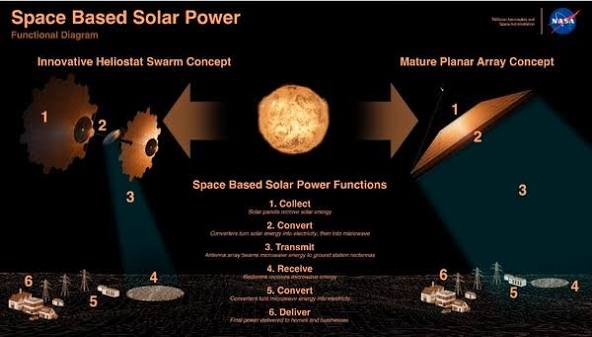
A typical system would have four major components:
- Large solar arrays collect sunlight.
- Power electronics convert the electricity into a form suitable for wireless transmission.
- Microwave or laser transmitters beam the energy toward Earth.
- Ground receiving stations convert the transmitted energy back into electricity for the grid.
The idea has an important advantage over ordinary solar farms: the satellite can spend much more of its time in sunlight.
The European Space Agency describes SBSP as a potential source of clean, reliable electricity available around the clock, with satellites transmitting energy to strategically located ground stations.
Why collect solar energy in space?
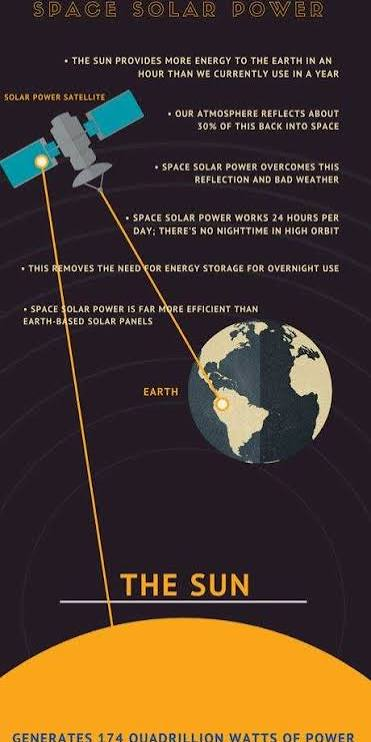
Earth’s atmosphere absorbs and scatters some solar radiation, while clouds, weather and nighttime interrupt solar generation.
In orbit, a solar collector can receive significantly more consistent sunlight.
JAXA says solar irradiance in space is roughly 40% stronger than on the ground and highlights the possibility of supplying power regardless of terrestrial weather conditions.
That doesn’t automatically make space solar cheaper. It simply gives the technology an energy-availability advantage.
How Does a Solar Power Satellite Work?
Think of a solar power satellite as a giant power station that happens to orbit Earth.
Step 1: Solar panels collect sunlight
Huge photovoltaic arrays convert sunlight into electricity.
Unlike a rooftop solar system, however, the array could eventually cover an enormous area.
Step 2: Electricity is converted for wireless transmission
The satellite’s electrical system converts the generated power into electromagnetic energy.
Two major approaches are being investigated:
- Microwave transmission
- Laser transmission
Microwave systems are generally attractive for large-scale power transmission because radio-frequency energy can pass through clouds and the atmosphere with relatively manageable losses.
Lasers can potentially use smaller receiving areas and tighter beams, but they introduce their own challenges involving atmospheric conditions, pointing accuracy and safety.
JAXA has research programs covering both microwave and laser wireless power transmission.
Step 3: Energy is beamed toward Earth
A precisely controlled transmitter directs the electromagnetic beam toward a receiving station.
For microwave systems, the ground facility is commonly called a rectenna, short for rectifying antenna.
The rectenna receives the microwave energy and converts it back into electrical power.
Step 4: Electricity enters the grid
After conversion and conditioning, the electricity can theoretically be supplied to homes, factories, data centers or other electricity users.
The result would be a renewable-energy system capable of delivering power independently of local sunshine and weather.
Why Is Space-Based Solar Power So Attractive?
The biggest argument for SBSP isn’t simply “solar panels in space.”
It is reliable solar electricity.
1. Solar power could be available 24/7
Terrestrial solar panels stop producing electricity at night.
A properly designed orbital system can receive sunlight for much longer periods and, depending on orbit, can potentially provide electricity for most or all of the day.
That makes SBSP particularly interesting as a complement to terrestrial wind and solar.
ESA’s research specifically highlights the potential for continuous energy and describes SBSP as a possible complement to weather-dependent renewable generation.
2. Clouds don’t block the satellite’s sunlight
Clouds are a major reason terrestrial solar generation varies.
An orbital solar collector operates above the atmosphere.
The ground transmission beam still has to travel through the atmosphere, but the solar collection itself isn’t affected by clouds.
3. Less land is required for the energy collector
A terrestrial solar farm needs land.
An orbital solar farm moves the main collection infrastructure into space.
However, this doesn’t mean SBSP requires no land. Large receiving stations would still be needed on Earth.
4. Energy could potentially be sent where it is needed
One intriguing feature is the possibility of directing energy toward different receiving stations.
JAXA specifically identifies the ability to direct power toward different locations as one potential advantage of SSPS technology.
That could be valuable for remote regions, islands or areas where conventional electricity infrastructure is expensive to build.
5. It could complement batteries and other storage
Solar and wind power are increasingly important, but their output varies.
SBSP could theoretically provide electricity when terrestrial renewable generation is low.
This is one reason energy-system researchers are examining SBSP as a potential source of firm or near-baseload clean electricity rather than as a replacement for every terrestrial renewable system.
The History of Space-Based Solar Power
The idea isn’t new.
Peter Glaser’s 1968 concept
American aerospace engineer Peter Glaser proposed a major space solar power concept in 1968.
His idea involved collecting sunlight with enormous orbital solar arrays and transmitting the energy to Earth using microwaves.
JAXA traces the modern SSPS concept to Glaser’s 1968 proposal.
NASA and the U.S. Department of Energy subsequently conducted extensive studies during the 1970s.
NASA’s historical studies examined large solar power satellites, microwave transmission, space construction, transportation and economics. One 1976 study considered systems producing 5–10 gigawatts of ground output.
The problem wasn’t that engineers couldn’t understand the concept.
The problem was scale and cost.
Building structures kilometers across and transporting huge amounts of hardware into orbit was far beyond what launch systems could economically support.
Why Didn’t We Build Solar Power Satellites in the 1970s?
The concept ran into a simple problem:
Everything was too expensive.
Launching material into orbit cost enormous amounts of money.
And a commercial SBSP system would require much more than solar panels.
It would need:
- Huge structures
- Power electronics
- Transmission antennas
- Attitude-control systems
- Thermal management
- Communication systems
- Radiation-resistant components
- Assembly equipment
- Maintenance systems
- Ground rectennas
- Grid connections
NASA’s historical studies identified the ability to fabricate and assemble very large structures in space as one of the major technological uncertainties.
Today, reusable rockets, lightweight materials, autonomous robotics and advanced electronics have changed the equation.
But they haven’t solved it.
The Technology Is Finally Being Tested in Space
One of the most important developments came from the California Institute of Technology’s Space Solar Power Project.
In January 2023, Caltech launched the Space Solar Power Demonstrator (SSPD-1).
The spacecraft tested several technologies needed for future space solar systems, including lightweight deployable structures, solar cells and wireless power transmission.
Its most famous experiment was MAPLE — Microwave Array for Power-transfer Low-orbit Experiment.
In 2023, MAPLE demonstrated wireless power transmission in space and successfully directed detectable microwave power toward Earth.
That was a genuine milestone.
But there is an important distinction:
It demonstrated the principle—not a commercial power station.
Caltech itself emphasized that commercially useful solar power beamed from space remained a future prospect.
The demonstration showed that the basic technology works.
It did not prove that gigawatt-scale SBSP is economically viable.
What Changed in 2025–2026?
The biggest change isn’t one spectacular experiment.
It is the growing number of organizations working on different pieces of the problem.
ESA’s SOLARIS programme
The European Space Agency has been investigating SBSP through its SOLARIS initiative.
ESA’s work focuses on determining whether space-based solar power could eventually become technically and economically viable for Europe.
ESA has described designs involving radio-frequency transmission and has been studying the enormous engineering challenges associated with collecting and transmitting useful amounts of energy from orbit.
ESA’s earlier economic studies concluded that SBSP could potentially become competitive with terrestrial electricity systems around the 2040 timeframe under favorable assumptions.
That is a projection—not a guarantee.
Japan continues long-term SSPS research
Japan has been researching space solar power for decades.
JAXA continues to investigate microwave and laser wireless power transmission, large-scale orbital structures and other enabling technologies.
JAXA’s own FAQ says it has previously considered development of a 1-GW SSPS in the 2030s, while also exploring smaller systems that could potentially be deployed sooner.
That illustrates the difference between a research roadmap and a commercial deployment date: the technology roadmap remains subject to research results and economic feasibility.
Private companies are entering the field
Private companies are also exploring new approaches.
For example, Aetherflux has been developing a concept based on laser power transmission and announced plans for an in-space demonstration aimed at eventually showing end-to-end power delivery.
These smaller systems are important because the industry doesn’t necessarily have to jump directly from today’s satellites to a giant gigawatt solar station.
It can first test smaller pieces of the architecture.
The Biggest Problem: Scale
This is where the exciting headlines need some reality checking.
A satellite that transmits a tiny amount of detectable power is relatively manageable.
A satellite that supplies a city is something completely different.
A commercial system could require structures measured in kilometers, enormous solar collecting areas and similarly large ground receiving facilities.
ESA notes that the quantity of energy that would need to be transmitted is vastly larger than today’s satellite communications systems, creating major technological hurdles.
The engineering challenge isn’t one giant problem.
It is hundreds of smaller problems that must all work simultaneously.
Challenge #1: Launch Costs
Everything starts with getting hardware into orbit.
Even if solar panels become extremely cheap, launching millions of kilograms of equipment could make the project uneconomic.
Future SBSP designs therefore depend heavily on:
- Reusable launch vehicles
- Lightweight materials
- High-volume manufacturing
- Autonomous assembly
- In-space manufacturing
- Standardized modules
The goal isn’t simply to build a lighter satellite.
It is to create an orbital manufacturing and construction ecosystem.
Challenge #2: Building Huge Structures in Orbit
A conventional satellite might fit inside a rocket fairing.
A solar power satellite could eventually be kilometers across.
It obviously can’t be launched in one piece.
Instead, thousands—or potentially millions—of components could need to be launched separately and assembled in orbit.
That creates difficult questions:
Who assembles it?
How are damaged components replaced?
How does the structure survive vibrations and thermal cycling?
How does it maintain its orientation?
How does it avoid collisions with other spacecraft?
JAXA specifically identifies large-scale orbital assembly, long-term maintenance and launching bulky materials as major challenges.
Challenge #3: Wireless Power Transmission Efficiency
Every conversion step loses some energy.
A simplified system might look like:
Sunlight → electricity → microwave/laser → transmitted energy → electricity
Losses can occur at every stage.
The overall efficiency therefore matters enormously.
If too much energy is lost, the satellite must collect even more sunlight and become larger.
That creates a feedback loop:
More power needed → larger satellite → more launches → higher cost.
Improving power electronics, antennas, photovoltaic cells and rectennas is therefore critical.
Challenge #4: Beam Accuracy
Imagine trying to point a laser pointer at a target thousands of kilometers away.
Now imagine that the laser pointer is attached to a giant flexible structure moving through space.
And imagine that the target is moving relative to the satellite.
That’s the precision challenge.
Microwave systems use phased arrays and sophisticated beam-forming techniques to direct energy.
The beam must remain inside its intended receiving area.
A commercial system would need highly reliable monitoring and automatic safety mechanisms.
This is one reason wireless power transmission isn’t simply a matter of “turning on a giant microwave.”
Challenge #5: Safety
The word microwave can make people nervous.
But the relevant question isn’t simply whether microwaves are being used.
It is how the beam is designed, controlled and operated.
A large SBSP system would need carefully controlled transmission zones, monitoring and automatic shutdown mechanisms.
Ground receiving stations would also need to be designed around safety requirements.
ESA and JAXA both identify safe transmission and reception as important technical challenges.
A commercial system could not be treated like an ordinary radio transmitter.
Challenge #6: Space Debris and Orbital Congestion
A huge orbital structure introduces another problem: space traffic.
Earth orbit is becoming increasingly crowded.
A large SBSP satellite would need to coexist with:
- Communications satellites
- Earth-observation satellites
- Navigation systems
- Scientific spacecraft
- Crewed spacecraft
- Other commercial constellations
A collision involving a massive solar power satellite could create a serious debris problem.
Long-term orbital management would therefore be essential.
Challenge #7: Economics
This may ultimately be the biggest challenge.
SBSP doesn’t compete only against fossil fuels.
It competes against increasingly cheap:
- Solar PV
- Wind power
- Batteries
- Long-duration energy storage
- Transmission infrastructure
- Nuclear power
- Hydropower
Terrestrial solar panels don’t need rockets.
Wind turbines don’t need orbital assembly.
Batteries don’t need spacecraft propulsion.
That means space solar power must offer enough additional value—especially reliability and energy availability—to justify its extraordinary infrastructure costs.
Is Space-Based Solar Power More Efficient Than Ground Solar?
This question has a surprisingly complicated answer.
It can have a major energy-availability advantage, but that doesn’t mean the entire system is automatically more efficient.
Space provides stronger and more continuous sunlight.
However, the satellite must then:
- Convert sunlight into electricity.
- Convert electricity into electromagnetic energy.
- Transmit it hundreds or thousands of kilometers.
- Capture the energy on Earth.
- Convert it back into electricity.
- Deliver it through the grid.
Every step has losses.
A ground solar panel can simply produce electricity directly where it is installed.
Therefore, SBSP’s potential advantage is less about simple panel efficiency and more about continuous energy availability.
Microwave vs Laser: Which Is Better?
| Feature | Microwave | Laser |
|---|---|---|
| Long-distance transmission | Strong candidate | Strong candidate |
| Cloud penetration | Generally better | More affected by clouds |
| Beam size | Larger | Much narrower |
| Ground receiver | Large rectenna | Potentially smaller receiver |
| Atmospheric effects | Relatively manageable | More significant |
| Safety requirements | Major consideration | Major consideration |
| Current research | Extensive | Extensive |
| Likely role | Large-scale power | Specialized applications |
For enormous grid-scale systems, microwaves remain a particularly important option.
Lasers could become attractive for specialized applications where smaller receiving stations or more precise energy delivery are valuable.
There may not be a single winner.
Could Space Solar Power Work With the Existing Grid?
Yes, at least in principle.
The ground receiving station would act somewhat like another power plant connected to the grid.
Energy could be delivered to a high-voltage network and distributed normally.
The major difference is that the energy source would be orbiting Earth.
A network of receiving stations could potentially allow power to be routed toward regions experiencing higher demand.
That flexibility is one of the reasons researchers see SBSP as potentially complementary to terrestrial renewable generation.
How Much Could a Solar Power Satellite Produce?
Proposed designs vary enormously.
Historical NASA studies considered systems capable of producing gigawatts of power. A 1976 NASA technical study examined individual microwave transmission links around the multi-gigawatt scale and analyzed a 10-GW space solar power concept.
Modern research is also exploring smaller and modular architectures.
For example, a 2026 research study modeled a 20-satellite low-Earth-orbit constellation and estimated realistic delivery on the order of tens of kilowatts per served site under its particular assumptions—not gigawatts.
This illustrates an important point:
Today’s demonstrations and simulations are many orders of magnitude smaller than the giant solar power satellites envisioned in classic SBSP studies.
Could Space Solar Power Become Cheaper?
Possibly.
Several technological trends could improve the economics:
Reusable rockets
Lower launch costs could dramatically reduce the price of putting hardware into orbit.
Lightweight solar panels
The less mass launched, the better.
Autonomous robotics
Robots could assemble and maintain large structures without requiring large numbers of astronauts.
Mass manufacturing
Instead of building one unique spacecraft, manufacturers could produce thousands of standardized modules.
Better solar cells
Higher-efficiency cells can produce more electricity from the same area.
Advanced power electronics
More efficient conversion reduces losses.
Improved wireless transmission
Higher-efficiency transmitters and receivers can reduce the amount of solar collection required.
In-space manufacturing
Eventually, some structures might be produced using materials sourced or processed in space.
That last step would be transformative—but it remains far from routine commercial reality.
What Do 2025–2026 Research Trends Tell Us?
The most interesting development is that SBSP research is becoming more modular and experimental.
Rather than asking:
“Can we build a gigantic solar satellite tomorrow?”
researchers are increasingly asking:
- Can lightweight structures survive deployment?
- Can solar cells operate reliably in orbit?
- Can microwave arrays steer beams precisely?
- Can energy be transmitted safely?
- Can small satellites coordinate power delivery?
- Can robots assemble large structures?
- Can the system become cheap enough?
Recent academic work is also examining LEO constellations rather than relying exclusively on traditional giant geostationary satellites. A June 2026 study, for example, modeled a 20-satellite LEO architecture and investigated power allocation among multiple ground stations.
Other 2026 research has explored satellite-grid wireless energy transfer for remote and disaster applications.
These aren’t commercial systems yet.
But they demonstrate how the research field is moving from a single gigantic concept toward multiple possible architectures.
So, When Could Space-Based Solar Power Become Practical?
This is where it is important to separate technically possible from commercially competitive.
2026–2030: Demonstration era
Expect more experiments involving:
- Wireless power transmission
- Small satellites
- Laser transmission
- Microwave arrays
- Lightweight deployable structures
- Orbital assembly technologies
The goal is to prove individual components.
2030–2040: Possible pilot systems
If launch costs continue falling and demonstrations succeed, larger pilot systems could become realistic.
These could serve specialized customers rather than entire national grids.
Potential applications might include:
- Remote locations
- Disaster response
- Military logistics
- Islands
- Off-grid industrial sites
- Space infrastructure
2040–2050: Potential commercial scale
This is the period in which some current European studies and roadmaps place serious commercial potential.
ESA’s economic studies have suggested that SBSP could potentially become cost-competitive around 2040 under favorable assumptions.
But other research has found that the economics depend strongly on achieving aggressive cost reductions.
A 2025 European energy-system study found that some advanced SBSP concepts could provide system-level benefits under optimistic future cost assumptions, while other designs remained economically unattractive.
So 2040 is not a promised launch date for commercial space solar.
It is better understood as a potential milestone if several difficult assumptions become reality.
Will Space Solar Power Replace Solar Panels on Earth?
Probably not.
And that’s actually a good thing.
The most realistic future may involve both.
Ground solar is already cheap, scalable and easy to deploy.
Wind power is also highly competitive.
Batteries are improving.
Transmission networks are expanding.
SBSP could fill a different role:
Reliable renewable electricity when terrestrial renewable generation isn’t enough.
Instead of replacing rooftop solar, SBSP might complement it.
Instead of replacing wind farms, it could provide power when wind output falls.
Instead of replacing batteries entirely, it could reduce how much storage is needed for certain grids.
What Would a Future Solar Power Satellite Look Like?
Imagine a structure potentially stretching for kilometers.
Across it are lightweight photovoltaic panels.
At the center or along its structure are power electronics and transmission equipment.
The satellite continuously tracks the Sun and Earth.
A huge phased microwave array points toward a receiving station.
On Earth, an enormous rectenna receives the energy.
The electricity then enters a conventional grid.
There are no fuel deliveries.
No coal trains.
No gas pipelines.
No nighttime shutdown.
But there is also no magic.
The system would be one of the largest and most complicated infrastructure projects humanity has ever attempted.
The Honest Verdict: Is It Actually Possible?
Yes—the basic concept is physically possible.
That part has already moved beyond theory.
Wireless power transmission has been demonstrated in space. Caltech’s MAPLE experiment successfully transmitted power wirelessly in orbit and directed detectable power toward Earth.
JAXA continues researching microwave and laser transmission.
ESA is studying the technical and economic case.
Private companies are developing smaller demonstrations.
So the question is no longer:
“Can energy be transmitted wirelessly from space?”
The better question is:
“Can we do it at enormous scale, safely and cheaply enough to compete with terrestrial energy?”
That question remains unanswered.
And it may take decades to answer.
The Biggest Opportunity May Not Be Electricity for Homes
One of the most interesting early uses of orbital solar power may be somewhere other than your house.
Consider a remote disaster zone.
A hurricane destroys the local grid.
A wildfire cuts transmission lines.
A remote military installation needs reliable power.
An isolated island has expensive fuel imports.
A conventional power plant takes months or years to build.
A future space-based system could potentially direct power toward a prepared receiving station.
This doesn’t require immediately building a 10-GW orbital megastructure.
It requires demonstrating smaller, controlled energy-delivery systems first.
That could make specialized applications an important stepping stone toward larger commercial systems.
Space-Based Solar Power: Pros and Cons
Advantages
- Potentially continuous solar-energy availability
- Less affected by terrestrial weather
- No nighttime interruption for appropriately designed orbits
- High solar irradiance in space
- Could complement wind and terrestrial solar
- Potentially useful for remote locations
- Electricity could be transmitted without physical power lines from the satellite
- Could reduce dependence on fuel-based generation
Disadvantages
- Extremely high development cost
- Huge launch requirements
- Complex orbital assembly
- Difficult maintenance
- Wireless transmission losses
- Beam-control and safety challenges
- Large ground receiving stations required
- Space-debris and orbital-management risks
- Difficult economics compared with increasingly cheap terrestrial renewables
- Regulatory and international coordination challenges
Frequently Asked Questions
What is space based solar power?
Space based solar power is a system that collects sunlight using solar arrays in orbit and transmits the resulting energy wirelessly to Earth, usually using microwaves or lasers.
How does a solar power satellite work?
A solar power satellite collects sunlight with photovoltaic panels, converts the resulting electricity into electromagnetic energy, beams it toward Earth and uses a ground receiver to convert it back into electricity.
Is space solar power real?
Yes. The technology has been demonstrated at small experimental scales. Caltech’s MAPLE experiment transmitted power wirelessly in space and directed detectable power toward Earth in 2023.
Can solar panels in space generate electricity 24/7?
They can receive sunlight for much longer periods than terrestrial solar panels, but the exact availability depends on the satellite’s orbit and periods when Earth blocks sunlight.
Why is orbital solar energy better than normal solar?
Its major potential advantage is not necessarily higher panel efficiency. It is the ability to collect sunlight more consistently without clouds and nighttime interrupting the collection process.
Does space-based solar power use microwaves?
Many proposed large-scale systems use microwaves because radio-frequency energy can be transmitted through the atmosphere. Other concepts use lasers. JAXA is researching both approaches.
Is microwave power from space dangerous?
A properly designed system would require strict beam-control, monitoring and safety systems. The technology would have to be engineered so that the transmission area is controlled and unintended exposure is minimized.
How expensive is space-based solar power?
There is no single reliable commercial price today because no full-scale system exists. The economics depend heavily on future launch costs, satellite mass, power-conversion efficiency, orbital assembly and maintenance.
Will space solar power be available by 2030?
Small demonstrations and pilot systems are possible, but a large commercial system supplying substantial grid electricity by 2030 would require major technological and economic progress.
Could space-based solar power replace fossil fuels?
Potentially as part of a broader clean-energy system, but it is unlikely to replace fossil fuels by itself. Terrestrial solar, wind, storage, nuclear, hydro and transmission will likely remain important.
When could space-based solar power become commercially practical?
Some studies and roadmaps point toward the 2040s or later, but this is highly uncertain. ESA has identified the 2040 timeframe as a possible point for competitive electricity under favorable assumptions, while research continues to show that economics depend strongly on future cost reductions.
Final Verdict
Space-based solar power is possible—but possible does not mean ready.
The physics works.
The first in-space wireless-power demonstrations have happened.
The world’s space agencies and private companies are now testing the technologies needed to move from laboratory experiments toward practical systems.
But the leap from a small demonstration to a giant orbital power station is enormous.
The central challenge isn’t collecting sunlight.
We already know how to do that.
The real challenge is building massive, lightweight, reliable, maintainable and economically competitive energy infrastructure in orbit.
If launch costs fall dramatically, autonomous assembly becomes practical, wireless transmission becomes highly efficient and satellite manufacturing reaches industrial scale, space-based solar power could become an important source of clean electricity in the second half of this century.
But terrestrial solar and wind aren’t waiting around.
They are getting cheaper right now.
That means the future of orbital solar energy probably won’t be about replacing everything we already have. Instead, its strongest role may be providing something terrestrial renewables struggle with:
reliable, dispatchable clean energy from a power plant that sits above the clouds.
The idea began as a bold vision in the 1960s.
More than half a century later, engineers have finally demonstrated pieces of it in orbit.
The next question is no longer whether we can beam power from space.
It is whether we can build the entire system cheaply enough to make doing so worthwhile.
And that is the experiment the next two decades will decide.