
If you are shopping for solar panels, you have probably seen numbers like 18%, 20%, 22%, or even 24% efficiency. But what do these percentages actually mean?
A panel with 22% efficiency does not necessarily produce 22% more electricity than a 20% panel. And a higher efficiency rating does not automatically mean it is the best choice for your home.
Understanding solar panel efficiency can help you compare panels more intelligently, estimate how much electricity your rooftop can produce, and avoid paying extra for performance you may not need.
This guide explains what a solar panel efficiency rating means, how panels are tested, why temperature and shading matter, how different technologies compare, and how much electricity you can realistically expect from 1 kW of solar capacity.
What Is Solar Panel Efficiency?
Solar panel efficiency is the percentage of sunlight that a solar panel converts into usable electrical energy.
For example, if a solar panel has an efficiency rating of 20%, it means approximately 20% of the solar energy hitting the panel is converted into electricity under standardized test conditions.
The remaining energy is mostly reflected, converted into heat, or lost through other physical and electrical processes.
A simple example
Imagine sunlight delivers 1,000 watts of solar energy per square metre to a panel.
A panel with:
- 18% efficiency → approximately 180 W/m²
- 20% efficiency → approximately 200 W/m²
- 22% efficiency → approximately 220 W/m²
- 24% efficiency → approximately 240 W/m²
This is a simplified example based on standardized testing rather than actual rooftop conditions.
Important point
A 20% efficient panel isn’t producing 20% of its rated capacity all day.
Solar panels experience changing sunlight, temperature, shading, orientation, inverter losses and other factors. The efficiency number is primarily a standardized way to compare how effectively the panel converts sunlight under specified test conditions.
What Does a 20% Solar Panel Efficiency Rating Actually Mean?
Suppose you purchase a modern 400 W solar panel with around 20% efficiency.
The panel’s power rating tells you its maximum electrical output under standard test conditions. The efficiency rating tells you how effectively its surface area converts incoming sunlight.
This distinction is important.
Two panels could both be rated at 400 W, but one could have higher efficiency because it achieves the same output using less physical roof area.
Why efficiency matters most when roof space is limited
Consider two hypothetical panels:
| Panel | Efficiency | Power |
|---|---|---|
| Panel A | 20% | 400 W |
| Panel B | 22% | 400 W |
If both produce 400 W under the same test conditions, Panel B doesn’t suddenly produce 440 W.
Instead, the 22% panel can potentially achieve the same 400 W output with a smaller panel footprint.
This makes high-efficiency panels particularly useful for:
- Small rooftops
- Apartments
- Urban homes
- Commercial roofs with limited usable space
- Installations where maximizing power per square metre matters
How Is Solar Panel Efficiency Calculated?
A simplified efficiency calculation is:
Efficiency (%) = Electrical power output ÷ Solar power received × 100
For example, if a panel receives 1,000 W of solar energy and produces 200 W:
200 ÷ 1,000 × 100 = 20%
Real solar panel testing is more precise and uses standardized conditions so manufacturers’ products can be compared consistently.
However, real-world performance can be different because your rooftop rarely has perfect laboratory conditions.
Solar Panel Efficiency vs Power Rating
These two specifications are often confused.
Efficiency
Efficiency tells you how effectively the panel converts sunlight into electricity relative to its surface area.
Power rating
Power rating, such as 400 W or 450 W, indicates the electrical output the panel is rated to produce under standardized test conditions.
A larger panel can sometimes have a higher wattage without being more efficient.
For example:
| Panel | Efficiency | Rated power |
|---|---|---|
| A | 20% | 400 W |
| B | 22% | 450 W |
| C | 23% | 450 W |
Panel C has both a higher efficiency and the same rated power as Panel B, meaning it can potentially deliver that output from a smaller surface area.
Why Higher Efficiency Doesn’t Always Mean Better Value
This is one of the most important things to understand when buying solar panels.
You might assume:
Higher efficiency = better solar panel = better investment
Not necessarily.
A high-efficiency panel may cost more. If you have plenty of available roof space, a less expensive panel with slightly lower efficiency could provide a better overall return on investment.
Example
Imagine:
Option A
- 20% efficiency
- Lower price
- Plenty of roof space
Option B
- 23% efficiency
- Higher price
- Smaller footprint
If your roof is large enough for Option A to generate the electricity you need, paying significantly more for Option B may not make financial sense.
On the other hand, if your roof is small, the extra efficiency could allow you to install more capacity.
What should you compare?
Don’t look at efficiency alone.
Consider:
- Price per watt
- Warranty
- Product degradation
- Temperature coefficient
- Panel dimensions
- Power rating
- Manufacturer reputation
- Installation quality
- Inverter compatibility
- Expected lifetime output
The best solar panel is usually the one that gives you the right combination of power, reliability, available space and cost.
The Shockley-Queisser Limit: Is There a Maximum Solar Efficiency?
Yes.
Solar cells have fundamental physical limitations.
One of the most famous is the Shockley-Queisser limit, which describes the theoretical efficiency ceiling for a conventional single-junction solar cell under idealized conditions.
For a traditional single-junction cell, the theoretical maximum is roughly 33% under the assumptions of the original model.
Why can’t a normal solar cell convert all sunlight into electricity?
Because sunlight contains photons with different energy levels.
Some photons do not have enough energy to generate electron-hole pairs in the semiconductor. Others have more energy than necessary, with the excess largely becoming heat.
There are also unavoidable electrical and optical losses.
What about laboratory records above 33%?
Technologies such as multijunction and tandem solar cells can exceed the single-junction limit because they use multiple absorber materials to capture different portions of the solar spectrum more efficiently.
This is one reason technologies such as perovskite-silicon tandem cells attract so much attention.
For today’s mainstream residential market, however, silicon-based panels remain the dominant technology.
Monocrystalline vs Polycrystalline vs Thin-Film Efficiency
Different solar technologies have different typical efficiency ranges.
| Technology | Typical module efficiency* | Main advantage | Main limitation |
|---|---|---|---|
| Monocrystalline | ~19–24% | High efficiency and good space utilization | Usually higher cost |
| Polycrystalline | ~15–20% | Lower-cost technology | Requires more space |
| Thin-film | ~10–19% | Lightweight and flexible options | Lower power density |
| Advanced high-efficiency silicon | ~21–24%+ | High output per m² | Can cost more |
*Typical ranges vary by product and technology generation.
Monocrystalline panels
Monocrystalline panels are made from high-purity silicon and are generally the most efficient mainstream residential option.
They are particularly attractive when roof space is limited.
Modern technologies such as TOPCon, heterojunction (HJT), and back-contact cells have pushed silicon module efficiency higher.
Polycrystalline panels
Polycrystalline technology historically offered a lower-cost alternative to monocrystalline panels.
However, the market has increasingly shifted toward higher-efficiency monocrystalline technologies.
Polycrystalline panels generally need more roof space for the same total system capacity.
Thin-film panels
Thin-film solar cells use very thin semiconductor layers rather than conventional crystalline silicon wafers.
Some thin-film technologies can perform well in specific conditions, including certain high-temperature or low-light environments, but they generally have lower efficiency and therefore require more area for the same rated power.
Why Solar Panels Lose Efficiency in Heat
Here’s a surprising fact:
Solar panels like sunlight, but they don’t like excessive heat.
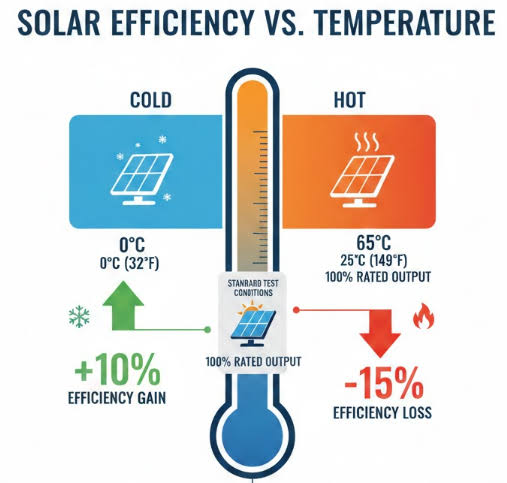
A panel needs sunlight to generate electricity, but its electrical performance generally decreases as its cell temperature rises.
This is why a panel can produce less power on a very hot afternoon even when the sun is extremely strong.
Temperature coefficient
Solar panels have a specification called the temperature coefficient of power.
It is normally expressed as a percentage change in power for each degree Celsius increase in cell temperature above the reference temperature.
For example, a hypothetical panel might have a temperature coefficient of:
-0.35%/°C
If the cell temperature rises 10°C above the reference condition:
10 × 0.35% = 3.5% reduction in power
The actual calculation is more nuanced because the reference condition and module temperature matter.
Why this matters in hot climates
If you live in a hot region, comparing temperature coefficients can be useful.
A panel with a less negative temperature coefficient may retain more of its power as temperatures rise.
However, don’t choose a panel based on temperature coefficient alone. Total energy production, cost and installation conditions matter too.
Real-World Solar Panel Efficiency Is Lower Than the Rating
The efficiency printed on the panel specification sheet is measured under standardized conditions.
Your rooftop is different.
Real-world output is affected by:
1. Sunlight intensity
Cloudy weather means less solar radiation reaches the panels.
2. Temperature
Higher cell temperatures generally reduce electrical output.
3. Orientation
A well-oriented panel generally receives more useful sunlight throughout the year.
4. Tilt angle
The ideal tilt depends on your location and system design.
5. Shading
Trees, buildings, water tanks, chimneys and neighboring structures can reduce production.
6. Dust and dirt
Accumulated dust can reduce the amount of sunlight reaching the cells.
7. Inverter losses
The electricity generated by the panels must be converted into usable AC electricity.
8. Wiring losses
Some energy is lost as electricity travels through cables and electrical equipment.
9. Panel degradation
Solar panels gradually lose some generating capacity over their operating life.
This is why your actual annual energy production is much more useful than simply looking at the efficiency percentage.
How Orientation and Shading Affect Solar Output
Even the most efficient solar panels can’t perform well if they are poorly installed.
Orientation
In the Northern Hemisphere, south-facing arrays are often favorable for maximizing annual solar exposure, but the best orientation depends on the location, roof structure and energy-use pattern.
For some rooftops, an east-west layout may make more sense because it spreads electricity production across the day.
Shading is especially important
Even partial shading can significantly affect a solar array.
A shadow from:
- A tree
- Water tank
- Chimney
- Nearby building
- Satellite dish
- Roof structure
can reduce output.
Modern module-level power electronics can help manage some shading scenarios, but good system design and avoiding shade remain important.
How Much Electricity Does 1 kW of Solar Produce Per Year?
This is where solar efficiency becomes practical.
A 1 kW solar system does not produce 1 kWh every hour.
Its annual production depends heavily on local solar resources, orientation, weather, system losses and other factors.
A rough planning range for annual output might look like this:
| Climate / location type | Approx. annual output per 1 kW |
|---|---|
| Lower-sun / cloudy climate | ~800–1,100 kWh |
| Moderate-sun climate | ~1,000–1,400 kWh |
| Strong-sun climate | ~1,200–1,700 kWh |
| Excellent solar resource | ~1,400–1,900+ kWh |
These are broad planning ranges rather than guarantees.
For example, a well-designed 5 kW system in a strong solar resource could potentially generate roughly 6,000–8,500 kWh per year, while a similar system in a less favorable climate could produce substantially less.
The exact result requires location-specific solar irradiation and system-loss calculations.
Does a 22% Panel Produce 10% More Electricity Than a 20% Panel?
Not necessarily.
A move from 20% to 22% efficiency represents a 10% relative increase in conversion efficiency:
22 ÷ 20 = 1.10
But that does not automatically mean your electricity bill will fall by 10%.
Your total production depends on:
- Panel area
- Number of panels
- System capacity
- Sunlight
- Temperature
- Orientation
- Shading
- Inverter efficiency
- Wiring
- Dirt
- Degradation
If both systems are designed to have the same total installed capacity, the difference in annual electricity generation may be much smaller than consumers expect.
Most Efficient Solar Panels: Should You Buy Them?
If your priority is maximizing electricity production from a limited roof area, high-efficiency panels can be an excellent choice.
They are particularly useful when:
You have a small roof
You may need high-efficiency modules to reach your desired system size.
Your electricity consumption is high
Higher power density can make it easier to install enough capacity.
You want a cleaner roof design
Fewer high-output panels can sometimes provide the same system capacity as more lower-output panels.
But if you have plenty of roof space, the cheapest cost per installed watt and expected lifetime production may matter more than achieving the highest possible efficiency percentage.
How to Choose Solar Panels Based on Efficiency
Instead of asking:
“Which panel has the highest efficiency?”
Ask:
“Which panel provides the best overall value for my roof and electricity needs?”
Check these specifications:
Efficiency
Higher efficiency means more electricity from a given area.
Power rating
Look for the panel’s rated wattage.
Temperature coefficient
A less negative coefficient can be beneficial in hot environments.
Degradation rate
Lower degradation can mean more electricity over the system’s lifetime.
Warranty
Look at both product and performance warranties.
Dimensions
A physically larger panel isn’t necessarily more efficient.
Price per watt
Compare total cost rather than only the sticker price.
Real-world energy yield
If available, examine expected production rather than relying only on laboratory efficiency.
Solar Panel Efficiency Comparison Table
| Factor | Lower Efficiency Panel | Higher Efficiency Panel |
|---|---|---|
| Electricity per square metre | Lower | Higher |
| Roof space required | More | Less |
| Usually cheapest per watt | Often | Not always |
| Useful for small roofs | Less suitable | Very suitable |
| Higher upfront price | Often lower | Often higher |
| Importance of roof space | Lower | Higher |
| Overall value | Depends on price and space | Depends on price and space |
Common Misconceptions About Solar Efficiency
Myth 1: A 20% panel wastes 80% of electricity
Not exactly.
The 20% figure describes conversion efficiency under standardized testing. The remaining incoming solar energy isn’t simply “wasted electricity.”
Much of it becomes heat or is not usable for photovoltaic conversion.
Myth 2: 24% efficiency means 24% electricity all day
No.
Solar panel efficiency changes with operating conditions.
Myth 3: The most efficient panel is always the best
Not necessarily.
Price, roof space, temperature performance, degradation and warranty all matter.
Myth 4: More sunlight always means more electricity
More sunlight generally helps, but excessive heat can reduce panel electrical efficiency.
Myth 5: Shading only slightly reduces production
Depending on the system design and location of the shade, even partial shading can have a significant effect.
Frequently Asked Questions
What is solar panel efficiency?
Solar panel efficiency is the percentage of incoming sunlight that a solar panel converts into electrical energy under specified test conditions.
Is 20% solar panel efficiency good?
Yes. Around 20% is a useful efficiency level for modern mainstream solar modules. Many current residential panels achieve efficiencies above 20%.
What is a good solar panel efficiency rating?
For a modern residential installation, roughly 20–24% is a strong range, although efficiency should be evaluated alongside price, warranty, degradation and temperature performance.
Are 24% efficient solar panels available?
Yes. Some premium commercial solar modules can reach around 24% or slightly higher depending on the technology and measurement conditions.
What is the most efficient type of solar panel?
Among mainstream residential technologies, high-efficiency monocrystalline silicon panels generally offer the highest module efficiency. Advanced technologies such as back-contact, TOPCon and HJT have pushed efficiency higher.
Does higher solar efficiency mean more savings?
Not automatically. Higher efficiency mainly becomes valuable when roof space is limited. The total system cost and energy production determine your actual financial return.
Do solar panels become less efficient in hot weather?
Yes. Solar cell power output generally decreases as cell temperature increases. The temperature coefficient indicates how strongly a panel responds to temperature.
Does shading reduce solar panel efficiency?
Shading reduces the amount of sunlight reaching the cells and can reduce system electricity production. The impact depends on the location and extent of the shade and the system’s electrical design.
How much electricity does 1 kW of solar produce?
A broad planning estimate is around 800–1,900+ kWh per year, depending heavily on climate, solar resource, orientation, shading and system losses.
Is a 20% panel better than a 15% panel?
Not automatically. A 20% panel can generate more power from the same area, but the 15% panel could potentially offer better value if it costs significantly less and you have plenty of roof space.
Final Takeaway
Solar panel efficiency is important, but it isn’t the only number that matters.
A 20% efficient panel converts a greater portion of incoming sunlight into electricity than a 15% panel, while a 22–24% panel can produce more power from the same physical roof area.
But choosing solar panels isn’t simply a race for the highest percentage.
For most homeowners, the smartest approach is to compare: