
Imagine a battery made from iron, water and air that could store renewable electricity for several days.
It sounds almost too simple.
But that is the idea behind the iron-air battery—a form of long duration energy storage designed to solve one of renewable energy’s biggest challenges: what happens when the sun stops shining and the wind stops blowing for hours or even days?
Instead of relying on lithium, nickel, cobalt or other specialized materials, iron-air batteries use a chemical reaction that is essentially reversible rusting.
When the battery produces electricity, iron reacts with oxygen and becomes rust. When the battery is charged, electricity turns the rust back into iron.


The technology is being commercialized by Form Energy, which began moving from pilot production toward commercial deployment in 2025. Its first commercial system is designed to discharge electricity continuously for up to 100 hours. (Form Energy)
That could make iron-air batteries particularly useful for a future electricity grid dominated by solar and wind.
What Is an Iron-Air Battery?
An iron-air battery is a rechargeable battery that uses iron as the main energy-storage material and oxygen from the air as part of its electrochemical reaction.
The basic concept is surprisingly straightforward:
Iron + oxygen → rust
But unlike the rusting of an old bicycle or metal gate, the process inside the battery is controlled and reversible.
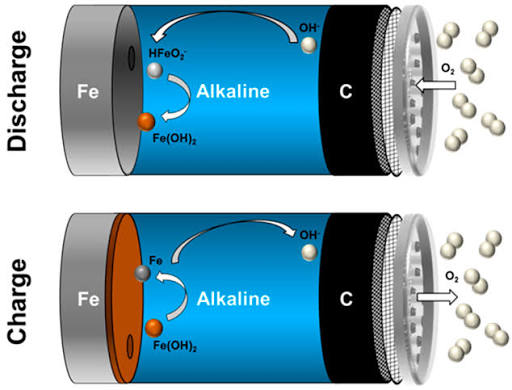
During discharge, the battery takes oxygen from the air and converts metallic iron into iron oxide, commonly described as rust.
During charging, electrical energy reverses the reaction, converting the iron oxide back into metallic iron.
In simplified terms:
Discharging:
Iron + Oxygen → Rust + Electricity
Charging:
Rust + Electricity → Iron + Oxygen
Form Energy describes this as a battery that effectively “breathes” oxygen in while discharging and releases oxygen while charging. (Form Energy)
That simple chemistry is what gives the technology its name—and its potential.
How Does an Iron-Air Battery Work?
You don’t need a chemistry degree to understand the basic cycle.
Think of an iron-air battery as having two important sides.
1. Iron electrode
The first side contains iron.
Iron is attractive for large-scale storage because it is extremely abundant and inexpensive compared with many specialized battery materials.
2. Air electrode
The other side interacts with oxygen from the surrounding air.
Instead of storing oxygen inside the battery, the system can draw it from the atmosphere.
3. Water-based electrolyte
The battery also uses a water-based, non-flammable electrolyte to allow ions to move through the cell.
Form Energy says its cells contain iron and air electrodes along with a water-based electrolyte. (Form Energy)
During discharge
Suppose the grid needs electricity.
The battery allows oxygen from the air to participate in the reaction with iron.
The iron gradually oxidizes.
In everyday language:
The iron rusts.
That chemical reaction releases electrical energy, which is delivered to the grid.
During charging
Now imagine that solar panels are producing more electricity than the grid needs.
Instead of wasting that electricity, the grid can send it into the battery.
The electricity reverses the chemical reaction, turning the iron oxide back into iron.
The battery is effectively “un-rusting” the iron.
Then the cycle can begin again.
Why Is 100-Hour Storage Such a Big Deal?
This is where iron-air batteries become particularly interesting.
Most lithium-ion battery systems are optimized for relatively short-duration energy storage. Depending on the application, they commonly operate over several hours rather than several days.
Iron-air technology is designed for something different.
Form Energy’s system is designed to provide electricity for up to 100 hours. (Form Energy)
That’s more than four days of continuous discharge.
Consider a simple example.
A 100 MW battery with 100 hours of duration could theoretically provide:
100 MW × 100 hours = 10,000 MWh
That’s 10 GWh of stored energy.
The important point isn’t simply the enormous number.
It’s the ability to shift electricity across multiple days, rather than simply from afternoon to evening.
Why Renewable Energy Needs Long-Duration Storage
Solar and wind power are inexpensive sources of electricity, but they aren’t always available when electricity demand is highest.
Solar production falls dramatically after sunset.
Wind can also remain weak for extended periods.
Imagine a week during which:
- Solar generation is excellent on Monday
- Wind generation is strong Tuesday
- Clouds reduce solar production Wednesday
- Wind speeds fall Thursday and Friday
- Electricity demand remains high throughout
A battery designed for a few hours can help with daily fluctuations.
But a multi-day battery can potentially help bridge the longer gap.
That’s the fundamental market Form Energy is targeting.
The U.S. Department of Energy has specifically identified multi-day storage as a potential way to support grids integrating large amounts of variable renewable generation and retiring fossil-fuel generation. (The Department of Energy’s Energy.gov)
Iron-Air vs Lithium-Ion Batteries
Iron-air batteries aren’t necessarily intended to replace lithium-ion batteries everywhere.
In fact, the two technologies could work together.
| Feature | Iron-Air | Lithium-Ion |
|---|---|---|
| Typical target duration | Up to 100 hours | Usually several hours |
| Main materials | Iron, water, air | Lithium-based chemistry and other materials |
| Best use | Multi-day storage | Short-duration/grid balancing |
| Energy density | Lower | Much higher |
| Physical footprint | Larger for equivalent energy | More compact |
| Fire risk | No thermal runaway in Form’s tested system | Thermal runaway is a known safety consideration |
| Long-duration economics | Designed specifically for multi-day storage | Can become expensive for very long durations |
| Renewable integration | Excellent for multi-day gaps | Excellent for daily cycling |
| Geographic requirements | Flexible siting | Flexible siting |
Form Energy says its iron-air technology is intended to complement lithium-ion, with each technology serving different grid requirements. (Form Energy)
The important distinction
Lithium-ion is extremely good at storing a lot of energy in a relatively small space.
Iron-air is trying to make very long storage durations economically practical.
That’s a different optimization problem.
Why Not Just Build More Lithium-Ion Batteries?
This is one of the most important questions.
If lithium-ion batteries already work, why develop another battery technology?
The answer is cost per stored kilowatt-hour over long durations.
Suppose you want four hours of storage.
Adding battery cells may be economically reasonable.
But imagine you want 24, 50 or 100 hours.
You need dramatically more battery capacity.
That can make conventional battery systems increasingly expensive.
Iron-air batteries take a different approach.
Instead of maximizing energy density, they prioritize:
Low material cost + long duration + abundant materials.
Form Energy says its technology is designed to store energy at a substantially lower cost than lithium-ion at long durations, with the company targeting costs below one-tenth of lithium-ion technology on certain comparisons. Those figures are company claims and should not be interpreted as a universal installed-cost result for every project. (Form Energy)
Why Iron Is So Interesting
Iron is one of the world’s most widely used metals.
It’s already produced at enormous industrial scale for steel manufacturing.
That creates an important potential advantage for energy storage.
A global energy-storage system cannot depend entirely on materials that are rare, expensive or difficult to source.
Iron is:
- Abundant
- Relatively inexpensive
- Well understood industrially
- Widely traded
- Recyclable
- Not dependent on a specialized battery-mineral supply chain in the same way as some advanced battery chemistries
Form Energy specifically describes iron, water and air as abundant and inexpensive materials for its battery system. (Form Energy)
What About Safety?
Large batteries need to be safe.
Lithium-ion systems can experience thermal runaway, where a damaged cell can heat uncontrollably and potentially ignite neighboring cells.
Iron-air chemistry takes a different approach.
Form Energy reports that its iron-air system completed UL9540A safety testing without flame or thermal runaway propagation. (Form Energy)
The system uses a water-based, non-flammable electrolyte, which is another safety advantage.
However, “safer” doesn’t mean “risk-free.”
Large energy-storage installations still require electrical protection, monitoring, cooling or environmental systems, fire planning where appropriate, and proper grid-integration equipment.
Why Form Energy Started Scaling Manufacturing
Form Energy was founded in 2017 and spent years developing and testing its iron-air technology.
The company selected its 100-hour iron-air chemistry as its first commercial product after technical and economic evaluation. (Form Energy)
The next major step was manufacturing.
Form built Form Factory 1 in Weirton, West Virginia, on the site associated with the former Weirton Steel mill.
The facility covers more than 550,000 square feet and was built specifically for high-volume iron-air battery manufacturing. (Form Energy)
Trial production began in 2024, while 2025 marked an important transition toward commercial demonstrations and increased manufacturing activity. Form says its first iron-air system for commercial demonstration was deployed in 2025 with Great River Energy, with the project expected to come online in 2026. (Form Energy)
This matters because laboratory batteries don’t transform the electricity system.
Factories do.
For iron-air technology to make a meaningful difference, manufacturers need to produce thousands or eventually millions of battery components reliably and economically.
Iron-Air Batteries Could Replace Fossil-Fuel Peaker Plants
One of the most interesting applications is replacing or reducing the need for peaker plants.
A peaker plant is a power plant that operates mainly when electricity demand becomes unusually high.
Many have historically relied on natural gas.
For example, imagine an electricity grid experiencing a heat wave.
Air conditioners run continuously.
Electricity demand rises.
Solar generation may fall toward evening just as demand remains high.
Traditionally, grid operators might start additional gas-fired generators.
A long-duration battery provides another possibility.
Instead of:
Renewable generation → demand falls → excess electricity curtailed
the grid could do:
Renewable generation → battery charging → stored electricity → multi-day discharge
And instead of:
High demand → gas peaker starts
the grid could potentially use:
High demand → stored electricity dispatched
This doesn’t mean iron-air batteries will eliminate every gas power plant.
Gas generators can provide other services, including long-duration backup and dispatchable capacity.
But long-duration storage creates another option for utilities planning increasingly renewable grids.
The U.S. Department of Energy has specifically pointed to iron-air storage as a potential tool for filling generation gaps as coal plants retire and variable renewable resources expand. (The Department of Energy’s Energy.gov)
Iron-Air vs Other Long-Duration Energy Storage
Iron-air isn’t the only technology competing to store electricity for many hours or days.
Several approaches are being developed.
1. Pumped Hydropower
Pumped-storage hydropower uses electricity to move water uphill.
When electricity is needed, the water flows downhill through turbines.
Advantages
- Proven technology
- Very large storage capacity
- Long operating life
- Excellent for grid-scale storage
Disadvantages
- Requires suitable geography
- Large infrastructure projects
- Long development timelines
Iron-air batteries don’t require mountains, reservoirs or specific geological formations.
Form Energy says its systems can be sited without relying on specific geological conditions. (Form Energy)
2. Flow Batteries
Flow batteries store energy in liquid electrolytes held in tanks.
Their biggest advantage is that energy capacity can be increased by making the tanks larger.
They’re therefore naturally suited to longer-duration applications.
Advantages
- Long-duration capability
- Potentially long cycle life
- Energy and power can be scaled separately
Disadvantages
- Larger physical footprint
- More complicated systems
- Electrolyte costs can matter significantly
3. Hydrogen
Excess renewable electricity can produce hydrogen through electrolysis.
Hydrogen can later be used to generate electricity.
Advantages
- Extremely long storage potential
- Can potentially store energy over weeks or seasons
- Hydrogen can also serve industrial applications
Disadvantages
- Energy losses during conversion
- Infrastructure requirements
- Storage and transportation challenges
- Green hydrogen remains relatively expensive in many markets
Hydrogen could therefore be especially useful for seasonal storage, while iron-air batteries may be better suited to multi-day grid balancing.
4. Thermal Energy Storage
Electricity can also be converted into heat and stored in materials such as molten salts or other thermal media.
These systems can be particularly attractive when electricity or heat is required.
The best technology depends heavily on the application.
The Biggest Advantage of Iron-Air Batteries
The strongest argument for an iron-air battery isn’t energy density.
It’s duration at potentially low cost.
A lithium-ion battery might be ideal for:
“I need electricity for the next four hours.”
An iron-air system is designed around a different question:
“What happens if renewable generation remains low for several days?”
That distinction could become increasingly important as wind and solar make up a larger percentage of electricity generation.
The Biggest Disadvantage
Iron-air batteries also have limitations.
Lower energy density
Iron-air systems are much less energy-dense than lithium-ion batteries.
That means more physical equipment can be required for the same amount of stored energy.
For a smartphone, laptop or electric car, that would be a major problem.
For a stationary grid battery, it may be much less important.
A utility doesn’t need its battery to fit inside your pocket.
Technology is still emerging
Lithium-ion has decades of commercial experience and a huge global manufacturing ecosystem.
Iron-air is much newer.
That means real-world performance, maintenance requirements, degradation, financing assumptions and long-term economics will need to be demonstrated across large numbers of projects.
Round-trip efficiency
Not all electricity used to charge a battery comes back out.
Some energy is lost during the charging and discharging process.
Iron-air batteries therefore compete not only on duration but also on total system economics.
Could Iron-Air Batteries Make a 100% Renewable Grid Possible?
Potentially, they could become one part of the solution.
But no single battery chemistry can solve every grid problem.
A renewable-heavy electricity system may need a portfolio containing:
- Solar power
- Wind power
- Lithium-ion batteries
- Long-duration batteries
- Pumped hydro
- Transmission
- Demand response
- Hydropower
- Geothermal energy
- Other dispatchable clean resources
- Potentially hydrogen or other seasonal storage
The strength of iron-air technology is that it could fill a specific gap:
multi-day energy storage.
Form Energy says grid planning studies indicate significant potential demand for multi-day storage as renewable penetration and electricity demand increase. (Form Energy)
A Simple Example: Three Days Without Much Wind
Imagine a region with huge amounts of wind and solar.
Day 1
Solar production is excellent.
Wind is strong.
The grid has more electricity than it needs.
An iron-air battery charges.
Day 2
Clouds reduce solar production.
Wind remains moderate.
The battery may remain mostly charged.
Day 3
A weather system arrives.
Solar output is weak.
Wind generation drops significantly.
Electricity demand remains high.
The battery begins supplying electricity.
Day 4
Renewable generation finally recovers.
The battery can begin recharging.
This is fundamentally different from using a battery only to move solar electricity from noon to 7 p.m.
It’s multi-day energy shifting.
Are Iron-Air Batteries Actually Made From Rust?
Yes—but there is an important distinction.
The battery doesn’t simply contain a pile of rusty metal.
It uses engineered electrodes, electrolyte and air-handling systems designed to control the electrochemical reactions.
The “rust” concept describes the underlying chemistry.
That’s what makes the technology so fascinating.
An everyday process that normally destroys metal is transformed into a controlled energy-storage mechanism.
What Happens to the Battery at the End of Its Life?
One potential advantage is that the system doesn’t depend on the same combination of scarce or expensive materials used in some other battery technologies.
Form Energy describes its system as highly recyclable and says it contains no heavy metals. (Form Energy)
Still, the environmental footprint of a battery doesn’t disappear simply because its materials are abundant.
Mining, manufacturing, transportation, construction and recycling all require energy and resources.
The real environmental benefit comes when the battery enables more renewable electricity and reduces the need for fossil-fuel generation.
The Future of Iron-Air Batteries
The biggest test for iron-air batteries is no longer whether the chemistry can work in a laboratory.
The challenge is scale.
Can manufacturers produce these batteries cheaply?
Can utilities operate them reliably for decades?
Can projects achieve their expected performance?
Can developers build thousands of megawatt-scale systems?
And most importantly:
Can multi-day batteries become cheaper than building and operating alternative sources of firm power?
Form Energy’s manufacturing expansion is designed to answer some of these questions.
Its Weirton facility is planned to expand substantially, with the company targeting at least 500 MW of annual battery manufacturing capacity by 2028. (Form Energy)
Meanwhile, commercial projects are moving forward.
In 2026, Form announced plans for a 300 MW / 30 GWh iron-air project with Xcel Energy in Minnesota, illustrating how the technology is being considered at a scale far beyond laboratory demonstrations. (Form Energy)
Iron-Air Batteries: Pros and Cons
Pros
- Up to 100-hour energy storage
- Uses abundant iron
- Uses water and air
- No lithium required for the core chemistry
- Potentially low cost for long-duration applications
- Designed for multi-day renewable energy storage
- Can complement lithium-ion batteries
- No thermal runaway in Form Energy’s reported UL9540A testing
- Doesn’t require specific geological conditions
- Could reduce dependence on fossil-fuel peaker plants
Cons
- Lower energy density than lithium-ion
- Requires larger physical installations
- Newer technology with less operating history
- Commercial-scale deployment is still developing
- Round-trip energy losses remain important
- Economics depend on project design and local electricity markets
- Manufacturing must scale successfully
Frequently Asked Questions
What is an iron-air battery?
An iron-air battery is a rechargeable battery that stores and releases electricity through a reversible electrochemical reaction between iron and oxygen. During discharge, iron oxidizes and forms rust; charging reverses the process.
How long can an iron-air battery store electricity?
Form Energy’s commercial iron-air system is designed to provide electricity for up to 100 hours, or more than four days of continuous discharge. (Form Energy)
Is an iron-air battery better than lithium-ion?
Not universally. Lithium-ion remains excellent for applications requiring high energy density and short-duration storage. Iron-air batteries are designed primarily for economical multi-day storage.
Is rust really used to generate electricity?
Yes. The underlying chemistry involves the oxidation and reduction of iron. In simple terms, the battery creates a controlled and reversible form of rusting.
Are iron-air batteries safe?
Form Energy reported successful UL9540A testing with no flame or thermal runaway propagation. Its system also uses a water-based, non-flammable electrolyte. (Form Energy)
Why use iron instead of lithium?
Iron is abundant, relatively inexpensive and already produced at enormous industrial scale. This makes it attractive for stationary storage where weight and compactness aren’t as important as they are in electric vehicles.
Can iron-air batteries replace gas power plants?
They could potentially replace some of the functions currently provided by fossil-fuel peaker plants, particularly during periods of prolonged renewable-energy shortages. However, they are more likely to become one component of a broader electricity system rather than completely replacing every gas plant.
Who is developing iron-air batteries?
Form Energy is one of the leading companies commercializing iron-air battery technology. Its first commercial product is designed around 100-hour energy storage. (Form Energy)
Are iron-air batteries good for solar and wind power?
Yes. Their ability to store electricity for multiple days makes them particularly interesting for renewable-heavy grids where solar and wind generation can fluctuate over extended periods.
Final Verdict: Could Rust Really Power the Future Grid?
The idea sounds almost like a science-fiction trick:
Charge a battery by turning rust into iron. Discharge it by turning iron back into rust.
But the underlying chemistry is real—and the potential grid application is enormous.
Lithium-ion batteries transformed short-duration energy storage. Iron-air batteries are attempting something different: making multi-day energy storage affordable enough to support a renewable-heavy grid.
The real breakthrough isn’t simply that iron can store electricity.
It’s that a material as ordinary as iron could potentially help solve one of the hardest problems in clean energy: what to do when renewable generation disappears for days instead of hours.
If the technology scales successfully, iron-air batteries could become an important piece of the future electricity system—working alongside lithium-ion batteries, wind, solar, transmission, pumped hydro and other forms of long-duration energy storage.
In other words, the future grid may not need to choose between lithium and iron.
It may need both.