
Artificial Photosynthesis Market: The Technology Turning Sunlight Into Chemicals
Solar panels have changed the way we think about renewable energy. They take sunlight and turn it into electricity.
But what if sunlight could be used to make hydrogen, fuels and industrial chemicals directly?
That is the idea behind artificial photosynthesis.
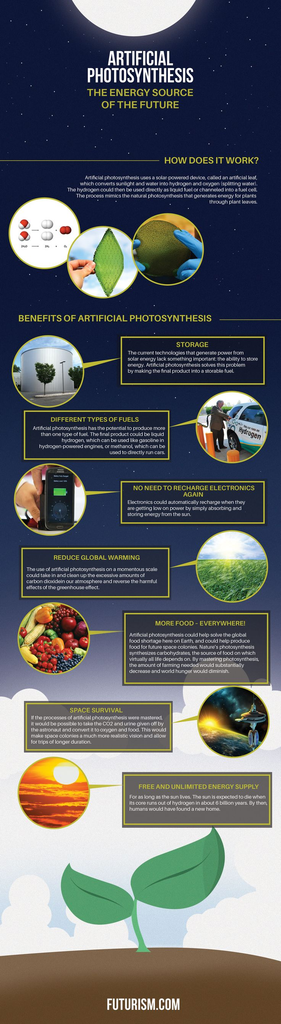
The artificial photosynthesis market is developing around technologies that imitate some of the key functions of plants. Instead of using leaves and biological enzymes, researchers use semiconductors, catalysts, photoelectrochemical cells and engineered materials to capture sunlight and drive chemical reactions.
The goal is simple: use sunlight, water and carbon dioxide as inputs and produce useful chemical products.
Recent research shows that the field is moving beyond individual laboratory experiments toward integrated solar-to-chemical systems, although efficiency, durability and large-scale deployment remain significant challenges. (ScienceDirect)
genui{“learning_viz”:{“type_id”:”PHOTOSYNTHESIS”,”locale_override”:”en-US”}}
What Is Artificial Photosynthesis?
Artificial photosynthesis is a technology that attempts to reproduce important aspects of natural photosynthesis using artificial materials and engineered systems.
Plants use sunlight to transform water and carbon dioxide into energy-rich molecules. Artificial systems replace the biological machinery with components such as:
- Light-absorbing semiconductors
- Photocatalysts
- Electrodes
- Molecular catalysts
- Photoelectrochemical cells
- Carbon-dioxide reduction catalysts
- Hydrogen-evolution catalysts
Depending on the design, an artificial photosynthesis system can produce hydrogen, carbon-based fuels, hydrogen peroxide or chemical feedstocks.
A 2026 scientific review highlights photocatalysts, photoelectrochemical cells and hybrid systems as important routes for solar-to-fuel conversion. (ScienceDirect)
How Does Artificial Photosynthesis Work?
Although different systems use different materials, the basic concept can be broken into several stages.
1. Sunlight is captured
A semiconductor or light-absorbing material captures energy from sunlight.
2. Electrical charges are created
The absorbed light generates excited electrons and corresponding positive charge carriers.
3. Charges move to reaction sites
The system attempts to separate these charges before they recombine and lose their energy.
4. Chemical reactions begin
Catalysts help drive reactions such as:
- Water splitting
- Hydrogen production
- Carbon dioxide reduction
- Oxygen production
- Chemical synthesis
5. Useful products are collected
Depending on the system, the final products could include hydrogen, carbon monoxide, methanol, hydrocarbons or other chemical compounds.
This makes artificial photosynthesis particularly interesting because it can potentially store solar energy in chemical bonds, rather than only producing electricity.
Why Is the Artificial Photosynthesis Market Growing?
Several forces are pushing interest in artificial photosynthesis.
1. Demand for Clean Hydrogen
Hydrogen is increasingly being investigated for industries where direct electrification is difficult.
Artificial photosynthesis could potentially use sunlight and water to produce hydrogen without relying entirely on conventional electricity-powered electrolysis.
Research published in 2026 has examined integrated photoelectrocatalytic and photovoltaic-electrolysis systems for solar hydrogen production, demonstrating the continuing effort to move toward larger-scale systems. (ScienceDirect)
2. Carbon Dioxide Can Become a Raw Material
One of the most interesting possibilities is using CO₂ as an input rather than simply treating it as waste.
Artificial photosynthesis systems can be designed to reduce carbon dioxide into useful carbon-containing products.
Potential products include:
- Carbon monoxide
- Methanol
- Formate
- Hydrocarbons
- Other chemical intermediates
This creates a connection between carbon capture, renewable energy and chemical manufacturing.
However, converting CO₂ efficiently and selectively remains technically challenging.
3. Growing Interest in Solar Fuels
Solar electricity is already commercially important.
But electricity isn’t always easy to store for long periods.
Chemical fuels provide another option.
Instead of:
Sunlight → Electricity
artificial photosynthesis aims for pathways such as:
Sunlight → Chemical Energy
That chemical energy could potentially be stored, transported and used later.
This is one reason artificial photosynthesis is attracting interest from researchers working on renewable fuels and long-duration energy storage.
Artificial Photosynthesis Market Segments

The market can be divided in several ways depending on the technology and application.
By Technology
Major technology categories include:
- Photocatalytic systems
- Photoelectrochemical systems
- Hybrid systems
- Co-electrolysis
- Molecular photocatalysis
Market research published in 2026 also separates artificial photosynthesis technologies into hybrid, photocatalytic and photoelectrochemical systems. (Research and Markets)
By Application
Potential applications include:
| Application | Potential Output |
|---|---|
| Hydrogen production | H₂ |
| CO₂ conversion | Carbon-based chemicals |
| Solar fuels | Synthetic fuels |
| Chemical production | Industrial feedstocks |
| Water treatment | Purified water / useful chemicals |
| Energy storage | Chemical energy |
Artificial Photosynthesis vs Solar Panels
Artificial photosynthesis isn’t necessarily a competitor to solar panels.
The two technologies solve different problems.
| Feature | Solar Panels | Artificial Photosynthesis |
|---|---|---|
| Main output | Electricity | Chemicals/fuels |
| Energy storage | Requires batteries or other storage | Stored in chemical bonds |
| Main input | Sunlight | Sunlight, water, CO₂ |
| Technology maturity | Commercial | Mostly emerging |
| Main challenge | Storage, materials, grid integration | Efficiency, stability, scale |
| Potential applications | Homes, grids, businesses | Hydrogen, fuels, chemicals |
The biggest potential advantage of artificial photosynthesis is that the energy is converted directly into chemical products.
Artificial Photosynthesis Companies and Industry Participants
The developing market includes companies and research organizations working across catalysts, solar fuels, CO₂ conversion and photoelectrochemical technologies.
Market research reports identify organizations including:
- Panasonic
- Toshiba
- Mitsubishi Chemical
- Siemens
- Fujitsu
- Toyota Central R&D Labs
- SunHydrogen
- Twelve
- ENGIE
- Evonik
- Cemvita Factory
These organizations do not all pursue identical artificial-photosynthesis technologies; the broader ecosystem covers different approaches to solar fuels, carbon conversion and chemical production. (Research and Markets)
New Materials Could Change Artificial Photosynthesis
Materials science is one of the most important parts of this industry.
Researchers are exploring:
Semiconductor catalysts
Materials such as titanium dioxide and other semiconductor systems can absorb light and initiate chemical reactions.
Molecular catalysts
Engineered molecules can be designed to perform specific chemical reactions.
Biomimetic catalysts
These attempt to reproduce some of the functions of biological enzymes.
Perovskites
Perovskite materials are receiving increasing attention because their optical and electronic properties can be tuned for solar-energy applications.
A perspective published in August 2026 specifically examined perovskite-driven artificial photosynthesis, including their potential use in water splitting and CO₂ reduction systems. (ScienceDirect)
The Biggest Challenge: Efficiency
Artificial photosynthesis sounds straightforward.
In reality, it is extremely difficult.
A system must simultaneously:
- Capture enough sunlight
- Separate charges efficiently
- Prevent unwanted recombination
- Drive chemical reactions
- Remain stable
- Produce the desired product selectively
- Operate for long periods
- Be inexpensive enough to scale
Improving one part of the system can sometimes create problems somewhere else.
For example, a highly efficient catalyst may rely on expensive or scarce materials.
That is why researchers are increasingly investigating earth-abundant catalysts and integrated system designs. (ScienceDirect)
Can Artificial Photosynthesis Replace Fossil Fuels?
Not yet.
Artificial photosynthesis remains an emerging technology.
Today’s commercial renewable-energy system is dominated by technologies such as solar photovoltaics, wind power, batteries and conventional hydrogen production.
Artificial photosynthesis has a different potential role.
It could eventually become useful for producing chemicals and fuels that are difficult to replace with direct electrification.
Potential long-term applications include:
- Green hydrogen
- Sustainable aviation fuel feedstocks
- Renewable chemical production
- Carbon-based industrial chemicals
- Solar fuels
- Distributed chemical manufacturing
The key question is whether researchers can move from laboratory-scale demonstrations to reliable industrial systems.
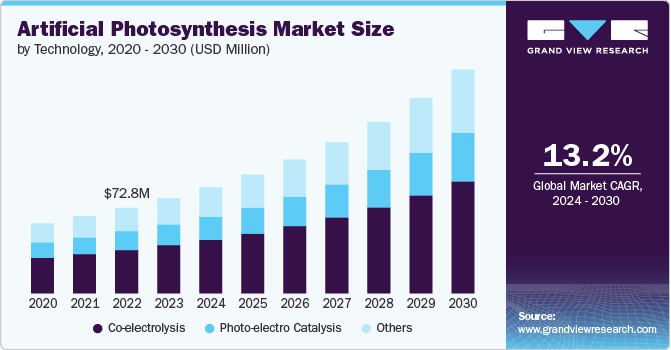
Artificial Photosynthesis Market Growth Outlook
Market forecasts vary considerably because different research companies define and measure the market differently.
One 2026 market study estimates the global market at $123.65 million in 2026, growing to approximately $296.64 million by 2032, representing a CAGR of about 15.95%. (Research and Markets)
Another research firm estimates $113.5 million in 2026 and about $190 million by 2030. (Grand View Research)
Other reports provide significantly different numbers, reinforcing the importance of checking the methodology and market definition behind any artificial photosynthesis market forecast. (Fortune Business Insights)
SEO tip: For your article, I recommend saying “market forecasts differ by research methodology” rather than putting one market-size number in the headline.
What Could Drive the Market Through 2030?
Several developments could accelerate adoption.
Better catalysts
Cheaper, more durable catalysts could reduce system costs.
Higher solar-to-fuel efficiency
Higher efficiency means more useful chemical production from the same amount of sunlight.
Better reactor designs
Large-scale reactors need to manage sunlight, heat, fluids and chemical products efficiently.
Carbon utilization
CO₂ conversion could create additional economic value.
Hydrogen demand
Growing demand for low-carbon hydrogen could create another market for solar-driven systems.
Advanced AI and materials discovery
Computational tools could help researchers identify promising catalysts and material combinations faster.
Artificial Photosynthesis: Advantages and Disadvantages
Advantages
- Uses sunlight as an energy source
- Can potentially produce chemical fuels
- Can use water as a feedstock
- Offers pathways for CO₂ utilization
- Could store renewable energy chemically
- May produce hydrogen and valuable chemicals
- Could complement renewable electricity
Disadvantages
- Technology is still developing
- Efficiency remains a major issue
- Catalyst durability can be difficult
- Some materials are expensive or scarce
- Scaling laboratory systems is challenging
- Reactor design is complicated
- Commercial economics are not yet established for many applications
Is Artificial Photosynthesis the Future of Renewable Energy?
Artificial photosynthesis probably won’t replace solar panels or wind turbines.
Instead, its greatest opportunity may be where renewable electricity alone isn’t enough.
Imagine a future solar facility that doesn’t only produce electricity.
It could use sunlight to manufacture:
Hydrogen → Chemicals → Fuels → Industrial feedstocks
That would turn solar energy into a manufacturing resource rather than simply an electricity source.
The technology still has a long way to go, but recent research is increasingly focused on stability, system integration, catalyst development and scalability—the exact problems that must be solved before artificial photosynthesis can become an industrial technology. (ScienceDirect)
Frequently Asked Questions
What is the artificial photosynthesis market?
The artificial photosynthesis market covers technologies and commercial activities related to converting sunlight into chemical products using engineered systems inspired by natural photosynthesis.
What can artificial photosynthesis produce?
Depending on the technology, it can potentially produce hydrogen, carbon monoxide, methanol, hydrocarbons, hydrogen peroxide and other chemicals.
Is artificial photosynthesis commercially available?
Some related technologies and components are being developed commercially, but artificial photosynthesis as a broad industrial technology is still at an emerging stage.
What is the main advantage of artificial photosynthesis?
Its biggest potential advantage is converting solar energy directly into storable chemical energy and useful chemical products.
Can artificial photosynthesis remove CO₂?
Some artificial photosynthesis systems are designed to use CO₂ as a feedstock and convert it into useful carbon-containing products. This is different from simply capturing and permanently storing CO₂.
What is holding artificial photosynthesis back?
The biggest barriers include efficiency, catalyst stability, product selectivity, cost, reactor design and large-scale deployment.
Is artificial photosynthesis better than solar panels?
Not necessarily. Solar panels are much more commercially mature and efficiently produce electricity. Artificial photosynthesis could complement solar power by producing fuels and chemicals.
Final Takeaway
The artificial photosynthesis market is developing at the intersection of renewable energy, hydrogen production, carbon utilization and sustainable chemistry.
Its promise is bigger than simply generating clean electricity.
The long-term vision is to use sunlight + water + CO₂ → fuels and chemicals.
That could make artificial photosynthesis particularly valuable for industries that cannot easily switch from fossil-based chemical feedstocks to direct electricity.
For now, however, the technology remains in an important transition period. Research in 2026 is increasingly concentrating on improving catalyst performance, stability, perovskite integration, reactor design and scaling—suggesting that the next stage of the industry will depend less on proving that artificial photosynthesis works and more on proving that it can work efficiently, cheaply and reliably at scale. (ScienceDirect)
Recommended SEO package
Primary Keyword: artificial photosynthesis market
SEO Title: Artificial Photosynthesis Market 2026: Technology, Growth & Future
Meta Description: Discover the artificial photosynthesis market in 2026, including solar fuel technology, hydrogen, CO₂ conversion, applications, companies, challenges and future growth.
URL: /artificial-photosynthesis-market-2026/
SEO Tags:Artificial Photosynthesis, Artificial Photosynthesis Market, Solar Fuel Technology, Artificial Leaf, Solar Hydrogen, CO2 Conversion, Renewable Energy, Clean Energy Technology, Photocatalysis, Photoelectrochemical Cells, Green Hydrogen, Solar Fuels, Clean Technology
Related search keywords:artificial photosynthesis market size • artificial photosynthesis market growth • artificial photosynthesis technology • artificial photosynthesis companies • artificial photosynthesis 2026 • artificial photosynthesis applications • solar fuel technology • artificial leaf technology • solar hydrogen production • CO2 conversion technology
Suggested featured-image text:
“Artificial Photosynthesis Market 2026”
Turning Sunlight, Water & CO₂ Into Fuels