
green hydrogen energy storage, hydrogen storage, green hydrogen 2026
Green Hydrogen Energy Storage: How It Works, Costs, Efficiency & Future
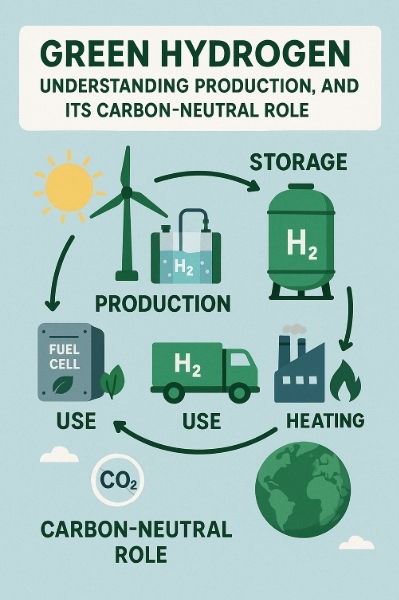
Green hydrogen is often described as a clean fuel for industry, shipping and heavy transport. But there is another potentially important role: using green hydrogen as a long-term energy storage medium.
The basic idea is straightforward. When solar and wind farms produce more electricity than the grid needs, that electricity can power electrolyzers that split water into hydrogen and oxygen. The hydrogen can then be stored for days, weeks or potentially entire seasons. When electricity is needed, the hydrogen can be converted back into electricity using a fuel cell or hydrogen-capable turbine.
The catch is efficiency. Batteries can typically return around 80–90% of the electricity put into them, while hydrogen-to-electricity storage systems can have round-trip efficiencies around 30–40%, depending on the equipment and system design. DOE research at a megawatt-scale hydrogen system, for example, measured roughly 28–35% round-trip efficiency. (The Department of Energy’s Energy.gov)
So why consider hydrogen at all?
Because long-duration and seasonal storage is a different problem from storing electricity for a few hours.
What Is Green Hydrogen Energy Storage?
Green hydrogen energy storage means using renewable electricity to produce hydrogen and then storing that hydrogen for later use.
Unlike a lithium-ion battery, which stores electrical energy electrochemically, hydrogen storage converts electricity into a chemical fuel.
The basic chain looks like this:
Solar/Wind → Electricity → Electrolyzer → Hydrogen → Storage → Fuel Cell/Turbine → Electricity
Hydrogen can also be used directly rather than converted back into electricity.
That distinction is important. Hydrogen may make more economic sense when it is used as an industrial feedstock or fuel than when it is repeatedly converted from electricity to hydrogen and back to electricity.
The International Energy Agency reports that global hydrogen demand exceeded 100 million tonnes in 2025, but almost all current demand remains concentrated in traditional applications such as refining, ammonia and other industrial processes. Low-emissions hydrogen production was still below 1% of total hydrogen production in 2025, although it is expected to exceed 1% in 2026. (IEA)
How Does Hydrogen Energy Storage Work?
The complete process has several stages.
1. Renewable Electricity Production
The process begins with renewable electricity.
A solar farm might generate large amounts of electricity during the middle of the day. A wind farm may produce more power at night or during periods of strong winds.
Sometimes renewable generation exceeds immediate electricity demand.
Normally, the excess electricity can be:
- exported to another region
- stored in batteries
- used by flexible industrial loads
- curtailed
Hydrogen provides another option.
Instead of wasting the excess electricity, an electrolyzer can use it to produce hydrogen.
2. Electrolysis
An electrolyzer uses electricity to split water into hydrogen and oxygen.
The simplified reaction is:
2H₂O → 2H₂ + O₂
The hydrogen becomes the energy-storage medium, while oxygen is produced as a by-product.
There are several electrolyzer technologies, including:
- Alkaline electrolyzers
- PEM electrolyzers
- Solid oxide electrolyzers
- Emerging anion exchange membrane systems
PEM and alkaline technologies are currently among the most commercially established options.
The electricity source matters enormously. Hydrogen is only considered green hydrogen when its production meets the relevant renewable-electricity criteria. Using electricity generated from fossil fuels can substantially change the emissions profile.
The U.S. Department of Energy notes that electrolysis can be particularly useful alongside variable renewable generation because excess wind or solar electricity can be diverted into hydrogen production rather than curtailed. (The Department of Energy’s Energy.gov)
3. Compression and Conditioning
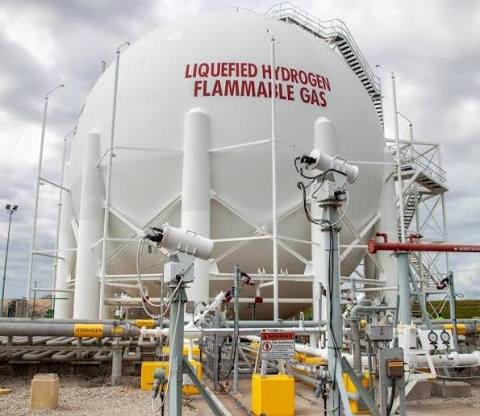
Hydrogen is a very light gas, so storing useful quantities requires either compression, cooling or conversion into another chemical carrier.
For gaseous storage, hydrogen can be compressed into tanks or larger storage systems.
Compression requires additional electricity, which further reduces the overall round-trip efficiency.
For very large quantities, other options become interesting, including:
- underground salt caverns
- geological storage
- liquid hydrogen
- ammonia
- liquid organic hydrogen carriers
Salt caverns are particularly interesting for large-scale storage because they can potentially hold enormous quantities of hydrogen for long periods.
The IEA reports that announced underground hydrogen storage projects could provide around 11 TWh of capacity by 2035, although only a small fraction had reached final investment decision or construction at the time of its 2026 review. (IEA)
4. Hydrogen Storage
Once produced and conditioned, hydrogen can be stored until it is required.
Storage duration is one of hydrogen’s biggest potential advantages.
A battery might economically store electricity for several hours. Hydrogen can potentially remain stored for:
Hours → Days → Weeks → Months → Seasons
This makes hydrogen particularly interesting for seasonal energy storage.
For example, a region with abundant summer solar generation could theoretically convert some excess electricity into hydrogen, store it and use that hydrogen during periods of lower renewable production.
That is very different from the typical use case for a lithium-ion battery.
5. Converting Hydrogen Back Into Electricity
When electricity is needed, stored hydrogen can be converted back into power.
Two major approaches are fuel cells and turbines.
Fuel cells
Fuel cells combine hydrogen with oxygen electrochemically to produce electricity.
The simplified reaction is:
Hydrogen + Oxygen → Electricity + Water + Heat
Fuel cells can provide relatively efficient electricity generation and have no combustion emissions at the point of use.
Hydrogen turbines
Hydrogen can also be burned in specially designed or adapted gas turbines.
This approach can be attractive for large-scale power generation because turbines can provide substantial electrical output and potentially integrate with existing power infrastructure.
However, combustion of hydrogen can produce nitrogen oxides, meaning emissions controls may still be necessary.
Hydrogen vs Battery Storage
This is where the debate becomes interesting.
Hydrogen isn’t necessarily competing with batteries for exactly the same job.
| Feature | Batteries | Green Hydrogen |
|---|---|---|
| Typical round-trip efficiency | ~80–90% | ~30–40% |
| Response speed | Very fast | Fast, depending on system |
| Short-duration storage | Excellent fit | Generally inefficient |
| Multi-day storage | Possible | Potentially attractive |
| Seasonal storage | Challenging at huge scale | Potentially attractive |
| Energy storage duration | Usually hours | Days to months |
| Energy density by mass | Lower | Very high |
| Large-scale storage | Increasingly deployed | Emerging |
| Direct industrial use | Limited | Major advantage |
| Infrastructure | Batteries/grid connection | Electrolyzers, storage, pipelines, turbines/fuel cells |
The efficiency difference is significant.
If 100 kWh of renewable electricity goes into a battery system, perhaps 80–90 kWh can eventually be returned.
With a hydrogen pathway, only roughly 30–40 kWh might come back as electricity after electrolysis, compression/storage and reconversion, depending on the specific system.
DOE research has reported approximately one-third round-trip efficiency for a megawatt-scale hydrogen system. (The Department of Energy’s Energy.gov)
That sounds like a major disadvantage—and it is for many short-duration applications.
But efficiency isn’t the only factor.
Why Store Energy as Hydrogen If It’s So Inefficient?
The answer is duration and scale.
Imagine you want to store 10 MWh for four hours.
A battery may be a logical solution.
Now imagine you want to store enormous amounts of energy for several months.
The economics can change.
Hydrogen’s storage component can potentially become relatively inexpensive at very large scales, especially where underground storage such as salt caverns is available.
The DOE’s Advanced Clean Energy Storage project in Utah illustrates this concept. The project combines 220 MW of alkaline electrolysis with two large salt caverns designed to store hydrogen for long-duration, potentially seasonal energy storage. (The Department of Energy’s Energy.gov)
In other words:
Batteries are highly efficient at storing electricity.
Hydrogen could be useful for storing enormous amounts of energy for a very long time.
Where Green Hydrogen Storage Makes Sense
Hydrogen storage is particularly interesting in several situations.
1. Seasonal Energy Storage
This could become one of hydrogen’s most important applications.
Solar and wind output varies considerably by season.
A grid might produce surplus renewable electricity during one season and experience shortages during another.
Hydrogen provides a way of moving energy through time rather than simply moving electricity through a transmission line.
2. Long Periods of Low Renewable Generation
Consider several consecutive days with:
- low wind
- cloudy weather
- high electricity demand
A battery fleet would need enormous energy capacity to cover a prolonged shortage.
Stored hydrogen could provide another layer of backup.
The hydrogen could remain untouched for long periods and be dispatched when needed.
3. Industrial Energy
Hydrogen doesn’t necessarily need to be converted back into electricity.
This is a major advantage.
Industries already use hydrogen for:
- ammonia production
- oil refining
- chemicals
- methanol
- other industrial processes
The IEA says around 85% of investment in low-emissions hydrogen projects in 2026 targets existing hydrogen uses in industry and refineries or hydrogen-based fuels. (IEA)
That means the strongest early business case may not be:
renewable electricity → hydrogen → electricity
but rather:
renewable electricity → hydrogen → industrial product
4. Shipping and International Energy Trade
Hydrogen can also be transformed into hydrogen-derived fuels such as ammonia.
This makes it possible to transport renewable energy across oceans in chemical form.
The IEA reports that first shipments of low-emissions hydrogen and hydrogen derivatives are already taking place, with ammonia playing an important role in emerging international supply chains. (IEA)
However, shipping hydrogen is not free.
Liquefaction, conversion and reconversion can consume substantial energy and add cost. The IEA estimates that delivering pure hydrogen through shipping can involve minimum costs of around $2/kg of hydrogen and energy consumption above 10 kWh/kg because of processes such as liquefaction or ammonia cracking. (IEA)
Green Hydrogen Economics in 2026
This is where the industry’s biggest challenge remains.
Green hydrogen is becoming cheaper in some locations, but it is not yet universally cost-competitive with conventional hydrogen.
The IEA’s 2026 Global Hydrogen Review says fossil-based hydrogen remains less expensive than renewable hydrogen in most parts of the world in the near term. It also says policy support remains necessary to close the cost gap. (IEA)
Several factors determine the cost of green hydrogen.
Electricity price
Electrolysis requires substantial electricity.
Cheap renewable electricity can dramatically improve project economics.
Electrolyzer utilization
An electrolyzer operating continuously can spread its capital cost across more kilograms of hydrogen.
But renewable electricity isn’t always available continuously.
This creates an important trade-off between cheap renewable electricity and high electrolyzer utilization.
Electrolyzer cost
The IEA reports current installed-system costs around $2,000–$2,450/kW for alkaline and PEM systems in its tracked data, with Chinese alkaline systems reaching approximately $750–$1,300/kW in some cases. (IEA)
Financing
Large hydrogen projects require enormous upfront investment.
High interest rates can make otherwise technically viable projects difficult to finance.
Storage and transport
Hydrogen needs infrastructure beyond the electrolyzer:
- compression
- storage
- pipelines
- ports
- ammonia facilities
- fuel cells or turbines
- safety systems
Each adds cost.
Offtake agreements
A hydrogen project needs customers willing to buy the hydrogen.
This has become one of the industry’s biggest bottlenecks.
The IEA reports that only around 20% of newly signed low-emissions hydrogen offtake volumes in 2025 were backed by firm contractual commitments. (IEA)
The NEOM Green Hydrogen Project
One of the world’s most closely watched green hydrogen projects is being developed in NEOM, Saudi Arabia.


The NEOM Green Hydrogen Company (NGHC) project in Oxagon combines renewable energy with large-scale electrolysis.
The project is designed to integrate up to 4 GW of solar and wind power and produce as much as 600 tonnes of green hydrogen per day. The hydrogen is intended for export in the form of green ammonia under a long-term agreement with Air Products. (NEOM)
The project is particularly useful as a real-world example because it demonstrates that green hydrogen isn’t being developed solely as a battery substitute.
Its business model connects:
Renewable electricity → Electrolysis → Hydrogen → Ammonia → Global export
According to NEOM, the project is targeting operations and exports in 2026. (NEOM)
The project therefore illustrates an important distinction:
Hydrogen can be an energy-storage medium, but its value can also come from functioning as a transportable chemical energy carrier and industrial feedstock.
The Biggest Problems With Hydrogen Energy Storage
Green hydrogen has significant potential, but several problems remain.
Low Round-Trip Efficiency
This is the biggest technical disadvantage.
Electricity must pass through several conversion stages:
Electricity → Hydrogen → Electricity
Every stage loses energy.
This makes hydrogen unattractive for many short-duration applications where batteries can deliver much more electricity from the same renewable input.
High Capital Costs
Large electrolyzers, storage facilities, pipelines and power-generation equipment require substantial investment.
Projects need high utilization and reliable offtake to justify these costs.
Hydrogen Leakage
Hydrogen is a very small molecule and can escape through materials and equipment more readily than larger gases.
This creates engineering and environmental-management challenges throughout the hydrogen supply chain.
Storage Challenges
Hydrogen has excellent energy content per unit of mass but poor volumetric energy density as a gas.
It therefore needs:
- compression
- cooling
- specialized tanks
- underground storage
- or conversion into carriers such as ammonia
Each solution brings additional costs and energy requirements.
Infrastructure Is Still Developing
Hydrogen infrastructure is nowhere near as extensive as electricity infrastructure.
The IEA reports that more than 40,000 km of hydrogen pipeline projects have been announced for 2035, but only about 9% of that length was operational or had committed investment in its 2026 assessment. (IEA)
That gap shows how much infrastructure still needs to be built.
Green Hydrogen 2026: Where Does the Industry Stand?
The hydrogen industry is growing, but development has been slower and more uneven than many early forecasts suggested.
According to the IEA, global installed electrolysis capacity more than doubled during 2025 to exceed 4 GW, while more than 2.5 GW was under construction and targeting operation in 2026. (IEA)
At the same time, the announced project pipeline has contracted.
The IEA estimates the pipeline of announced low-emissions hydrogen production for 2030 at around 27 million tonnes, down substantially from the previous assessment because of delays and cancellations. (IEA)
This doesn’t mean hydrogen has failed.
Rather, the industry is moving from a period of ambitious announcements toward a more difficult phase in which projects must demonstrate:
- competitive costs
- reliable customers
- financing
- infrastructure
- regulatory compliance
- renewable electricity availability
That is a healthier test for the technology than simply counting announced projects.
What Could Make Hydrogen More Competitive?
Several developments could improve the economics.
Cheaper renewable electricity
Since electricity is a major input, cheaper solar and wind power can directly reduce hydrogen production costs.
Larger electrolyzers
Mass production and larger projects could lower capital costs.
Better electrolyzer efficiency
Higher efficiency means less electricity is required to produce each kilogram of hydrogen.
Low-cost geological storage
Large underground storage facilities could make long-duration hydrogen storage more economical.
Hydrogen demand growth
Strong demand from ammonia, steel, shipping, aviation fuels and chemicals could improve project utilization.
Government policy
Production incentives, carbon pricing, clean-fuel standards and offtake guarantees can help close the gap between green and fossil-based hydrogen.
The IEA’s 2026 analysis concludes that policy support remains important because low-emissions hydrogen remains more expensive than unabated fossil-based hydrogen in most regions in the near term. (IEA)
Is Green Hydrogen Better Than Batteries?
There isn’t a universal answer.
For short-duration electricity storage, batteries generally benefit from much higher round-trip efficiency.
For very long-duration or seasonal storage, hydrogen can offer characteristics that batteries struggle to replicate economically at massive scale.
A future electricity system could therefore use both.
For example:
Solar + Battery:
Store afternoon solar → supply evening demand.
Hydrogen:
Store surplus renewable energy → retain it for weeks or months → provide backup during prolonged renewable shortages.
Hydrogen for Industry:
Use renewable electricity → make hydrogen → produce ammonia, steel, chemicals or synthetic fuels.
This combination could be more useful than trying to make one technology perform every type of energy-storage task.
Pros and Cons of Green Hydrogen Energy Storage
Advantages
- Can store energy for very long periods
- Potentially suitable for seasonal storage
- Large quantities can potentially be stored underground
- Can absorb surplus solar and wind generation
- Hydrogen can be used directly by industry
- Can be converted into ammonia and other energy carriers
- Can support long-distance energy trade
- Reduces renewable-energy curtailment
- Provides another form of long-duration grid backup
Disadvantages
- Low electricity-to-electricity efficiency
- Electrolyzers remain expensive
- Requires significant renewable electricity
- Compression and storage consume additional energy
- Hydrogen infrastructure is still developing
- Transportation can be complicated and expensive
- Projects often require policy support
- Large-scale commercial deployment remains limited
The Bottom Line
Green hydrogen energy storage is not a replacement for batteries.
Its strongest potential may lie somewhere batteries are less naturally suited: storing enormous amounts of energy for days, weeks or seasons while simultaneously supplying fuel and industrial feedstock.
The efficiency penalty is substantial. A hydrogen storage system may return only around one-third of the electricity originally supplied, compared with roughly 80–90% for many battery systems. (The Department of Energy’s Energy.gov)
But energy storage isn’t only about efficiency.
It is also about:
duration + scale + cost + infrastructure + location + end use.
That is why hydrogen remains relevant in 2026 despite its conversion losses.
The emerging NEOM project demonstrates one version of the model: use abundant renewable electricity to make hydrogen, convert it into ammonia and connect it to global markets. Meanwhile, projects such as Advanced Clean Energy Storage in Utah demonstrate how hydrogen can potentially be used for large-scale, long-duration electricity storage. (The Department of Energy’s Energy.gov)
The most realistic future may therefore be a diversified energy system in which batteries handle many short-duration storage needs while hydrogen handles selected long-duration, seasonal and industrial applications.
Frequently Asked Questions
1. What is green hydrogen energy storage?
Green hydrogen energy storage uses renewable electricity to produce hydrogen through electrolysis. The hydrogen is stored and later used as a fuel, industrial feedstock or converted back into electricity.
2. How efficient is hydrogen energy storage?
Round-trip electricity-to-electricity efficiency is typically around 30–40%, depending on the electrolyzer, storage method and electricity-generation technology. A DOE megawatt-scale demonstration measured approximately 28–35%. (The Department of Energy’s Energy.gov)
3. Why use hydrogen instead of batteries?
Hydrogen can potentially store very large quantities of energy for much longer periods, including weeks or seasons. Batteries are generally more efficient but can become expensive when extremely large amounts of energy capacity are required for long durations.
4. Can hydrogen store solar energy?
Yes. Solar electricity can power electrolyzers to produce hydrogen. The hydrogen can then be stored and used later.
5. What can stored hydrogen be used for?
Stored hydrogen can generate electricity through fuel cells or turbines, or it can be used directly in industries such as ammonia, chemicals and potentially low-emissions steel production.
6. Is green hydrogen expensive in 2026?
In most regions, yes. The IEA says renewable hydrogen remains more expensive than fossil-based hydrogen in the near term, although costs vary significantly by location and project. Policy support remains important for many projects. (IEA)
7. What is the NEOM green hydrogen project?
The NEOM Green Hydrogen Company project in Saudi Arabia is a large renewable-hydrogen facility designed around up to 4 GW of solar and wind generation and production of up to 600 tonnes of hydrogen per day. The hydrogen is intended to be exported as green ammonia. (NEOM)
8. Can hydrogen provide seasonal energy storage?
Potentially, yes. Long-duration storage is one of the strongest arguments for hydrogen because it can remain stored for extended periods and be dispatched when renewable electricity production is insufficient.
9. What is the biggest disadvantage of hydrogen storage?
For electricity storage, the biggest disadvantage is its low round-trip efficiency. Much of the original renewable electricity is lost during electrolysis, compression, storage and reconversion.
10. Will hydrogen replace batteries?
Probably not as a general replacement. Batteries and hydrogen address different storage requirements. Batteries are well suited to many short-duration applications, while hydrogen has potential advantages for long-duration, seasonal and industrial energy applications.
SEO Keyword Set
Primary keyword:
- green hydrogen energy storage
Secondary keywords:
- hydrogen storage
- green hydrogen 2026
- hydrogen energy storage
- long duration energy storage
- seasonal energy storage
- hydrogen fuel cell storage
- green hydrogen production
- renewable hydrogen
- hydrogen electricity storage
- hydrogen storage technology
Long-tail keywords:
- how does green hydrogen energy storage work
- green hydrogen vs battery storage
- green hydrogen energy storage efficiency
- is hydrogen good for seasonal energy storage
- green hydrogen cost 2026
- how hydrogen stores renewable energy
- hydrogen storage for renewable energy
- green hydrogen electricity generation
- NEOM green hydrogen project
- hydrogen as long duration energy storage