
What Is a Smart Grid?
So, what is a smart grid?
A smart grid is a modern electricity network that uses digital technology, sensors, communications, automation and data to monitor and manage electricity more intelligently.
Unlike a traditional electricity grid, where information has historically flowed mainly from the power plant toward consumers, a smart grid can support two-way communication between utilities, grid equipment and customers.
In simple terms, think of it as an electricity grid with a digital nervous system.
A traditional grid can deliver electricity very effectively, but many parts of it were designed for an era when electricity generally flowed in one direction: from large power stations through transmission and distribution networks to homes and businesses.
Today’s electricity system is much more complicated.
Homes may have rooftop solar panels, batteries, electric vehicles and smart appliances. Businesses may operate large batteries or flexible loads. Wind and solar farms can change their output depending on weather conditions.
A smart grid uses digital technologies to help coordinate all these moving parts.
The U.S. Department of Energy describes smart-grid technologies as including two-way communications, advanced meters, sensors, automated controls and systems capable of detecting and responding to grid problems.
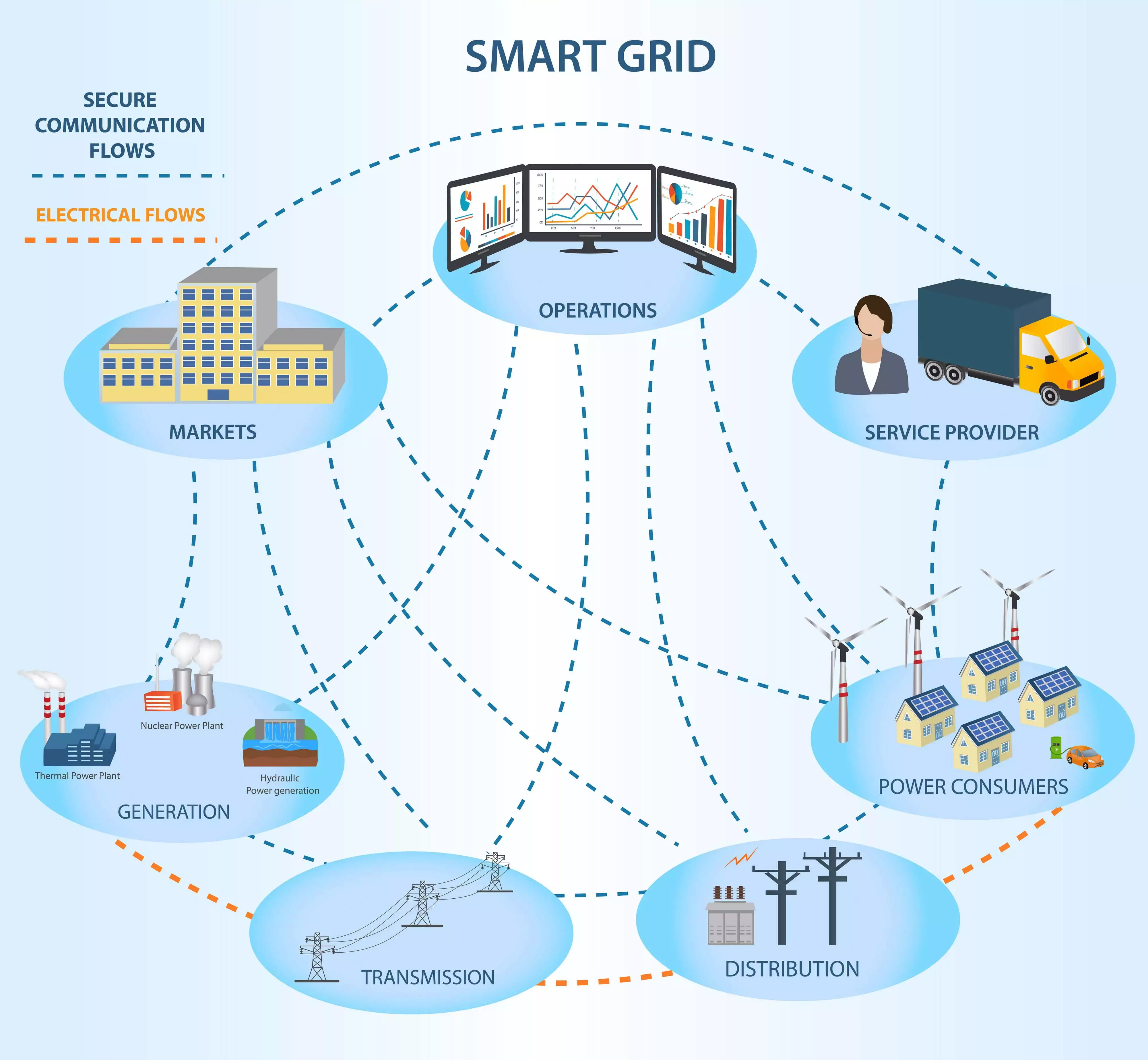
Smart Grid Explained in Simple Terms
Imagine your electricity grid as a huge road network.
A traditional grid is like a road system where traffic information is limited. If there is an accident, congestion may not be detected immediately, and drivers may have to wait until someone discovers the problem.
What Is a Smart Grid
A smart grid is more like a road network equipped with:
- Traffic sensors
- GPS
- Automatic signals
- Real-time monitoring
- Connected vehicles
- Automated rerouting
- Central traffic management
Electricity doesn’t literally travel through the grid according to traffic rules, of course. But the comparison helps explain the idea.
A smart grid continuously collects information about electricity generation, consumption, voltage, equipment conditions and faults.
Software and automated equipment can then use that information to help utilities make faster decisions.
Traditional Grid vs Smart Grid
The biggest difference is information and control.
| Feature | Traditional Grid | Smart Grid |
|---|---|---|
| Communication | Mostly limited | Two-way communication |
| Metering | Manual/periodic in many systems | Digital and frequently automated |
| Fault detection | Often requires investigation | Sensors can detect problems quickly |
| Power flow | Primarily one-directional | Can accommodate more bidirectional flows |
| Renewable energy | More difficult to coordinate | Designed to integrate distributed resources |
| Consumer information | Limited | Detailed usage information |
| Demand response | Limited automation | Can automatically adjust flexible demand |
| Distributed solar | Relatively simple | Requires advanced monitoring and control |
| Grid restoration | Often manual | Can use automated switching |
| Data analytics | Limited | Extensive |
| EV integration | Basic | Can coordinate charging |
| Battery integration | Limited | Can coordinate distributed and utility-scale storage |
A smart grid isn’t necessarily a completely new electricity network.
In many cases, it is an existing grid upgraded with digital technologies, communications, sensors, automation and advanced control systems.
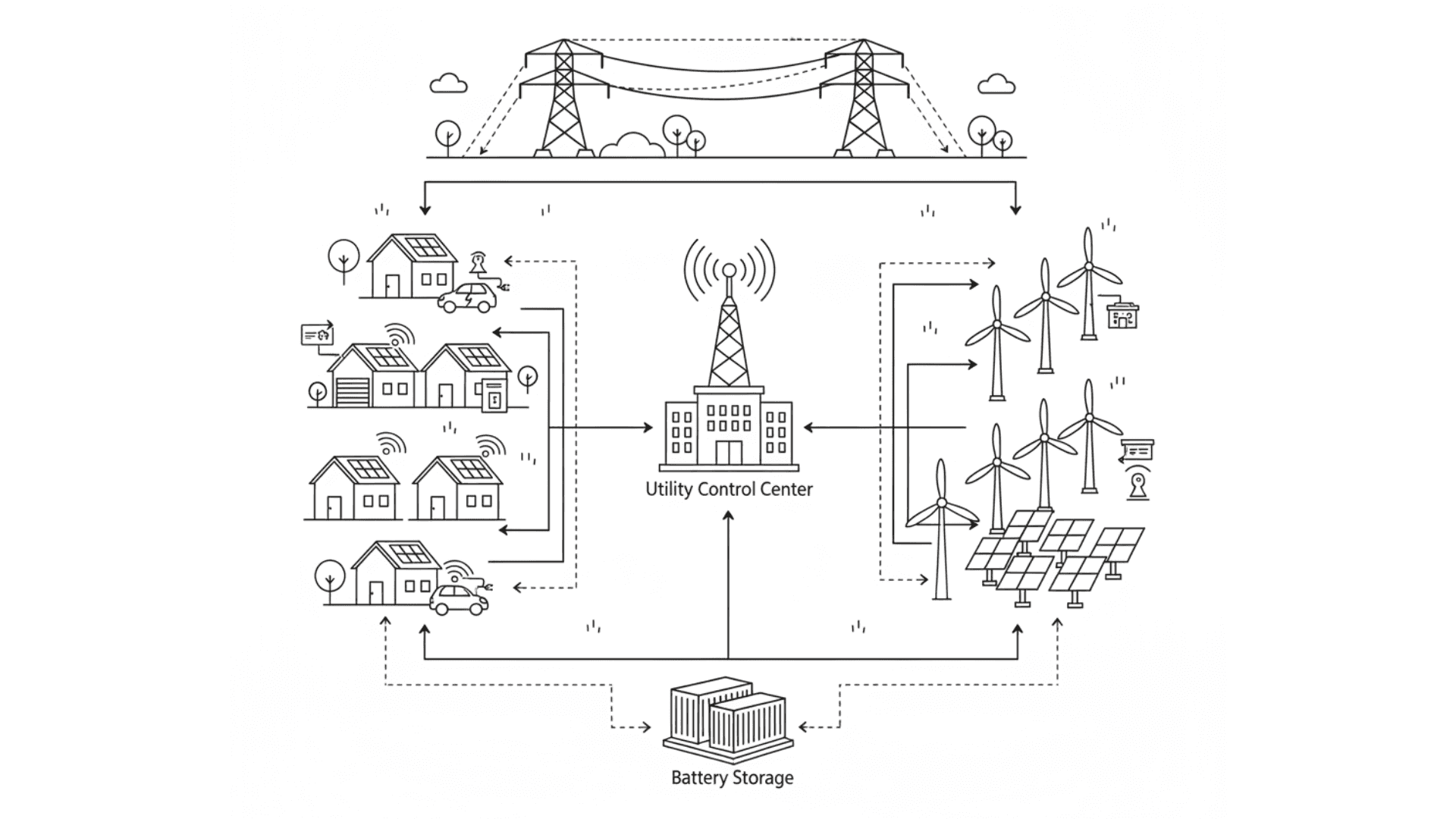
How Does a Smart Grid Work?
A smart grid combines several technologies.
The basic process looks like this:
Generation → Transmission → Distribution → Smart Devices → Consumer
But information can move in both directions.
For example:
Home → Smart Meter → Utility
and:
Utility → Smart Meter → Home
At the same time, information from solar panels, batteries, substations and other equipment can flow into grid-management systems.
This gives operators a much clearer picture of what is happening across the network.

1. Two-Way Communication
Two-way communication is one of the most important features of a smart grid.
In a traditional system, the utility may know how much electricity was consumed only after a meter reading.
With modern digital infrastructure, information can be transmitted automatically.
For example, a smart meter can communicate information such as:
- Electricity consumption
- Voltage conditions
- Power-quality information
- Outage information
- Meter status
- Consumption patterns
The utility can also send information or commands back to connected equipment.
This communication enables more sophisticated services and automated grid management.
The U.S. Department of Energy identifies two-way communication as a fundamental technology behind smart-grid systems.
2. Smart Meters
A smart meter is a digital electricity meter capable of recording and communicating electricity-use information.
Traditional electricity meters generally measure consumption.
Smart meters can provide much more information and can communicate that information to the utility.
For consumers, this can mean:
- More detailed electricity-use information
- Automated meter readings
- Faster outage detection
- More flexible billing structures
- Better understanding of consumption patterns
Smart meters are particularly important because they create a connection between the customer and the digital electricity network.
The IEA notes that smart meters improve visibility into electricity flows and can support new billing structures while increasing consumer awareness of electricity consumption.
3. Automated Demand Response
Electricity demand changes throughout the day.
For example, electricity consumption may increase when millions of people turn on:
- Air conditioners
- Water heaters
- Washing machines
- EV chargers
- Industrial equipment
A smart grid can respond to these changes more intelligently.
This is where demand response becomes important.
Demand response means changing electricity consumption in response to grid conditions, electricity prices or signals from a utility or energy-management system.
For example, a smart home could automatically delay EV charging for an hour when the grid is experiencing high demand.
A water heater might operate during a lower-demand period.
A commercial building might temporarily reduce certain loads.
The customer can potentially save money under appropriate electricity tariffs, while the grid gains flexibility.
4. Distributed Energy Resource Management
Modern electricity systems increasingly contain thousands or millions of smaller energy resources.
These are called distributed energy resources, or DERs.
Examples include:
- Rooftop solar
- Home batteries
- Commercial batteries
- Electric vehicles
- EV chargers
- Smart appliances
- Flexible industrial equipment
- Small generators
Managing all these devices individually would be extremely difficult.
That’s why utilities and grid operators increasingly use Distributed Energy Resource Management Systems (DERMS).
DERMS can help monitor and coordinate distributed resources.
For example, during a period of high demand, a system could potentially coordinate:
Solar + Batteries + EV Charging + Flexible Loads
instead of treating every device as an isolated system.
This becomes increasingly important as electricity systems become more decentralized.
5. Grid Self-Healing
One of the most interesting smart-grid capabilities is automated fault detection and restoration.
Traditional grids often require workers to investigate faults and manually operate equipment.
Modern grids can use:
- Sensors
- Automated switches
- Digital relays
- Control systems
- Communications networks
to identify certain problems much faster.
For example, imagine a tree damages a power line.
A smart distribution network may detect the fault, isolate the affected section and reroute electricity through another available path.
The result can be:
Detect → Isolate → Reroute → Restore
This capability is sometimes described as a self-healing grid.
It doesn’t mean the grid literally repairs broken infrastructure by itself.
Instead, automated systems can identify and respond to certain faults with limited human intervention.
The U.S. Department of Energy specifically identifies automated feeder switches and fault-detection technologies as important smart-grid technologies.
Why Do We Need Smart Grids?
The electricity system is changing rapidly.
For much of the 20th century, electricity generally moved from large centralized power plants toward consumers.
Today, the system is becoming much more complicated.
Electricity can come from:
- Large solar farms
- Wind farms
- Rooftop solar
- Batteries
- Hydropower
- Conventional power plants
- Electric vehicles
- Other distributed resources
At the same time, electricity demand is increasing in many markets because of:
- Electric vehicles
- Data centres
- Air conditioning
- Heat pumps
- Industrial electrification
- Digital technologies
The IEA expects global electricity demand to continue growing strongly through 2030, with electrification, data centres, EVs and cooling among the factors driving demand.
This creates a major challenge:
The grid has to become more flexible while handling more electricity and more sources of generation.
Smart Grids and Renewable Energy
Renewable energy makes smart-grid technology particularly important.
Solar and wind power don’t operate exactly like traditional dispatchable generators.
Solar production changes throughout the day.
Wind production changes with weather conditions.
For example:
Morning: Solar generation increases
Afternoon: Solar production may be high
Evening: Solar generation falls while household demand may remain high
A smarter grid can combine multiple resources to manage these changes.
For example:
Solar → Battery → Grid → Home
A battery could store electricity when supply is abundant and release it later when demand is higher.
Smart-grid technologies can also help operators monitor voltage, manage congestion and coordinate distributed resources.
The IEA has identified grid capacity and flexibility as increasingly important as electricity generation, storage and demand expand.
What Does a Smart Grid Look Like for Consumers?
You don’t necessarily need to understand the complex technology behind a smart grid to benefit from it.
For consumers, the experience may be surprisingly simple.
You might have:
Smart Meter
Your electricity consumption is automatically measured and communicated.
Smart Home
Your appliances can respond to energy prices or grid signals.
Rooftop Solar
Your solar system can generate electricity for your home and potentially export surplus electricity, depending on local rules.
Home Battery
Your battery can store electricity and supply your home later.
Smart EV Charger
Your charger can schedule charging during selected periods.
Mobile App
You may be able to see electricity consumption in near real time.
The goal is to make the electricity system more responsive without requiring consumers to manually control everything.
Smart Grids and Time-of-Use Electricity Tariffs
Another consumer-facing feature is time-of-use pricing.
Instead of charging exactly the same electricity price throughout the day, a utility may have different prices for different periods.
For example:
| Period | Possible Grid Condition |
|---|---|
| Overnight | Lower demand |
| Morning | Demand increasing |
| Afternoon | Solar generation may be high |
| Evening | Demand may increase significantly |
Under a time-of-use tariff, prices can vary between these periods.
A household with a smart home could potentially respond automatically.
For example:
Low-price period → Charge EV
High-price period → Reduce flexible consumption
Solar production period → Run selected appliances
The exact tariffs and consumer programs vary significantly by country and utility.
Smart Grids and Electric Vehicles
EVs are both an electricity demand source and, with suitable technology, a potential source of flexibility.
Millions of EVs charging at the same time could create additional demand.
Smart charging can coordinate charging schedules.
Instead of every vehicle charging immediately, charging could be shifted toward periods when electricity is cheaper or when the grid has more available capacity.
More advanced systems can potentially support vehicle-to-grid (V2G) applications, where compatible EVs can send electricity back to the grid.
This requires suitable vehicles, chargers, software, regulations and utility programs.
Smart Grid Security and Privacy
Making the electricity grid digital also introduces new challenges.
A connected grid needs cybersecurity.
Potential concerns include:
- Cyberattacks
- Unauthorized access
- Data privacy
- Communication failures
- Software vulnerabilities
- Equipment interoperability
- System reliability
Smart-grid operators therefore need strong cybersecurity, authentication, encryption, monitoring and backup systems.
Consumer energy data also needs appropriate protection because detailed electricity-use information can reveal patterns about how a building is used.
Cybersecurity is now one of the dimensions used in international assessments of grid digitalisation.
Which Countries Are Leading in Smart Grid Deployment?
There isn’t one simple worldwide ranking because “smart grid leadership” can mean different things.
A country might lead in smart-meter deployment while another leads in grid automation, distributed energy integration, research or digital grid management.
The IEA reports that China, Japan, the United States and parts of Europe have been major centres of smart-grid innovation and deployment. East Asia, particularly China and Japan, has been a major source of smart-grid inventions, while North America and Western Europe have also played major roles.
The IEA’s recent assessment of grid digitalisation also found differences between regions: North America had the highest average score in its 2024 utility benchmark, Europe showed balanced performance, and Asia-Pacific was closing the gap rapidly, particularly in advanced metering.
China
China has invested heavily in electricity infrastructure, digitalisation, renewable energy and smart-meter deployment.
It is also one of the world’s largest electricity markets and renewable-energy markets.
United States
The U.S. has made substantial investments in grid modernisation, advanced metering, sensors, automation, storage and distributed-energy management.
Japan
Japan has extensive experience with advanced electricity infrastructure, energy efficiency and smart-grid technologies.
Europe
European countries have developed smart-metering, demand-response, renewable-integration and smart-charging programs at different speeds.
India
India is rapidly expanding smart metering and grid modernisation.
Under India’s Revamped Distribution Sector Scheme (RDSS), smart metering has become a major component of electricity distribution modernisation.
As of January 2026, India’s Ministry of Power reported 4.19 crore smart meters installed under RDSS, while 5.59 crore smart meters had been installed across India under various schemes.
A March 2026 Ministry of Power update reported 5.97 crore smart meters installed across the country under various schemes, alongside sanctioned smart-metering works covering 19.79 crore consumers under RDSS.
These figures show that India’s smart-meter rollout is already occurring at very large scale.
Smart Grid Benefits
Smart grids can provide benefits to different parts of the electricity system.
For Consumers
Potential benefits include:
- Better visibility into electricity use
- Automated meter readings
- Faster outage information
- Flexible electricity tariffs
- Better integration with solar
- Better integration with batteries
- Smart EV charging
For Utilities
Potential benefits include:
- Better demand forecasting
- Faster fault detection
- Improved outage management
- Better electricity-loss monitoring
- Improved asset management
- More efficient grid operations
For Renewable Energy
Smart grids can help:
- Integrate more solar
- Integrate more wind
- Coordinate batteries
- Manage distributed generation
- Balance supply and demand
- Manage grid congestion
For the Electricity System
A modernised grid can improve:
- Reliability
- Flexibility
- Resilience
- Visibility
- Automation
- Renewable integration
The U.S. Department of Energy notes that grid modernisation can help reduce outage frequency and duration, improve restoration, integrate renewables and give consumers better access to energy-use information.
What Are the Disadvantages of Smart Grids?
Smart grids aren’t without challenges.
High Upfront Investment
Utilities need to invest in:
- Smart meters
- Sensors
- Communication networks
- Software
- Control systems
- Cybersecurity
- Grid equipment
Cybersecurity Risks
More connected equipment creates a larger digital attack surface.
Data Privacy
Smart meters can generate detailed information about electricity consumption.
Compatibility Problems
Different devices and systems need to communicate with each other.
Consumer Adoption
Customers may not automatically change their electricity-use habits simply because smart technology is available.
Regulatory Challenges
Electricity markets and regulations must evolve to support new technologies such as distributed energy resources, demand response and V2G.
Smart Grid vs Renewable Energy: What’s the Connection?
Renewable energy and smart grids solve different problems.
Renewable energy answers:
Where can we get cleaner electricity?
Smart grids answer:
How can we manage an increasingly complex electricity system?
The two technologies complement each other.
A future electricity system could combine:
Solar + Wind + Batteries + EVs + Smart Homes + Smart Grid
The grid becomes the platform connecting all of these technologies.
The Future of Smart Grids
The next generation of smart grids is likely to become increasingly automated.
Artificial intelligence and advanced analytics can help utilities analyse huge amounts of data.
Potential applications include:
- Electricity demand forecasting
- Renewable generation forecasting
- Predictive maintenance
- Fault detection
- EV charging management
- Battery optimisation
- Grid congestion management
- Distributed energy coordination
The IEA reports that patents related to AI-enhanced electricity-grid technologies have increased substantially, with the United States and China among the leading countries in AI-related smart-grid development.
However, smart-grid development isn’t just about AI.
Basic infrastructure remains extremely important.
A sophisticated software platform cannot compensate for insufficient transmission capacity, aging distribution equipment or inadequate communications infrastructure.
Smart Grid Example: A Future Home
Imagine a home with:
- 6 kW rooftop solar
- A home battery
- An electric car
- Smart appliances
- A smart meter
During the afternoon:
Solar panels → Home
Extra solar electricity:
Solar → Battery
Later in the evening:
Battery → Home
If electricity prices are higher during the evening, the system may reduce grid consumption by using stored electricity.
The EV charger can also schedule charging for an appropriate period.
The smart meter communicates consumption information.
The utility or aggregator can potentially coordinate flexible equipment according to local rules.
This is one example of how the smart grid can connect technologies that previously operated independently.
Frequently Asked Questions About Smart Grids
What is a smart grid in simple words?
A smart grid is an electricity network that uses digital communication, sensors, automation and data to monitor and manage electricity more intelligently.
How is a smart grid different from a traditional grid?
A traditional grid generally has less real-time communication and automation. A smart grid adds digital monitoring, two-way communication, automated controls and better integration of distributed energy resources.
What is a smart meter?
A smart meter is a digital electricity meter that can automatically record and communicate electricity-use information.
Can smart grids reduce electricity bills?
They can help consumers manage electricity consumption and participate in programs such as time-of-use pricing or demand response. Actual savings depend on the utility, tariff, technology and consumer behaviour.
Are smart grids renewable energy grids?
Not exactly.
A smart grid can use renewable energy more effectively, but a smart grid can contain many different forms of electricity generation.
Can smart grids prevent power outages?
Smart grids cannot eliminate outages.
However, sensors, automated switches and advanced control systems can help detect faults faster, isolate affected sections and restore service more quickly in suitable networks.
Do smart grids use artificial intelligence?
Some modern grid systems use AI and machine learning for applications such as forecasting, anomaly detection and optimisation. However, AI is only one part of smart-grid technology.
Are smart grids expensive?
Modernising electricity networks requires significant investment. However, the costs and benefits vary substantially by country, utility and project.
Does India have smart grids?
Yes. India has been deploying smart meters and other digital grid technologies through programs including RDSS. The Ministry of Power reported tens of millions of smart meters installed across the country by 2026.
What is the future of the smart grid?
The future grid is expected to become more digital, automated, flexible and capable of coordinating solar, wind, batteries, EVs and other distributed energy resources.
Final Takeaway: What Is a Smart Grid?
So, what is a smart grid?
It is essentially an electricity grid enhanced with digital communication, sensors, automation, data and intelligent control.
The traditional grid was largely designed around a one-way flow of electricity from large generators to consumers.
The modern grid has to manage something much more complicated:
Large power plants + solar + wind + batteries + EVs + smart homes + changing electricity demand.
Smart-grid technologies help connect and coordinate these resources.
For consumers, this could mean smarter meters, better information, automated appliances, flexible electricity pricing, easier integration of rooftop solar and smarter EV charging.
For utilities, it can mean better visibility, faster fault detection, improved demand management and more flexible grid operations.
As electricity systems become increasingly digital and renewable generation expands, the smart grid is becoming an important part of how modern electricity networks are designed and operated.
Quick Smart Grid Summary
Smart grid = Traditional electricity grid + digital technology + communication + automation + data
The five concepts to remember are:
- Two-way communication — information can move between consumers, equipment and utilities.
- Smart meters — digital meters provide detailed consumption information and automated communication.
- Demand response — elect
What Is a Smart Grid, What Is a Smart Grid, What Is a Smart Grid, What Is a Smart Grid, What Is a Smart Grid, , What Is a Smart Grid,What Is a Smart Grid, What Is a Smart Grid