
microgrid explained, what is a microgrid, microgrid renewable energy
A microgrid is a local electricity network that can connect to the main power grid but can also disconnect and operate independently when necessary.
Unlike the traditional electricity system—where power may travel hundreds of kilometres from large power plants to consumers—a microgrid brings generation, storage and electricity management closer to the people and facilities using the power.
The U.S. Department of Energy defines a microgrid as a group of interconnected electrical loads and local energy resources that operates as a controllable entity and can transition between grid-connected and islanded operation. (The Department of Energy’s Energy.gov)
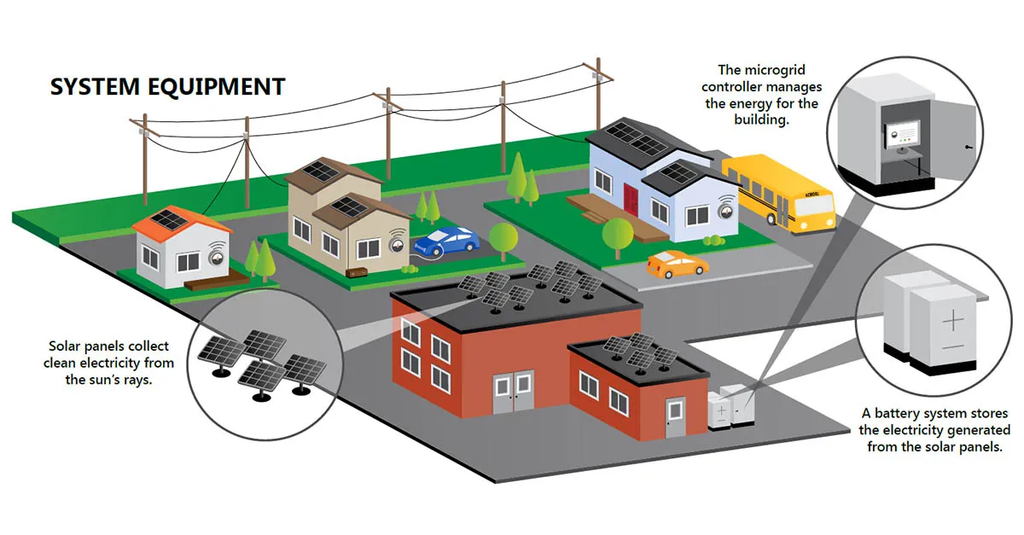
A typical renewable-energy microgrid can combine:
- ☀️ Solar panels
- 🔋 Battery energy storage
- 🌬️ Wind turbines
- ⚡ Backup generators
- 🏭 Local industrial generation
- 🧠 Smart energy-management software
- 🔌 Power inverters and controllers
- 🏠 Homes, businesses or critical facilities
The result is essentially a small, locally managed power system.
How Does a Microgrid Work?
The easiest way to understand a microgrid is to imagine a small community with its own miniature electricity system.
During normal conditions, the microgrid can take electricity from the main grid while also producing power locally.
If the main grid experiences an outage, the microgrid can disconnect—an operation known as islanding—and continue supplying selected loads using its local resources. (The Department of Energy’s Energy.gov)
The basic process
Solar/Wind/Generator → Inverter → Microgrid Controller → Battery → Buildings/Homes
Here’s what happens:
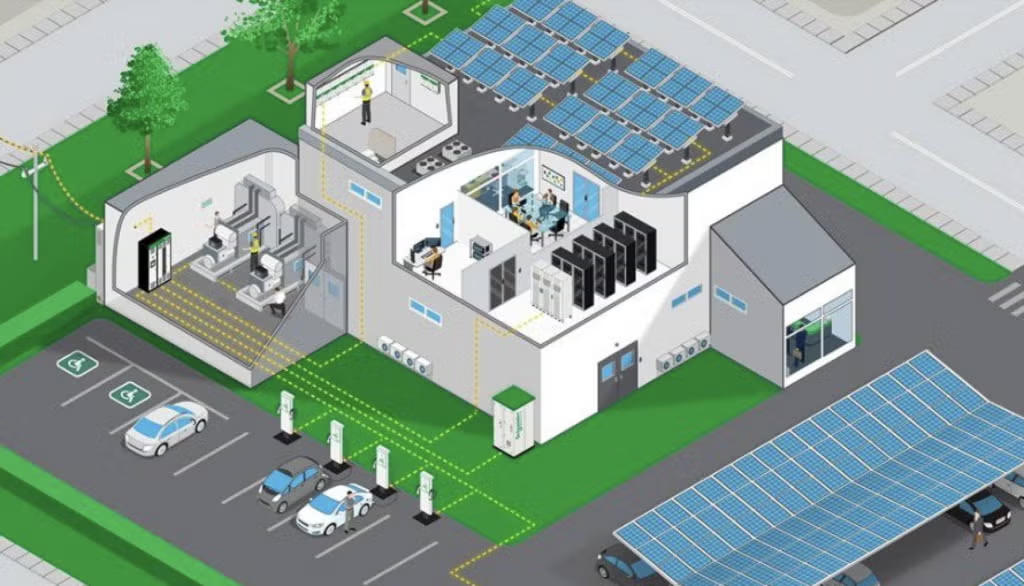
1. Local electricity generation
Solar panels, wind turbines, biomass systems, natural-gas generators or other sources produce electricity.
For a renewable microgrid, solar PV is often an important generation source.
2. Battery storage
When local generation exceeds demand, batteries can store some of the electricity.
Later, the batteries can supply electricity when:
- Solar production falls
- Demand increases
- The main grid fails
- Electricity prices are high
3. Smart controller
The microgrid controller is the brain of the system.
It continuously monitors electricity production, battery state, building demand and the connection to the main grid.
It can determine when to:
- Charge batteries
- Discharge batteries
- Use solar power
- Start backup generation
- Reduce non-essential loads
- Disconnect from the main grid
DOE notes that advanced controllers coordinate local resources and demand while allowing microgrids to operate either connected to the utility or independently. (The Department of Energy’s Energy.gov)
4. Islanding during an outage
Suppose a storm damages the electricity network.
Instead of waiting for the utility grid to be restored, the microgrid can disconnect from the damaged network and continue supplying designated loads.
This is particularly important for hospitals, emergency facilities and other critical infrastructure.
Why Are Microgrids Important?
Traditional electricity grids are highly interconnected. That provides enormous benefits, but it also creates vulnerabilities.
A damaged transmission line, wildfire, cyclone, hurricane, flood or other event can interrupt electricity for thousands or millions of customers.
Microgrids create another layer of resilience by allowing some electricity generation and storage to remain available locally.
The U.S. Department of Energy specifically identifies aging infrastructure, rising electricity demand and increasingly severe natural disasters among the factors creating reliability and resilience challenges for the conventional grid. (The Department of Energy’s Energy.gov)
Instead of asking:
“How quickly can the main grid be repaired?”
a microgrid can sometimes provide another question:
“Can this community continue operating while the main grid is being repaired?”
Why Are Hospitals Building Microgrids?
Hospitals are one of the clearest applications for microgrid technology.
A hospital cannot simply shut down because electricity disappears.
Critical equipment can include:
- Ventilators
- Intensive-care equipment
- Operating-room systems
- Refrigeration for medicines
- Medical imaging equipment
- Emergency lighting
- Communications
- Water systems
- Data centres
- Heating and cooling
Traditional backup generators already provide emergency electricity at many hospitals.
A microgrid can go further by coordinating multiple sources of generation, storage and loads as one system.
Example: San Carlos Hospital in the United States
A current U.S. example is the proposed San Carlos Hospital Community Microgrid for the San Carlos Apache Tribe.
The DOE project includes:
- 750 kW of solar PV
- 500 kW battery energy storage
- A microgrid controller
The system is designed to provide resilient local electricity for the hospital and community. (The Department of Energy’s Energy.gov)
This illustrates an important trend: microgrids aren’t necessarily replacing conventional backup generators overnight. Instead, solar, batteries, generators and intelligent controls can work together.
Why Universities Are Using Microgrids
University campuses are almost perfect environments for microgrids.
A large campus may contain:
- Classrooms
- Laboratories
- Dormitories
- Hospitals
- Data centres
- Libraries
- Sports facilities
- Research equipment
- Restaurants
- Administrative buildings
These buildings are physically close but can have very different electricity requirements.
A campus microgrid can coordinate those resources as one energy system.
University of Illinois example
The University of Illinois Urbana-Champaign operates a campus microgrid.
According to the U.S. Department of Energy, campus microgrids can provide backup electricity and isolate problems so that an outage affecting one part of a campus does not necessarily bring down other buildings. (The Department of Energy’s Energy.gov)
Campus microgrids can also integrate renewable energy, energy storage and other generation technologies.
Microgrids for Military Bases
Military installations have particularly strong reasons to develop microgrids.
A military facility may require electricity for:
- Communications
- Radar
- Security systems
- Medical facilities
- Data centres
- Water infrastructure
- Operations buildings
Losing grid electricity can therefore create operational problems.
Microgrids can provide local generation and storage while reducing dependence on a single external electricity supply.
DOE describes military bases as one of the environments where distributed energy resources and microgrids can support operation during grid disturbances. (The Department of Energy’s Energy.gov)
Microgrids for Remote Villages
Perhaps the most transformative application is rural electrification.
Connecting a remote village to a national electricity grid can require:
- Transmission lines
- Distribution infrastructure
- Transformers
- Poles
- Substations
- Significant construction
In some locations, extending the conventional grid can be difficult or expensive.
A solar-and-battery microgrid can instead generate electricity close to where it is consumed.
A village system might look like:
Solar panels → Battery storage → Local distribution network → Homes + businesses + school + health centre
This can provide electricity for:
- Lighting
- Refrigeration
- Water pumping
- Agriculture
- Shops
- Schools
- Healthcare
- Small manufacturing
The World Bank has identified solar mini-grids and other distributed renewable-energy systems as important tools for expanding electricity access in underserved rural communities. (World Bank)
India: Microgrids for Rural Communities
India is increasingly experimenting with decentralized renewable-energy systems, particularly where reliable electricity access can support agriculture and rural businesses.
In August 2026, Tata Power’s renewable microgrid subsidiary described projects combining solar microgrids, solar irrigation, energy-efficient technologies and productive-use equipment for rural communities. (Tata Power)
The idea is important because rural electrification isn’t simply about putting a light bulb in a house.
Reliable electricity can also power:
- Irrigation pumps
- Cold storage
- Milling equipment
- Small workshops
- Shops
- Internet connectivity
- Schools
- Healthcare facilities
That turns electricity infrastructure into an economic-development tool.
India’s healthcare example
Researchers have also proposed a microgrid architecture for AIIMS Madurai combining:
- Solar PV
- Wind generation
- Battery storage
- Backup diesel generation
- Utility-grid connection
The published design was intended to improve electricity security for a healthcare facility. (OUP Academic)
Africa: Microgrids and Energy Access
Africa presents another major application for microgrids.
Large numbers of rural communities have historically lacked reliable grid electricity, making decentralized energy systems particularly relevant.
Solar mini-grids can provide electricity without requiring every remote community to wait for a large centralized grid expansion.
The World Bank has estimated that solar mini-grids could potentially provide electricity to hundreds of millions of people in Africa by 2030 if deployment barriers are addressed. (World Bank)
More recently, the World Bank announced a $200 million first-phase financing package for renewable distributed-energy solutions in Benin, the Central African Republic, Liberia and Sierra Leone, including mini-grids for underserved communities. (World Bank)
These systems can serve homes while also supporting:
- Health centres
- Schools
- Farms
- Small businesses
- Community services
Microgrids for Industrial Facilities
Factories can be particularly sensitive to electricity interruptions.
Even a short outage can potentially:
- Stop production lines
- Damage equipment
- Spoil products
- Interrupt computing systems
- Create safety problems
- Cause significant downtime
A microgrid can provide local generation and storage while intelligently managing electricity demand.
For industrial customers, another benefit is power quality.
Modern factories increasingly depend on sensitive electronics, automation and digital control systems. DOE has noted that microgrids can help industrial facilities maintain reliable, high-quality electricity. (The Department of Energy’s Energy.gov)
How Much Does a Microgrid Cost?
There isn’t one standard microgrid price.
A system serving a few buildings can have a completely different cost from a village, hospital or industrial facility.
The cost depends on:
- System size
- Solar capacity
- Battery capacity
- Generator capacity
- Distribution infrastructure
- Control equipment
- Inverters
- Land
- Grid interconnection
- Engineering
- Construction
- Software
- Regulatory requirements
- Maintenance requirements
A simple cost structure
Microgrid cost = Generation + Storage + Distribution + Controls + Engineering + Installation + Financing
Batteries can represent a substantial part of the investment, particularly when the system is designed to operate for long periods without the main grid.
Large projects can reach millions of dollars.
For example, the DOE announced a $72.8 million partial loan guarantee in 2024 for the Viejas Microgrid project in California, which includes 15 MW of solar generation and 70 MWh of long-duration energy storage. (The Department of Energy’s Energy.gov)
That project demonstrates how large modern microgrids can become: they are not necessarily tiny systems anymore.
Why Are Microgrids Complex?
Building a microgrid isn’t simply a matter of installing solar panels and batteries.
Engineers need to answer questions such as:
How much electricity is required?
A hospital may have very different electricity requirements at 3 a.m. compared with 3 p.m.
What happens when the grid fails?
The system needs to safely transition into islanded operation.
Which buildings get priority?
A hospital may prioritize intensive care, operating rooms and emergency systems over administrative offices.
How long should batteries operate?
A battery designed for a short outage is different from one designed to provide electricity through a prolonged disruption.
What happens when solar production falls?
Clouds, nighttime conditions or storms can reduce renewable generation.
How does the system reconnect?
The microgrid must safely synchronize with the main grid before reconnecting.
These technical requirements explain why microgrid projects require electrical engineering, controls expertise, software and careful planning.
Microgrids vs Traditional Backup Generators
| Feature | Traditional Generator | Microgrid |
|---|---|---|
| Local generation | Yes | Yes |
| Battery storage | Usually no | Often |
| Solar integration | Limited | Common |
| Intelligent energy management | Limited | Core feature |
| Can island from grid | Usually not as a complete network | Yes |
| Renewable energy | Optional | Often central |
| Load management | Limited | Advanced |
| Long-term energy optimization | Limited | Possible |
| Grid services | Limited | Possible |
A generator can still be an important part of a microgrid.
In fact, many resilient microgrids use a combination of solar + batteries + generators + grid connection.
Microgrid vs Off-Grid System
These terms are sometimes confused.
Microgrid
A microgrid can normally operate with the main grid or independently from it.
Off-grid system
An off-grid system operates without relying on the main electricity grid.
For example:
Remote solar village: potentially off-grid.
University campus with solar, batteries and grid connection: microgrid.
The distinction isn’t always perfectly simple because real-world systems can combine characteristics, but the ability to operate as a controlled electrical island is central to the modern microgrid concept. (The Department of Energy’s Energy.gov)
The Role of Renewable Energy
Renewable energy makes microgrids particularly interesting.
A traditional microgrid might depend heavily on diesel or natural gas.
A modern renewable microgrid can instead combine:
Solar + Battery + Wind + Smart Controller + Backup Generator
During sunny conditions, solar provides electricity.
Excess electricity can charge batteries.
When solar output falls, batteries can supply power.
During a prolonged outage, a backup generator can provide additional energy if required.
This hybrid architecture can improve resilience while reducing dependence on fuel-based generation.
Microgrids and Extreme Weather
Extreme weather is one of the major reasons interest in microgrids has grown.
Events such as:
- Hurricanes
- Floods
- Wildfires
- Cyclones
- Heat waves
- Ice storms
- Severe thunderstorms
can damage conventional electricity infrastructure.
A centralized grid may experience widespread failures when important transmission or distribution assets are damaged.
A microgrid doesn’t make electricity infrastructure immune to disasters. Solar panels, batteries, distribution lines and other equipment can also be damaged.
But local generation and islanding can provide another layer of resilience.
DOE identifies increasing frequencies of higher-impact natural disasters alongside aging infrastructure and growing demand as challenges for grid reliability. (The Department of Energy’s Energy.gov)
Benefits of Microgrids
1. Improved resilience
Critical facilities can continue operating during certain grid outages.
2. Renewable energy integration
Microgrids can combine solar and wind with batteries.
3. Local electricity production
Electricity can be generated close to where it is consumed.
4. Energy storage
Batteries can store excess electricity and provide it later.
5. Potential cost savings
When intelligently operated, a microgrid can potentially reduce peak electricity purchases and optimize energy use.
6. Rural electrification
Remote communities can receive electricity without waiting for full grid expansion.
7. Energy independence
Organizations can reduce dependence on a single external electricity supply.
8. Grid support
Some microgrids can provide services to the larger electricity system when connected to it.
Challenges of Microgrids
Microgrids aren’t a universal solution.
High upfront investment
Solar, batteries, controllers, switchgear and distribution equipment can require significant capital.
Technical complexity
Designing a system that can safely operate both connected and disconnected from the grid is complicated.
Maintenance
Batteries, generators, inverters and control equipment require ongoing maintenance.
Regulation
Grid-interconnection requirements and electricity regulations vary by jurisdiction.
Financing
A technically attractive project may still struggle to secure financing.
Battery limitations
Batteries have finite capacity and cannot necessarily provide electricity indefinitely during a prolonged outage.
DOE itself identifies high upfront costs, complex design and regulatory barriers among the limitations affecting microgrid adoption. (The Department of Energy’s Energy.gov)
What Does the Future of Microgrids Look Like?
Microgrids are increasingly moving beyond the idea of simply being “backup power.”
The newer vision is a flexible local energy platform.
Future microgrids could combine:
- Solar
- Wind
- Batteries
- Electric vehicles
- Vehicle-to-grid systems
- Smart buildings
- AI-based forecasting
- Demand response
- Heat pumps
- Hydrogen
- Backup generators
- Advanced power electronics
Instead of electricity flowing in only one direction, energy could move among buildings, batteries, electric vehicles and the wider grid.
DOE’s current microgrid research describes microgrids as potential building blocks for a more flexible and resilient electricity system. (The Department of Energy’s Energy.gov)
Microgrids Explained in One Simple Example
Imagine a small village with 200 homes.
The village installs:
500 kW solar farm
↓
Battery storage
↓
Smart microgrid controller
↓
Homes + school + clinic + shops
During the day:
☀️ Solar → Homes
☀️ Solar → Battery
At night:
🔋 Battery → Homes
During a national-grid outage:
🔋 Battery + Solar → Critical buildings
During a long period of poor weather:
⚡ Backup generator → Critical loads
That is the basic concept behind a renewable microgrid.
Frequently Asked Questions
What is a microgrid?
A microgrid is a localized electricity network containing electrical loads and local energy resources that can operate while connected to the main grid or independently from it.
How does a microgrid work?
A microgrid combines local electricity generation, energy storage, electrical distribution and intelligent controls. A controller balances supply and demand and can disconnect the system from the main grid during an outage.
Can a microgrid use solar energy?
Yes. Solar PV is one of the most common renewable resources used in microgrids. Batteries can store excess solar electricity for later use.
Can a microgrid operate without the main grid?
Yes. A properly designed microgrid can operate in islanded mode, meaning it disconnects from the main electricity grid and supplies its local loads using available resources.
Why do hospitals need microgrids?
Hospitals require highly reliable electricity for critical medical equipment, communications, lighting, cooling and other essential systems. A microgrid can provide additional resilience during utility outages.
Are microgrids only for hospitals?
No. They are used or developed for campuses, military facilities, industrial sites, commercial buildings, remote communities and other critical infrastructure.
Are microgrids expensive?
They can require substantial upfront investment. Costs depend on the size of the system, generation technologies, battery capacity, controls, distribution infrastructure and local regulations.
Are microgrids the same as off-grid systems?
No. A microgrid can generally operate both connected to and independently from the main grid. An off-grid system is designed to operate without the main grid.
Can microgrids use batteries?
Yes. Battery energy storage is frequently used to store electricity and provide power when renewable generation is unavailable or the main grid fails.
Can microgrids reduce electricity bills?
Potentially. Depending on electricity tariffs and system design, microgrids can optimize local generation, battery storage and electricity consumption. The financial outcome depends heavily on the project.
Final Takeaway
A microgrid is essentially a small, intelligent electricity system that can produce, store and manage power locally.
Its biggest advantage isn’t simply generating renewable electricity. The important feature is the ability to keep operating when the larger electricity grid cannot.
That’s why microgrids are attracting attention in hospitals, universities, military facilities, factories and remote villages.
In India, they can support rural electrification and productive agricultural uses. In the United States, they are being developed for critical facilities, campuses and tribal communities. Across Africa, solar mini-grids are being deployed as part of broader efforts to expand reliable electricity access. (Tata Power)
As electricity demand grows and extreme-weather risks put additional pressure on centralized infrastructure, local generation + energy storage + intelligent controls could become an increasingly important part of how electricity systems are designed.
SEO Tags
microgrid, microgrid explained, what is a microgrid, how microgrids work, microgrid renewable energy, solar microgrid, battery microgrid, renewable energy microgrid, rural microgrid, hospital microgrid, campus microgrid, smart grid, energy storage, distributed energy, off-grid energy, microgrid technology
Suggested Focus Keyword
what is a microgrid
Secondary Keywords
- microgrid explained
- how does a microgrid work
- microgrid renewable energy
- solar microgrid
- microgrid energy storage
- hospital microgrid
- rural microgrid
- campus microgrid
- microgrid benefits
- microgrid cost
- microgrid vs off-grid
- renewable energy microgrid
what is a microgrid,what is a microgrid,what is a microgrid,what is a microgrid,what is a microgrid,what is a microgrid,what is a microgrid