
Imagine plugging your electric car into your home at night and waking up to discover that your EV did more than charge.
It helped power your house.
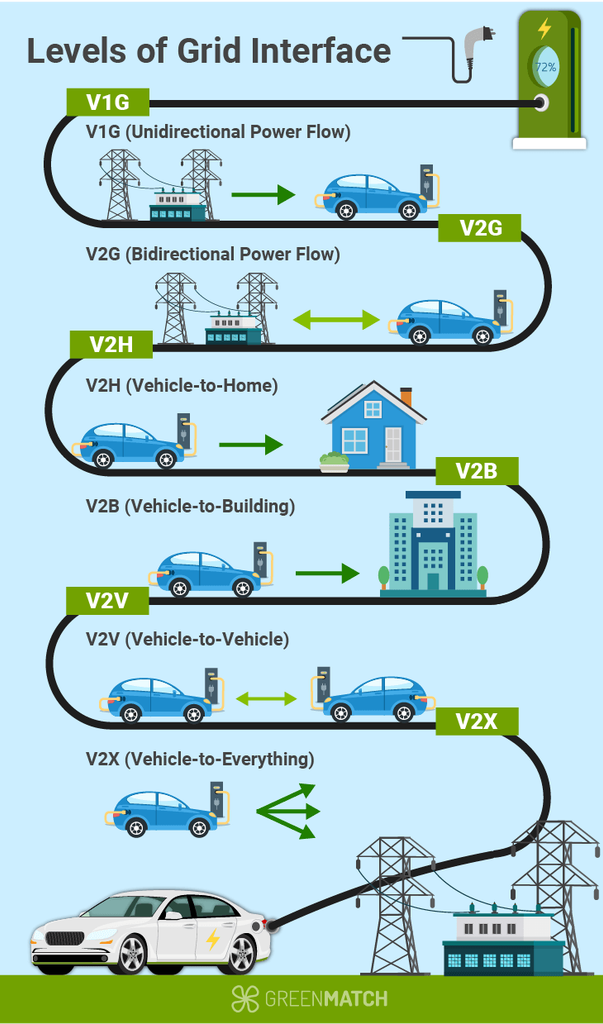
Or imagine thousands of parked electric cars automatically charging when electricity is abundant and sending some of that stored electricity back to the grid when demand suddenly rises.
That is the idea behind vehicle-to-grid (V2G) technology.
Instead of treating an electric vehicle as simply a large electricity consumer, V2G turns the EV battery into a flexible energy-storage resource. The vehicle can charge from the grid when electricity is available and, when permitted, discharge electricity back through a compatible bidirectional charger.
The technology is moving from demonstrations toward commercial deployment. The International Energy Agency says the first commercial V2G offers for private EV owners appeared in 2025, although the number of compatible vehicles remains limited and interoperability is still developing.
In 2026, companies including Nissan and Volkswagen are expanding their plans, while Ford is developing systems that allow compatible F-150 Lightning vehicles to provide power to homes and, in selected programs, potentially participate in grid-related energy management.
So how does V2G actually work, and could your electric car eventually become part of the electricity system?
What Is Vehicle-to-Grid (V2G)?
Vehicle-to-grid (V2G) is a form of bidirectional charging that allows an electric vehicle to both receive electricity and send electricity back to an electrical grid.
Traditional EV charging is one-way:
Grid → Charger → EV battery
V2G adds a second direction:
Grid ↔ Bidirectional charger ↔ EV battery
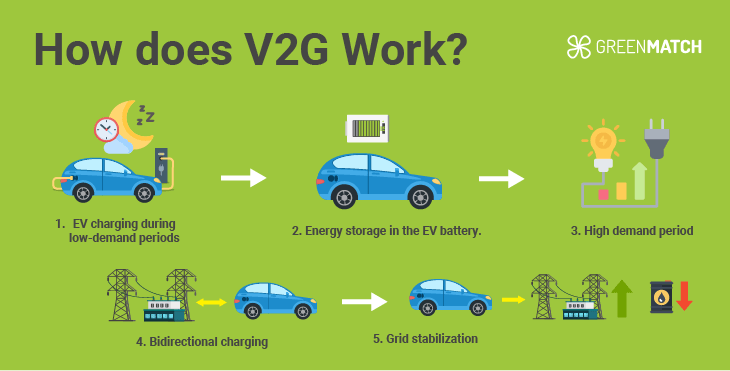
When electricity is inexpensive or renewable electricity is abundant, the system can charge the vehicle.
When electricity demand is high, a participating EV can potentially send some of its stored electricity back to the grid.
Nissan describes V2G as a system in which EVs can automatically charge during periods of surplus electricity and supply electricity back during periods of high demand.
This makes the EV battery more than transportation equipment. It becomes a temporary energy-storage resource.
V2G vs V2H vs V2L
These terms are often confused.
| Technology | Meaning | Where the electricity goes |
|---|---|---|
| V2G | Vehicle-to-Grid | Electricity grid |
| V2H | Vehicle-to-Home | Your house |
| V2B | Vehicle-to-Building | Commercial building |
| V2L | Vehicle-to-Load | Appliances/devices |
| V2X | Vehicle-to-Everything | General category |
A vehicle can support one or several of these capabilities depending on its hardware, software, charger and market.
Importantly, an EV that supports V2H does not automatically support V2G.
How Does V2G Technology Work?
V2G requires significantly more technology than simply plugging an EV into a normal charger.
A typical system contains:
- V2G-compatible electric vehicle
- Bidirectional charger
- Energy-management software
- Communication system
- Smart meter or grid connection
- Utility or energy-market integration
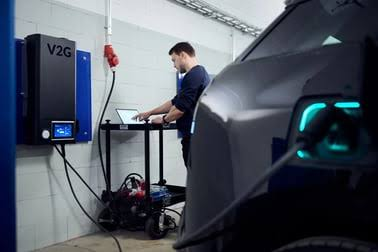
The bidirectional charger controls the flow of electricity between the vehicle and the electrical system.
International standard ISO 15118-20 defines communication requirements that support bidirectional power transfer between EVs and charging equipment.
The process can look like this:
Step 1: The EV charges
The vehicle charges when electricity is cheap, renewable electricity is available or the grid has spare capacity.
Step 2: The system monitors conditions
Software monitors factors such as:
- electricity prices
- grid demand
- battery state of charge
- weather
- renewable-energy production
- the driver’s departure schedule
Step 3: The vehicle stores electricity
The EV battery acts as temporary energy storage.
For example, a 70-kWh battery could theoretically contain considerably more energy than a typical household needs for several hours, although only part of that battery may be made available for V2G.
Step 4: The EV exports electricity
When the grid needs additional flexibility, the charger reverses the energy flow.
EV battery → Bidirectional charger → Grid
Step 5: The EV recharges
Later, the system can recharge the vehicle when electricity demand falls or renewable generation increases.
The goal isn’t to constantly drain the battery.
Instead, smart software attempts to balance the driver’s transportation needs with grid requirements.
Why Would the Grid Need EV Batteries?
Solar and wind power create a unique challenge.
Solar generation can be extremely high during sunny hours but drops rapidly after sunset. Wind production can also change depending on weather conditions.
At the same time, electricity demand changes throughout the day.
V2G can potentially help bridge these differences.
For example:
Midday
Solar production is high → EVs charge.
Evening
Solar production falls and household demand rises → participating EVs can discharge electricity.
Overnight
Demand decreases → EVs recharge.
This is particularly interesting as electricity systems add more variable renewable generation.
The IEA says smart charging and V2G can provide additional flexibility as EV electricity demand grows, although current V2G deployment remains limited by vehicle availability, regulation and interoperability.
Which Electric Cars Support V2G?
This is where things become complicated.
Not every EV with a large battery can automatically perform V2G.
The vehicle must have compatible hardware and software, and the charging equipment and local electricity system must also support bidirectional operation.
Nissan LEAF
The Nissan LEAF has been one of the best-known vehicles associated with bidirectional charging.
Nissan has used the LEAF in V2H and V2G demonstrations for years. Its earlier systems used CHAdeMO-based bidirectional charging, while Nissan is now developing newer V2G systems for European markets.
Nissan announced plans to introduce V2G technology in selected EVs in the UK from 2026, followed by expansion into other European markets.
Nissan’s current V2G plans are therefore more nuanced than simply saying “every LEAF supports V2G.”
Compatibility depends on the specific vehicle, market, charger and service.
Ford F-150 Lightning
The Ford F-150 Lightning demonstrates another important application: using an EV battery to power a home.
Ford’s Home Backup Power system uses the F-150 Lightning, Charge Station Pro and Home Integration System to transfer electricity from the vehicle to the home during an outage.
Ford has also introduced Home Power Management features that can discharge vehicle energy to help offset household electricity consumption during expensive periods. In selected markets and utility programs, Ford says customers may also be able to return electricity to the grid and receive financial incentives.
This distinction matters:
Vehicle-to-home is not the same thing as vehicle-to-grid.
A Lightning owner may have bidirectional home-power functionality without necessarily having access to a V2G electricity-market program.
Volkswagen ID Series
Volkswagen is another major automaker moving V2G toward broader commercial deployment.
In June 2026, Volkswagen Group and Elli announced an integrated V2G offering for Germany combining compatible electric vehicles, a bidirectional charger, smart meter, electricity tariff and software.
Volkswagen says around one million MEB-based vehicles in Europe were technically ready for bidirectional charging, although actual commercial availability depends on the specific vehicle, market and system configuration.
The company announced a planned German market launch of its integrated private-customer V2G package beginning in the fourth quarter of 2026.
This illustrates an important trend: V2G is increasingly becoming an energy-service ecosystem, rather than simply a feature inside an EV.
Can You Make Money With V2G?
Potentially, yes.
But V2G should not be viewed as guaranteed passive income.
The economics depend heavily on:
- local electricity prices
- utility programs
- V2G tariffs
- energy-market rules
- charger cost
- installation cost
- vehicle compatibility
- battery degradation
- how frequently the vehicle participates
A simplified example illustrates the concept.
Suppose an EV has 60 kWh of usable battery capacity.
If the owner makes 10 kWh available to the grid during a high-price period, the vehicle could potentially earn revenue based on the amount of electricity exported and the compensation offered by the program.
The owner could then recharge the vehicle later when electricity prices are lower.
The economic model is essentially:
Charge cheaply → store electricity → discharge when valuable → recharge later
But there are losses during charging and discharging, and V2G programs may compensate owners through different mechanisms rather than simply paying a retail electricity price.
NREL notes that V2G can provide EV owners with a potential revenue source while also providing demand-response services to the grid.
Volkswagen’s 2026 V2G offering similarly describes the potential for customers to reduce energy costs and generate additional economic value from their vehicle batteries.
What About Battery Degradation?
This is probably the biggest question for EV owners.
Every battery experiences ageing.
Battery degradation is influenced by factors including:
- temperature
- state of charge
- depth of discharge
- charging rate
- battery chemistry
- total energy throughput
- time
V2G adds additional charge/discharge cycles, so it can increase battery use.
However, the answer isn’t simply “V2G destroys batteries.”
Recent research and modelling show that the impact depends heavily on how V2G is managed.
The IEA reports that well-managed V2G can limit degradation, and in some circumstances managed charging can reduce capacity loss compared with uncontrolled charging because vehicles spend less time sitting at very high states of charge.
A 2025 study published in Applied Energy modelled V2G over a 10-year period and estimated that V2G increased total battery degradation by roughly 9%–14% under its studied scenarios. The study also estimated the compensation needed to offset degradation and other costs. These are modelled results, not a universal prediction for every EV or V2G program.
This is why future V2G systems are likely to use software that limits unnecessary battery cycling.
For example, the system could avoid discharging the battery below a driver’s minimum reserve.
A driver might specify:
“Keep at least 60% charge because I need to drive tomorrow morning.”
The energy-management system could then use only the remaining capacity for grid services.
The Smart Charging Hardware Challenge
You can’t simply connect an ordinary EV charger to the electricity grid and expect electricity to flow backwards.
V2G requires compatible bidirectional equipment.
That equipment needs to:
- safely reverse power flow
- communicate with the vehicle
- communicate with energy-management systems
- meet grid regulations
- manage voltage and frequency
- protect the battery
- disconnect safely when required
This creates a major compatibility challenge.
The IEA says ISO 15118-20 provides an important international framework for bidirectional charging, but implementation remains inconsistent. Current V2G offerings can be limited to particular combinations of vehicles and chargers using proprietary systems.
In other words:
V2G is not yet a universal “plug in any EV and get paid” technology.
V2G Could Also Help During Power Outages
There is another application that doesn’t necessarily require selling electricity to the grid.
Backup power.
An EV battery can potentially provide electricity to a home when the grid goes down.
Ford’s F-150 Lightning is one example. Its Home Backup Power system can transfer energy from the vehicle to a connected home when the required equipment is installed.
Nissan has also developed V2H systems that allow EV batteries to supply homes.
Nissan describes V2H as a way to use stored EV energy when electricity prices are high and to provide backup power during outages, subject to regional availability.
This creates an interesting relationship between:
EV + Solar Panels + Home + Battery + Grid
During sunny periods:
Solar → Home + EV
During evening demand:
EV → Home
During a grid outage:
EV → Home
And under a V2G program:
EV → Grid
The car becomes another component of the household energy system.
What Happens If Millions of EVs Participate?
This is where V2G becomes particularly interesting.
Imagine 1 million EVs, each providing an average of:
- 50 kWh of available battery energy
- 5 kW of discharge power
The theoretical fleet would represent:
50 GWh of stored energy
and up to:
5 GW of instantaneous power
Those numbers are illustrative, not a forecast. Real-world availability would be lower because vehicles have different battery sizes, charge levels, departure schedules, charging limits and participation rates.
Now imagine several million vehicles participating.
The combined resource could become comparable to a large distributed energy-storage fleet.
NREL has highlighted the potential of bidirectional EVs to provide grid balancing, renewable-energy integration and resilience services.
The biggest advantage is that the batteries already exist.
A utility doesn’t necessarily have to build a completely separate stationary battery for every unit of flexibility.
Instead, millions of privately owned vehicles could provide small amounts of flexibility while parked.
V2G Could Be Especially Useful With Solar Energy
Consider a household with rooftop solar.
During the middle of the day, the solar panels may produce more electricity than the home needs.
Without storage, that excess electricity may be exported to the grid depending on the local rules.
With an EV:
Solar → EV battery
Then in the evening:
EV battery → Home
And under a V2G program:
EV battery → Grid
This could increase the usefulness of rooftop solar by allowing more electricity to be shifted from the time it is generated to the time it is needed.
Nissan specifically describes using EV batteries to store surplus solar generation and later use that energy during higher-demand periods.
The Biggest Challenges Facing V2G
V2G has considerable potential, but several barriers remain.
1. Limited Vehicle Compatibility
Most EVs still don’t offer universal V2G capability.
The IEA says current V2G offers remain limited to relatively few compatible vehicle and charger combinations.
2. Bidirectional Charger Cost
A bidirectional charger can cost more than a conventional EV charger.
Installation may also require electrical upgrades, smart-meter integration and other equipment.
3. Battery Degradation
Additional cycling can increase battery wear, although sophisticated control strategies can reduce the impact.
4. Grid Regulations
Electricity markets have different rules for exporting electricity.
A system that works in one country or utility territory may not be permitted or economically viable somewhere else.
5. Driver Convenience
The vehicle’s primary job remains transportation.
A V2G system must ensure that the driver has enough charge when they need to leave.
6. Interoperability
A vehicle, charger, utility and energy-management platform must communicate correctly.
The IEA identifies interoperability as one of the important obstacles to scaling V2G.
7. Cybersecurity
Connecting millions of vehicles to energy networks creates another consideration: cybersecurity.
The IEA’s 2026 Global EV Outlook notes that cybersecurity risks will become increasingly important as EVs and charging systems become more integrated with electricity systems.
V2G vs Home Battery: What’s the Difference?
A home battery is permanently installed.
An EV battery moves.
That creates both advantages and disadvantages.
| Feature | EV with V2G | Home battery |
|---|---|---|
| Battery already owned | Yes, if you own an EV | No |
| Can drive away with stored energy | Yes | No |
| Can provide home backup | With compatible system | Yes |
| Can support grid services | Potentially | Potentially |
| Installation | Requires compatible equipment | Requires installation |
| Battery has transportation purpose | Yes | No |
| Availability | Depends on vehicle location | Usually always available |
An EV therefore has an unusual advantage: you already bought the battery for transportation.
The challenge is that the battery isn’t always sitting at home.
Is V2G the Future of Electric Vehicles?
V2G is unlikely to replace conventional grid-scale batteries, pumped hydro or other forms of energy storage.
Instead, it could become one layer of a much larger energy-storage system.
Stationary batteries can respond whenever they are connected.
EVs have to account for drivers.
But EVs have one enormous potential advantage: scale.
Millions of vehicles may spend much of their time parked.
If software can coordinate those vehicles without interfering with people’s mobility, their combined batteries could provide substantial flexibility.
Volkswagen’s 2026 announcement demonstrates this direction. The company says roughly one million MEB-based vehicles in Europe are technically ready for bidirectional charging, creating a potential foundation for scaling V2G across multiple brands and models.
The technology is therefore shifting from laboratory demonstrations toward integrated commercial energy services.
What Would a V2G Future Look Like?
Imagine arriving home at 6 p.m.
Your EV is plugged into the charger.
The electricity grid is experiencing high demand.
Your energy-management system knows you won’t drive until 8 a.m.
Instead of immediately charging or simply sitting idle, the vehicle participates in a V2G program.
It supplies a controlled amount of electricity to the grid.
At 2 a.m., demand falls.
The vehicle recharges.
At 7 a.m., your battery is ready for your commute.
You receive compensation for participating.
The process happens automatically.
That’s the basic vision behind V2G.
The car doesn’t just consume electricity.
It becomes part of the electricity system.
Frequently Asked Questions About V2G
What does V2G stand for?
V2G stands for Vehicle-to-Grid. It describes technology that allows a compatible electric vehicle to send electricity from its battery back to the electricity grid.
Can every electric car do V2G?
No. V2G requires compatible vehicle hardware, software, bidirectional charging equipment and an appropriate utility or energy-market program.
Can a V2G car power my house?
Potentially. That’s generally called Vehicle-to-Home (V2H). Some vehicles support V2H even when full V2G functionality isn’t available.
Can V2G make EV owners money?
Potentially. Participating owners may receive payments or credits for supplying electricity or grid-balancing services. Actual compensation depends on the local electricity market, utility program, vehicle, charger and operating costs.
Does V2G damage the battery?
Additional charging and discharging can increase battery cycling and therefore potentially increase degradation. However, research indicates that intelligent V2G management can reduce unnecessary battery stress, and the impact varies substantially with operating conditions.
Does the Nissan LEAF support V2G?
The Nissan LEAF has supported bidirectional energy applications and has been used extensively in V2H and V2G demonstrations. Nissan is also introducing V2G technology in selected European markets fro