Renewable Energy-Powered Desalination
More than 2 billion people currently live with high water stress, and that number is expected to keep climbing as populations grow and climate change strains traditional freshwater sources. Desalination — turning seawater or brackish water into drinking water — has long been part of the answer, but conventional plants are notoriously energy-hungry and often run on fossil fuels. Pairing desalination with solar and wind power is one of the most promising ways to close that gap. Here’s how the technology works, what it offers, where it struggles, and which projects are proving it out.
Renewable Energy-Powered Desalination
How Solar-Powered Desalination Works

Solar energy can drive desalination in two main ways
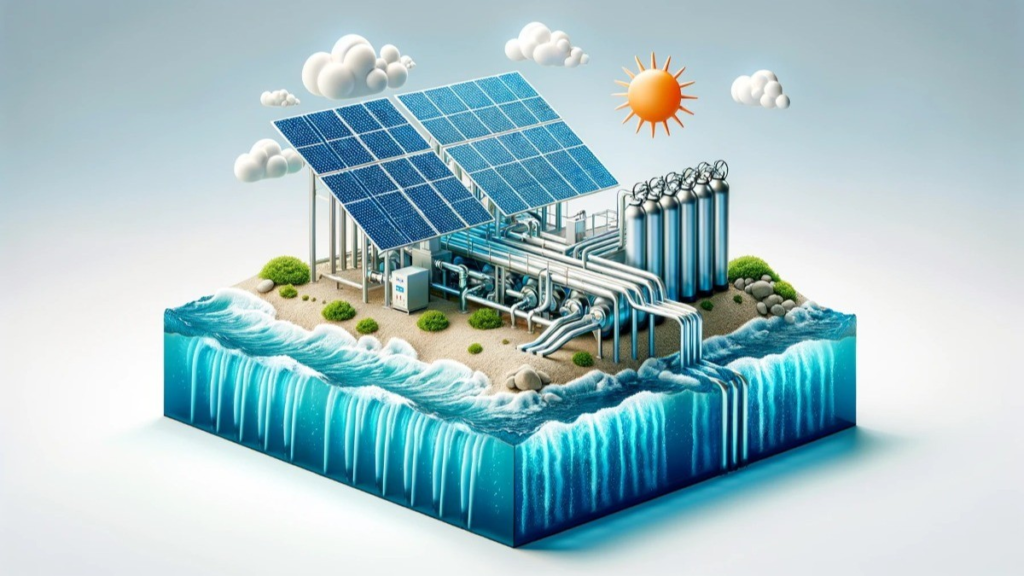
Photovoltaic (PV) + Reverse Osmosis (RO). Solar panels generate electricity that powers high-pressure pumps, forcing seawater through membranes that filter out salt and minerals. This is by far the most common configuration in commercial-scale projects, and it benefits from RO’s relatively low energy demand compared with older thermal methods. Some PV-driven RO systems have achieved specific energy consumption as low as 0.3–0.36 kWh per cubic meter of water — a fraction of what conventional thermal desalination requires.
Solar Thermal Distillation. Instead of generating electricity, this approach uses concentrated sunlight or solar collectors to heat seawater directly, evaporating it and condensing the vapor into fresh water. It’s mechanically simpler and well-suited to small, off-grid systems, but throughput is lower and it hasn’t scaled to industrial levels the way PV-RO has. Emerging designs, like a Monash University/IIT Bombay prototype using a carbon-infused floating membrane, are pushing to solve chronic problems like salt buildup on evaporator surfaces, with early versions producing around 18 liters of drinking water per day.
How Wind-Powered Desalination Works
Wind-driven systems generally fall into two categories:
Grid-connected wind + RO. Wind farms feed electricity into the grid or directly to a desalination plant’s pumps, similar to the PV-RO model but using turbines instead of panels. This is the more common commercial arrangement.
Standalone/off-grid systems. Turbines power RO or electrodialysis units directly, often on islands or in remote coastal areas without reliable grid access. Because wind is intermittent, these systems typically pair turbines with battery storage, flywheels, or control systems that scale desalination output up or down with the available power. Research also shows a smaller share of experimental designs where turbines mechanically drive high-pressure pumps without an intermediate electrical generation step, cutting out conversion losses.
Wind-powered RO currently makes up a meaningful share of renewable-desalination installations worldwide, though photovoltaic-RO remains the more widely deployed combination overall.
Benefits
- Lower carbon footprint. Replacing fossil-fuel electricity with solar or wind can cut a plant’s greenhouse gas emissions dramatically — some wind-powered facilities report carbon footprint reductions in the range of tens or even hundreds of thousands of tons of CO2 per year.
- Energy independence for remote and off-grid areas. Coastal communities, islands, and villages without reliable grid infrastructure can produce their own drinking water without importing fuel.
- Falling costs. Desalination costs overall have dropped roughly 80% over the past two decades as membrane technology and energy recovery devices have improved, and pairing plants with renewables further reduces operating expenses tied to electricity.
- Scalability across sizes. The technology ranges from small containerized units producing a few cubic meters a day for a village, up to massive utility-scale plants serving millions of people.
Challenges

- Intermittency. Solar and wind output fluctuates with weather and time of day, while desalination plants — especially large RO facilities — run most efficiently under steady, continuous power. Cloud cover or calm winds can force plants to throttle output or rely on batteries, backup generators, or grid power to keep running.
- Storage and cost trade-offs. Batteries and other storage solutions add capital cost. Some projects sidestep this by treating water production itself as a form of storage — running desalination hard when renewable power is abundant and storing the resulting water rather than storing electricity.
- Brine disposal. Every liter of fresh water produced leaves behind concentrated brine that must be disposed of carefully to avoid harming marine ecosystems — a problem renewables don’t solve on their own.
- Upfront capital costs. Solar panels, wind turbines, desalination units, and power conditioning equipment represent a large initial investment, even though operating costs drop over time.
- Market maturity gaps. Despite decades of pilot projects, purely wind-powered desalination plants have struggled to become mainstream commercial products; most large-scale renewable desalination today uses solar PV paired with grid backup rather than pure off-grid wind systems.
Real-World Projects
Hassyan Solar Desalination Plant, Dubai, UAE. Commissioned by Dubai Electricity and Water Authority and ACWA Power, this reverse osmosis plant is set to be the largest in the world powered solely by solar energy once fully operational in 2027, with capacity to supply roughly two million people and a total investment of about €848 million.
NEOM, Saudi Arabia. This large-scale development is one of the highest-profile tests of solar-driven RO desalination at scale, alongside Saudi Arabia’s broader desalination expansion, including the Shuaiba 3 plant, which entered commercial operation in 2025 partly powered by dedicated solar PV.
Perth Seawater Desalination Plant, Australia. Linked to a wind farm of 48 turbines, this plant has been supplying millions of liters of drinking water daily since 2006, cutting the facility’s carbon footprint by an estimated 150,000 tons of CO2 annually.
Canary Islands, Spain. Home to one of the highest concentrations of wind-powered desalination pilot projects in the world, including autonomous systems combining wind turbines, flywheels, and RO modules that have operated since the early 2010s. A newer pumped-storage project under construction on Gran Canaria aims to store wind energy on a weekly cycle and desalinated water on a seasonal cycle.