
Ocean Thermal Energy Conversion (OTEC) is one of the most promising yet least developed renewable energy technologies. Unlike solar and wind power, which depend on weather conditions, OTEC can generate electricity 24 hours a day by utilizing the natural temperature difference between warm surface seawater and cold deep ocean water.
As global demand for clean, reliable energy increases, OTEC is gaining attention as a potential source of continuous renewable power for tropical and island regions.
What Is Ocean Thermal Energy Conversion (OTEC)?
Ocean Thermal Energy Conversion is a technology that generates electricity from the temperature gradient that exists in tropical oceans.
The sun heats the ocean surface, creating warm water temperatures of approximately 25°C to 30°C (77°F to 86°F). Meanwhile, water located 800–1,000 meters below the surface remains cold, typically around 4°C to 5°C (39°F to 41°F).
OTEC systems use this temperature difference—usually at least 20°C (36°F)—to drive a power generation cycle.
Key Principle
The larger the temperature difference between warm and cold water, the more efficiently the system can produce electricity. Ocean Thermal Energy Conversion
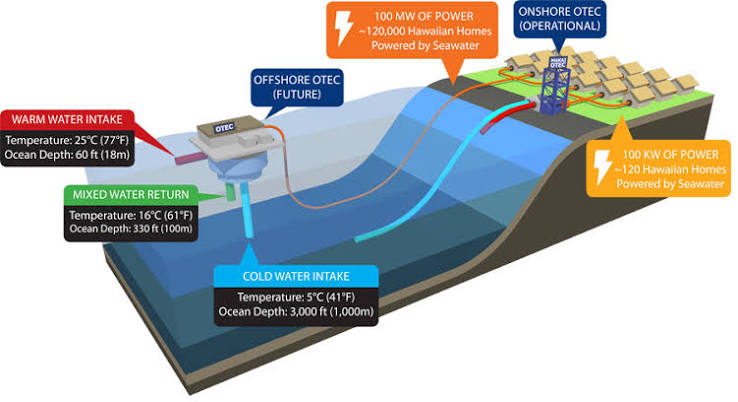
How OTEC Works
Step 1: Warm Surface Water Collection
Warm seawater from the ocean surface is pumped into the OTEC plant.
Step 2: Vaporizing a Working Fluid
The warm water heats a low-boiling-point fluid such as ammonia.
Because ammonia boils at a much lower temperature than water, it rapidly turns into vapor.
Step 3: Turbine Rotation
The expanding ammonia vapor spins a turbine connected to a generator.
The generator converts mechanical energy into electricity.
Step 4: Condensation
Cold seawater from deep ocean layers is pumped upward.
This cold water cools the ammonia vapor, converting it back into liquid form.
Ocean Thermal Energy Conversion
Step 5: Cycle Repeats
The liquid ammonia is recycled through the system, creating a continuous electricity generation process.
Types of OTEC Systems
1. Closed-Cycle OTEC
The most common design.
How it works:
- Uses ammonia or another working fluid
- Warm seawater evaporates the fluid
- Vapor drives turbines
- Cold seawater condenses the vapor
Advantages:
✔ Reliable operation
✔ Commercially preferred
✔ High efficiency compared to other OTEC designs
2. Open-Cycle OTEC
Uses seawater itself as the working fluid.
Process:
- Warm seawater enters a low-pressure chamber
- Water boils into steam
- Steam drives a turbine
- Steam condenses into freshwater
Advantages:
✔ Produces electricity
✔ Generates desalinated drinking water
✔ Useful for islands with water shortages
3. Hybrid-Cycle OTEC
Combines open-cycle and closed-cycle technologies.
Benefits:
- Electricity generation
- Freshwater production
- Improved overall system efficiency
Electricity Generation Process
Warm Surface Water
        ↓
Heat Exchanger
        ↓
Ammonia Vaporizes
        ↓
Turbine Spins
        ↓
Generator Produces Electricity
        ↓
Cold Deep Water Condenses Vapor
        ↓
Cycle Repeats
The process operates continuously as long as the ocean temperature difference remains sufficient.
Why Tropical Oceans Are Ideal
OTEC works best near the equator where warm surface temperatures are consistently high.
Suitable Regions
- Hawaii
- Caribbean Islands
- Philippines
- Indonesia
- India
- Pacific Islands
- Maldives
- Puerto Rico
- Ocean Thermal Energy Conversion
These locations experience year-round temperature differences that can support commercial OTEC operations.
Major OTEC Pilot Projects Around the World
Hawaii, United States
Hawaii has hosted several OTEC demonstration projects and remains a leading center for OTEC research.
Key achievements include:
- Experimental electricity generation
- Deep seawater pumping technologies
- Long-term system testing
Okinawa, Japan
Japan has invested heavily in OTEC development.
Projects focus on:
- Small-scale power generation
- Freshwater production
- Commercial feasibility studies
Martinique (Caribbean)
Martinique has explored floating OTEC plants capable of supplying renewable electricity to island communities.
India
India’s ocean research agencies have conducted OTEC feasibility studies in the Lakshadweep and Andaman regions.
The country possesses significant potential due to its extensive tropical coastline.
Advantages of OTEC
1. Continuous Power Generation
Unlike solar and wind energy, OTEC operates 24/7.
This makes it a reliable baseload energy source.
2. Massive Renewable Resource
The oceans absorb enormous amounts of solar energy daily.
Only a small fraction needs to be utilized to generate significant power.
3. Zero Fuel Cost
OTEC uses naturally occurring temperature differences.
No fossil fuels are required.
4. Low Carbon Emissions
OTEC systems produce minimal greenhouse gas emissions.
This helps reduce climate change impacts.
5. Freshwater Production
Open-cycle systems can simultaneously generate drinking water through desalination.
6. Aquaculture Opportunities
Cold deep ocean water contains nutrients beneficial for:
- Fish farming
- Seaweed cultivation
- Marine agriculture
7. Cooling Applications
Deep seawater can provide air-conditioning for buildings, hotels, and industrial facilities.
Environmental Benefits
Reduced Fossil Fuel Dependence
OTEC can replace diesel generators commonly used on islands.
Stable Renewable Electricity
Provides power regardless of weather conditions.
Supports Sustainable Development
Can improve energy security for remote coastal communities.
Minimal Land Use
Most infrastructure is located offshore, reducing land requirements.
Challenges and Limitations
1. Low Efficiency
OTEC systems typically achieve only 3–7% thermal efficiency due to the relatively small temperature difference.
2. High Capital Costs
Building:
- Offshore platforms
- Large heat exchangers
- Deep-water intake pipes
requires substantial investment.
3. Engineering Complexity
Pipes extending nearly 1 kilometer below the ocean surface must withstand:
- Strong currents
- Corrosion
- Storm damage
4. Location Restrictions
OTEC is practical only in tropical and subtropical regions with adequate temperature gradients.
5. Environmental Concerns
Potential issues include:
- Marine ecosystem disruption
- Nutrient upwelling effects
- Changes in local water chemistry
Careful environmental monitoring is necessary.
Commercial Viability
OTEC remains more expensive than solar and wind energy today.
However, costs are expected to decline as:
- Larger plants are built
- Materials improve
- Engineering expertise grows
- Government support increases
Many analysts believe OTEC could become particularly valuable for island nations where imported fuel prices are high.
Future of OTEC
The future of OTEC looks promising due to:
Floating Power Plants
Large offshore facilities could supply electricity directly to coastal cities.
Energy + Water Systems
Combining power generation and freshwater production improves project economics.
Green Hydrogen Production
OTEC electricity could be used to create hydrogen fuel for transportation and industry.
Grid Stability
As renewable energy adoption increases, OTEC can provide dependable baseload power that complements intermittent solar and wind generation.
Conclusion
Ocean Thermal Energy Conversion represents one of the world’s largest untapped renewable energy resources. By harnessing the natural temperature difference between warm surface water and cold deep ocean water, OTEC can generate clean, continuous electricity while also supporting freshwater production, aquaculture, and sustainable coastal development.
Although high costs and engineering challenges have slowed widespread adoption, advances in marine technology and growing demand for reliable renewable energy may finally unlock the vast potential hidden beneath our oceans.
SEO Focus Keywords
- Ocean Thermal Energy Conversion
- OTEC Technology
- OTEC Power Generation
- Renewable Ocean Energy
- Ocean Energy Systems
- Tropical Renewable Energy
- OTEC Plant
- Ocean Thermal Power
- Clean Energy from Oceans
- Future Ocean Energy Technology
Meta Description
Ocean Thermal Energy Conversion (OTEC) uses ocean temperature differences to generate clean electricity 24/7. Learn how OTEC works, its advantages, challenges, pilot projects, and future commercial potential.