
offshore wind power, offshore wind farm, how offshore wind works
Offshore wind power is becoming one of the most important sources of new renewable electricity around the world. Instead of installing turbines on hills, plains, or farmland, developers place enormous wind turbines in oceans and coastal waters where winds are generally stronger and more consistent.
The technology has advanced rapidly. Modern offshore turbines can produce more than 10 MW each, while giant projects now contain hundreds of turbines and several gigawatts of generating capacity. Floating foundations are also opening the possibility of building wind farms in much deeper water, far beyond the areas suitable for traditional foundations.
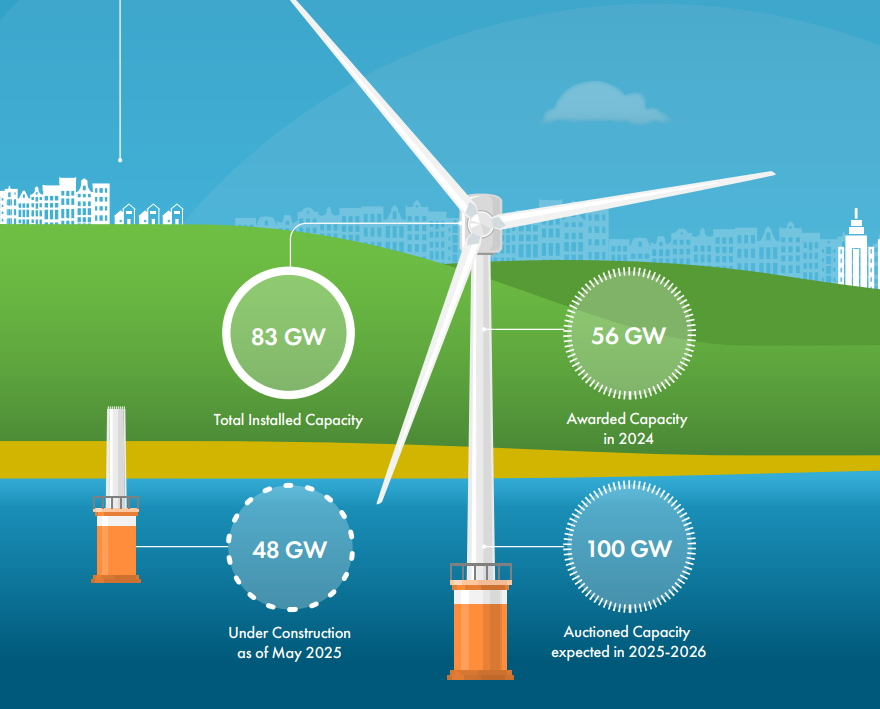
As of 2026, the offshore wind industry is approaching a major milestone. According to the Global Wind Energy Council (GWEC), global offshore wind capacity reached 92.5 GW by the end of 2025, after 9.3 GW of new capacity was connected during 2025. China alone accounted for 48.4 GW. GWEC expects annual installations to grow substantially during the coming decade.
But offshore wind is not simply “onshore wind with bigger turbines.” Building in the ocean introduces complex engineering, expensive vessels, underwater cables, harsh weather conditions, and difficult maintenance requirements.
So, how does offshore wind work, why is it so powerful, and what does the industry look like in 2026?
What Is Offshore Wind Power?
Offshore wind power is electricity generated by wind turbines installed in seas, oceans, or large bodies of water.
The basic process is straightforward:
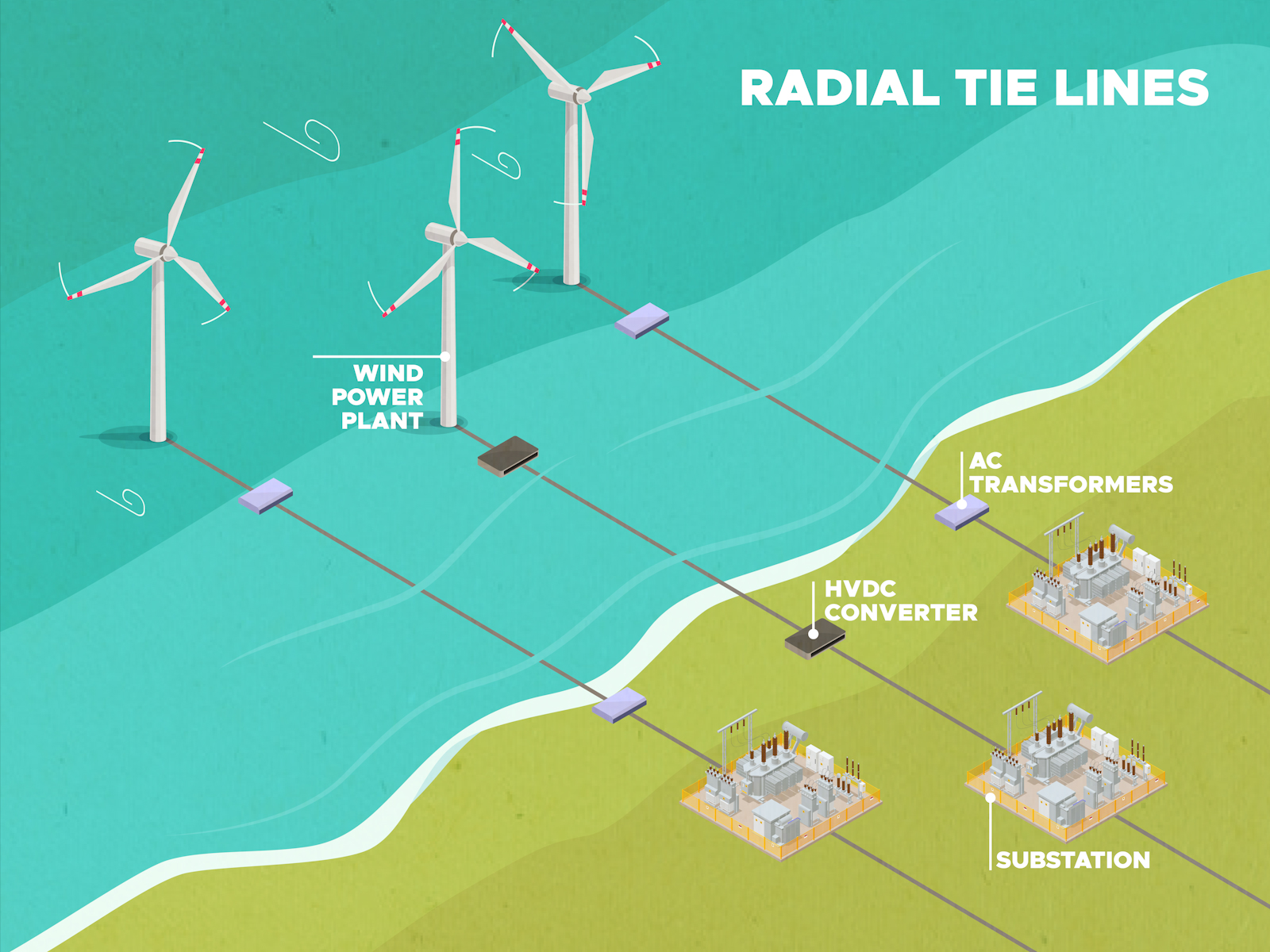
Wind → Turbine blades → Generator → Offshore substation → Undersea cable → Electricity grid
Wind pushes the turbine blades, causing the rotor to spin. The rotor drives a generator inside the nacelle, producing electricity.
Electricity from multiple turbines is collected through inter-array cables. It is then sent to an offshore substation, where voltage is increased for efficient transmission.
Finally, export cables carry the electricity beneath the seabed to land, where it connects to the national electricity grid.
For projects located far from shore, high-voltage direct current (HVDC) transmission can be particularly useful because it reduces transmission losses over long distances. The UK’s Dogger Bank project, for example, uses HVDC technology to transmit electricity from its offshore site to the British grid.
Why Is Offshore Wind More Powerful Than Onshore Wind?
One of the biggest advantages of building wind farms at sea is the quality of the wind resource.
1. Stronger winds
There are fewer physical obstacles over the ocean.
On land, buildings, hills, forests, and other structures create turbulence and slow the wind down near the surface.
Over the ocean, the wind can travel long distances without encountering many obstacles.
That allows offshore turbines to capture strong, relatively smooth airflow.
2. More consistent wind
Offshore wind tends to be more consistent than wind at many land-based locations.
A turbine doesn’t necessarily need extremely strong wind all the time. What matters is having a reliable wind resource that allows the turbine to operate productively for a large portion of the year.
This can give offshore wind farms high capacity factors compared with many conventional land-based wind projects.
For example, the 30 MW Hywind Scotland floating wind farm has recorded a 54% capacity factor, demonstrating the strong wind resource available offshore.
3. Much larger turbines
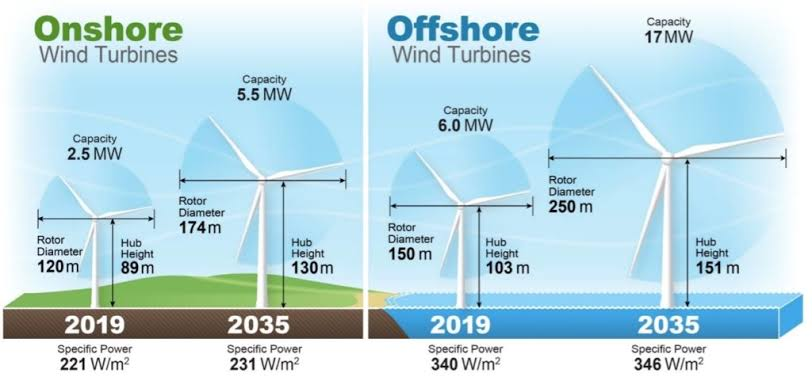
Offshore developers can install much larger turbines because there are fewer restrictions related to land availability, transportation routes, noise, and proximity to buildings.
Large offshore turbines can have:
- Huge rotor diameters
- Blades longer than 100 metres
- Turbine capacities above 10 MW
- Tower heights of hundreds of metres when measured to the blade tip
The Dogger Bank project in the UK is using GE Vernova Haliade-X turbines rated at 13 MW for its first two phases and 14 MW turbines for its third phase.
4. Large areas for wind farms
The ocean provides enormous areas where turbines can be arranged in large arrays.
A single offshore wind farm can therefore contain dozens or even hundreds of turbines.
How Offshore Wind Works
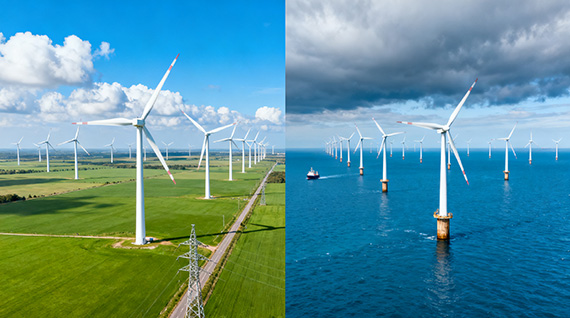
The complete process involves much more than simply putting a turbine in the ocean.
Step 1: Finding a Suitable Offshore Site
Before construction begins, developers study potential locations for years.
Engineers and environmental scientists examine:
- Wind speed
- Water depth
- Seabed geology
- Waves
- Ocean currents
- Shipping routes
- Fishing activity
- Marine ecosystems
- Distance from shore
- Grid connection opportunities
- Construction and maintenance access
The ideal site has strong winds, suitable seabed conditions, reasonable water depth, and access to electricity transmission infrastructure.
Step 2: Installing the Foundation
The type of foundation depends mainly on water depth and seabed conditions.
There are two major categories:
- Fixed-bottom offshore wind
- Floating offshore wind
Fixed-bottom turbines are attached directly to the seabed.
Floating turbines are supported by floating platforms anchored to the seabed.
Fixed-Bottom Offshore Wind
Fixed-bottom technology is currently the dominant form of offshore wind.
It is generally used in relatively shallow waters where engineers can economically install foundations into the seabed.
The U.S. Department of Energy notes that offshore turbines in waters shallower than roughly 60 metres can use fixed-bottom foundations, while deeper areas increasingly require floating technology.
Common Fixed-Bottom Foundations
Monopile Foundations
A monopile is essentially a giant steel tube driven deep into the seabed.
The basic structure looks like:
Seabed → Monopile → Transition piece → Tower → Turbine
Monopiles are particularly common because they are relatively simple compared with more complicated foundation designs.
At Dogger Bank, for example, monopile foundations are installed into the seabed before a transition piece and turbine are attached.
Jacket Foundations
Jacket foundations resemble large steel lattice structures.
Several legs extend to the seabed and provide support for the turbine.
They can be useful in deeper water or locations where monopiles become less practical.
Gravity-Based Foundations
Instead of being deeply driven into the seabed, gravity-based foundations rely heavily on their mass to remain stable.
They can be useful in certain seabed conditions but require substantial quantities of material.
Floating Offshore Wind
Floating offshore wind is one of the industry’s most exciting technologies.
Instead of fixing the turbine directly to the seabed, the turbine sits on a floating platform.
The platform is held in position using moorings and anchors.
This allows turbines to operate in waters much deeper than those suitable for conventional fixed-bottom foundations.
The U.S. Department of Energy estimates that about two-thirds of U.S. offshore wind potential is located in waters too deep for today’s fixed-bottom foundations.
That makes floating wind especially important for countries with deep coastal waters.
How Does a Floating Wind Turbine Stay in Place?
A floating wind turbine is not simply allowed to drift.
The platform is connected to the seabed using mooring lines.
A simplified system looks like:
Wind turbine
↓
Floating platform
↓
Mooring lines
↓
Anchors
↓
Seabed
The platform can move slightly with waves and wind while the mooring system keeps the turbine within its designated position.
Fixed-Bottom vs Floating Offshore Wind
| Feature | Fixed-Bottom | Floating |
|---|---|---|
| Foundation | Attached to seabed | Floating platform |
| Typical water depth | Shallow to moderate | Deep water |
| Commercial maturity | Highly mature | Emerging |
| Current deployment | Dominant | Much smaller |
| Installation | Offshore foundation installation | Platform fabrication + towing + anchoring |
| Potential locations | Nearshore/shallow areas | Much deeper waters |
| Cost | Generally lower | Currently higher |
| Future potential | Very large | Extremely large |
Floating wind is still more expensive than conventional offshore wind, but costs are expected to fall as the technology scales.
How Are Offshore Wind Turbines Installed?
Installing an offshore wind turbine is a major engineering operation.
A typical fixed-bottom installation can involve:
1. Preparing the seabed
Engineers may conduct seabed surveys and prepare the foundation location.
2. Installing the foundation
A specialized vessel transports the foundation offshore.
For monopiles, large hydraulic hammers can drive the steel structure into the seabed.
3. Installing the transition piece
The transition piece connects the underwater foundation to the turbine tower.
4. Installing the tower
Tower sections are lifted into position.
5. Installing the nacelle
The nacelle contains major mechanical and electrical equipment.
6. Installing the rotor
The hub and blades are assembled and lifted into position.
Large installation vessels are essential because offshore turbines are enormous.
Dogger Bank, for example, uses specialized jack-up installation vessels capable of handling extremely heavy turbine components.
How Does Electricity Get From the Ocean to Your Home?
Generating electricity is only half the challenge.
The electricity must travel from turbines located many kilometres offshore to the mainland.
A typical system works like this:
Turbines
↓
Inter-array cables
↓
Offshore substation
↓
Export cable
↓
Onshore substation
↓
National grid
↓
Homes and businesses
For projects located far offshore, HVDC transmission can be particularly valuable.
Dogger Bank is an important example because its electricity is transmitted using HVDC technology, including offshore converter infrastructure.
Why Are Offshore Wind Farms So Expensive?
Offshore wind has enormous potential, but building a wind farm in the ocean costs considerably more than building many comparable projects on land.
There are several reasons.
1. Difficult Construction Conditions
Working offshore means dealing with:
- Large waves
- Strong winds
- Saltwater corrosion
- Tides
- Limited construction windows
- Extreme weather
- Deep water
- Seabed conditions
Construction crews cannot simply drive a truck to a turbine.
2. Specialized Installation Vessels
Offshore wind requires highly specialized ships.
These include:
- Jack-up vessels
- Heavy-lift vessels
- Cable-laying vessels
- Survey vessels
- Service operation vessels
- Crew transfer vessels
These vessels are expensive to build and operate.
3. Underwater Cables
Every offshore wind farm requires extensive electrical infrastructure.
Cables must be installed beneath the seabed and protected against damage from anchors, fishing equipment, and other marine activities.
4. Offshore Maintenance
Maintaining a turbine on land can involve driving a service vehicle to the site.
Maintaining a turbine dozens or hundreds of kilometres offshore is much harder.
Technicians may need specialized vessels or helicopters.
Weather can also prevent maintenance crews from reaching turbines.
5. Larger Turbines Mean Larger Components
Modern offshore turbines are gigantic.
Transporting and installing blades, towers, generators, and foundations requires specialized logistics.
What Is Driving Offshore Wind Costs Down?
Despite its challenges, offshore wind has experienced major technological progress.
Larger Turbines
A larger turbine can generate more electricity from a single foundation.
That can reduce the number of:
- Foundations
- Cables
- Turbine positions
- Installation operations
- Maintenance visits
required for a given project capacity.
The U.S. Department of Energy identifies larger turbines and technology improvements as important factors behind historical offshore wind cost reductions.
Better Installation Vessels
New vessels can install larger turbines faster and handle heavier components.
This reduces the amount of time each turbine requires offshore.
Improved Foundations
Engineers are developing foundations that use less steel while maintaining structural strength.
Better Digital Monitoring
Modern wind farms use sensors and software to monitor:
- Blade condition
- Gearbox temperature
- Generator performance
- Vibration
- Wind conditions
- Electrical output
Predictive maintenance can identify potential failures before they become major problems.
Improved Transmission
HVDC systems can make long-distance electricity transmission more efficient.
This is increasingly important as wind farms move farther offshore.
Bigger Projects
Large wind farms can benefit from economies of scale.
Developers can spread project-development, engineering, port, transmission, and operational costs across a larger amount of generating capacity.
Which Countries Lead Offshore Wind?
The offshore wind industry is heavily concentrated in a relatively small number of markets.
China
China is the world’s largest offshore wind market by a substantial margin.
GWEC reports that China installed 6.6 GW of new offshore wind capacity in 2025, bringing its cumulative offshore capacity to 48.4 GW by the end of the year. China accounted for approximately 52% of global offshore wind capacity.
China’s advantages include:
- Huge manufacturing capacity
- Large coastal industrial regions
- Strong domestic demand
- Large-scale project development
- Extensive turbine and component supply chains
United Kingdom
The UK is one of the world’s most mature offshore wind markets.
Its North Sea location provides strong wind resources and relatively shallow areas suitable for fixed-bottom wind.
Major projects include:
- Hornsea
- Dogger Bank
- East Anglia
- Moray East
- Seagreen
The UK added more than 1 GW of offshore capacity during 2025, the largest amount in Europe that year.
Dogger Bank
Dogger Bank is particularly important.
The project consists of three 1.2 GW phases for a total capacity of 3.6 GW.
When fully operational, it is designed to become the world’s largest offshore wind farm.
The UK government also granted development consent in May 2026 for the two-part Dogger Bank South project, with up to 1.5 GW planned for each of its East and West projects.
Denmark
Denmark has a special place in offshore wind history.
It was one of the pioneers of commercial offshore wind development and remains an important European offshore wind market.
Projects such as Horns Rev and Anholt helped demonstrate that large wind farms could operate successfully in marine environments.
Denmark’s offshore wind experience also helped establish supply chains, engineering expertise, and policy frameworks later adopted by other European markets.
United States
The United States has enormous offshore wind potential, particularly along the Atlantic and Pacific coasts.
However, the U.S. market has developed more slowly than China and several European countries.
One important project is Vineyard Wind 1, an approximately 800 MW project offshore Massachusetts. BOEM describes it as the first large-scale offshore wind project approved in the United States.
The U.S. also has significant floating wind potential because much of its best offshore wind resource is located in deep water.
Major Offshore Wind Projects to Watch
Dogger Bank — United Kingdom
Capacity: 3.6 GW
Location: North Sea
Technology: Fixed-bottom
Turbines: 277
Key feature: HVDC transmission
Dogger Bank is one of the defining offshore wind projects of the 2020s.
Its first power was generated in October 2023, and the project is being developed in three phases.
Hornsea 2 — United Kingdom
Capacity: 1.3 GW
Turbines: 165
Location: Approximately 89 km off the Yorkshire coast
Hornsea 2 entered full operation in 2022 and was described by Ørsted as the world’s largest installed wind farm at that time.
Hywind Scotland — United Kingdom
Capacity: 30 MW
Technology: Floating
Turbines: 5
Water depth: Approximately 95–120 metres
Hywind Scotland is historically significant because it was the world’s first floating wind farm.
It began producing electricity in 2017 and demonstrated that commercial-scale floating wind could operate successfully in deep water.
Vineyard Wind 1 — United States
Capacity: 800 MW
Location: Offshore Massachusetts
Technology: Fixed-bottom
Vineyard Wind represents an important step in establishing a large-scale offshore wind industry in the United States.
The project has also demonstrated some of the risks involved in scaling a new industry, including turbine-component failures and regulatory intervention. BOEM says a blade failure occurred in July 2024 and that the subsequent suspension was lifted after review and corrective measures in January 2025.
The 2026 State of the Offshore Wind Industry
The offshore wind industry enters 2026 with a mixture of rapid technological progress and serious economic challenges.
According to GWEC, the world had 92.5 GW of installed offshore wind capacity at the end of 2025, while more than 50 GW of projects were under construction. GWEC expects annual installations to increase significantly during the next decade.
However, the industry is not growing without difficulties.
The International Energy Agency has reduced its offshore wind forecast because of:
- Higher financing costs
- Supply-chain problems
- Policy changes
- Inflation
- Higher project costs
- Difficult auction conditions
- Project cancellations
The IEA expects around 140 GW of offshore wind capacity additions between 2025 and 2030, with the annual market potentially reaching more than 37 GW by 2030.
This means the long-term opportunity remains enormous, but developers and governments need to make projects financially viable.
Why Floating Wind Could Change the Industry
Fixed-bottom wind is limited by water depth.
Floating wind removes much of that geographical limitation.
Instead of asking:
“Where is the seabed shallow enough?”
developers can increasingly ask:
“Where are the strongest winds and where can we connect to the grid?”
That could unlock enormous offshore wind resources around countries with deep coastal waters.
Potential floating wind markets include:
- United States
- United Kingdom
- Norway
- Japan
- South Korea
- France
- Portugal
- Spain
- Australia
The challenge is cost.
Floating wind currently requires expensive floating structures, mooring systems, anchors, dynamic cables, and specialized installation techniques.
The U.S. Department of Energy’s Floating Offshore Wind Shot aims to reduce floating wind costs by more than 70%, targeting $45/MWh by 2035 for deep-water sites far from shore.
Environmental Benefits of Offshore Wind
Offshore wind produces electricity without burning fossil fuels during operation.
Its major climate benefits include:
- Very low operational carbon emissions
- No fuel combustion
- No direct air pollution from electricity generation
- Large electricity-generation potential
- Limited competition for land
- Ability to serve coastal population centres
However, offshore wind is not environmentally impact-free.
Construction can affect marine environments through:
- Underwater noise
- Seabed disturbance
- Vessel traffic
- Cable installation
- Changes to marine habitats
- Potential interactions with birds and marine mammals
Good project planning therefore requires environmental assessments, monitoring, and mitigation measures.
Offshore Wind vs Onshore Wind
| Factor | Offshore Wind | Onshore Wind |
|---|---|---|
| Wind quality | Generally stronger and smoother | Highly location-dependent |
| Turbine size | Very large | Usually smaller |
| Land requirement | Low on land | Requires land |
| Construction | More complex | Simpler |
| Maintenance | Difficult | Easier |
| Transmission | Often requires subsea cables | Usually simpler |
| Cost | Generally higher | Generally lower |
| Floating option | Yes | No |
| Expansion potential | Very large | Limited by land and siting |
| Technology maturity | Mature for fixed-bottom | Highly mature |
Offshore wind is therefore not automatically better than onshore wind.
Instead, the two technologies solve different problems.
Onshore wind is generally cheaper and easier to maintain.
Offshore wind can access stronger wind resources and very large areas while minimizing direct competition for land.
The Future of Offshore Wind Power
The next stage of offshore wind will likely be defined by several trends.
Bigger turbines
Turbines will continue getting larger, although there are practical limits involving materials, transportation, installation, and reliability.
Floating wind
Floating platforms could become one of the industry’s biggest growth areas.
Smarter wind farms
Artificial intelligence, digital twins, sensors, and predictive maintenance could improve turbine availability and reduce operating costs.
Better transmission
Large offshore grids and HVDC networks could eventually connect multiple wind farms to several countries and electricity markets.
Industrial-scale manufacturing
Standardized components, larger factories, specialized ports, and dedicated installation vessels should reduce project costs.
Hybrid offshore energy systems
Future offshore projects could potentially combine wind generation with:
- Battery storage
- Hydrogen production
- Offshore solar
- Interconnectors
- Other marine energy technologies
Frequently Asked Questions About Offshore Wind
What is offshore wind power?
Offshore wind power is electricity generated by wind turbines installed in seas or oceans. Turbines convert wind energy into electricity, which is transmitted to shore through underwater cables.
How does offshore wind work?
Wind turns the turbine blades, which rotate a generator. Electricity from multiple turbines is collected through underwater cables and sent to an offshore substation before being transmitted to land and connected to the electricity grid.
Why is offshore wind more powerful?
Offshore locations often have stronger and more consistent winds because there are fewer physical obstacles such as buildings, forests, and hills. Offshore turbines can also be much larger than many land-based turbines.
What is a fixed-bottom offshore wind turbine?
A fixed-bottom turbine has a foundation physically attached to the seabed. Monopiles, jackets, and gravity-based foundations are examples.
What is floating offshore wind?
Floating offshore wind places turbines on floating platforms anchored to the seabed. It allows wind farms to operate in deeper water where fixed foundations are impractical.
Is offshore wind more expensive than onshore wind?
Generally, yes. Offshore projects require specialized vessels, foundations, underwater cables, offshore substations, complex construction, and more difficult maintenance.
Is offshore wind getting cheaper?
The industry has historically benefited from larger turbines, improved foundations, better installation methods, stronger supply chains, and economies of scale. However, recent inflation, interest rates, supply-chain constraints, and project risks have temporarily pushed costs higher in some markets.
Which country has the most offshore wind?
China is currently the global leader. It had approximately 48.4 GW of offshore wind capacity at the end of 2025, according to GWEC.
Is floating wind the future?
Floating wind is likely to become increasingly important because it can unlock deep-water areas that fixed-bottom turbines cannot economically reach. However, costs must fall substantially before floating wind can compete widely with established fixed-bottom projects.
Final Takeaway
Offshore wind power is transforming how countries think about renewable electricity.
The ocean provides access to strong winds, enormous development areas, and fewer land-use constraints. Modern turbines are becoming extraordinarily large, while fixed-bottom foundations have become a mature commercial technology.
The next major step is floating offshore wind.
Floating platforms could move wind farms into deeper waters with stronger resources, dramatically expanding the geographical potential of the industry. But reducing costs, improving supply chains, expanding ports and vessels, and building reliable transmission infrastructure will be critical.
The 2026 industry is therefore at an interesting point: offshore wind is no longer an experimental technology, but it is still evolving rapidly.
With global installed capacity already above 90 GW and hundreds of gigawatts of projects in development, offshore wind is positioned to become a major pillar of the global clean-energy system over the coming decades.
SEO Keywords
- offshore wind power
- offshore wind farm
- how offshore wind works
- offshore wind energy
- floating offshore wind
- fixed bottom offshore wind
- offshore wind turbines
- offshore wind cost
- offshore wind farms 2026
- offshore wind energy explained
- largest offshore wind farm
- offshore wind technology
- offshore wind capacity
- wind turbines at sea