
Introduction
The clean-energy transition has created a problem that is easy to overlook: what happens when the sun isn’t shining and the wind isn’t blowing?
Solar panels can produce huge amounts of electricity during the day, while wind farms can generate power at night or during periods of strong wind. But electricity grids need to balance supply and demand every second.
That is where pumped hydro storage comes in.
Often described as a giant rechargeable battery, pumped hydropower has been storing electricity for decades. Instead of relying on lithium, sodium, or other battery materials, it uses something remarkably simple: water, gravity, reservoirs, and turbines.
Pumped hydro storage remains the dominant form of installed grid-scale energy storage worldwide, with roughly 200 GW of installed capacity globally, depending on the dataset and year counted.
The basic concept is straightforward:
Use cheap electricity to pump water uphill. Release that water downhill through turbines when electricity is valuable or needed.
It sounds simple, but the technology can store enormous quantities of energy and operate for decades.
As solar and wind continue expanding, pumped hydro could become even more important—not as a replacement for batteries, but as one of the technologies that helps make a renewable-heavy electricity grid practical.
What Is Pumped Hydro Storage?
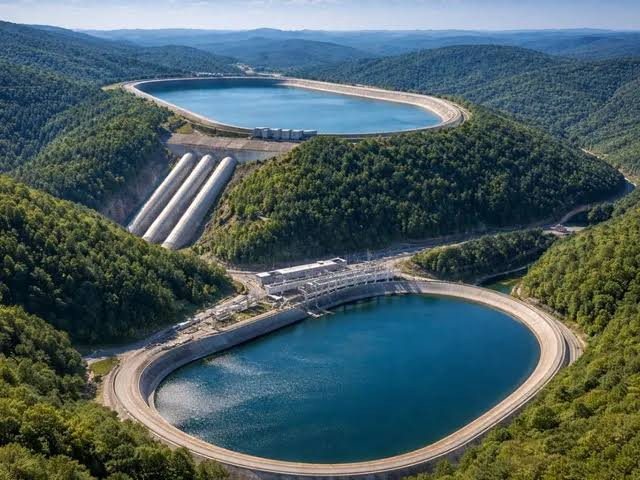
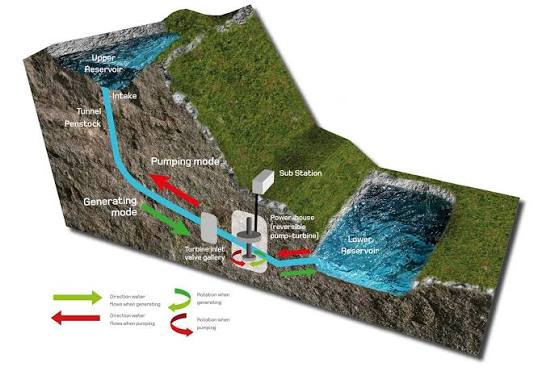
Pumped hydro storage (PHS) is a form of large-scale energy storage that uses electricity to move water from a lower reservoir to a higher reservoir.
When electricity is abundant and relatively inexpensive, electric pumps move water uphill.
Later, when electricity demand increases, the stored water is released back downhill. As it falls, it passes through hydroelectric turbines that generate electricity.
In simple terms:
Electricity → Pump → Water moves uphill → Water stores potential energy → Water flows downhill → Turbine → Electricity
The system is essentially converting electrical energy into gravitational potential energy and then converting it back into electricity.
The two-reservoir system
A conventional pumped hydro facility generally has:
- An upper reservoir
- A lower reservoir
- Pumps
- Turbines
- Generators
- Pipes or tunnels connecting the reservoirs
- Power electronics and grid connections
Some modern plants use reversible pump-turbines. These machines can operate in two directions.
During charging, they consume electricity and pump water uphill.
During discharge, water flows downhill through the same equipment and generates electricity.
How Does Pumped Hydro Storage Work?
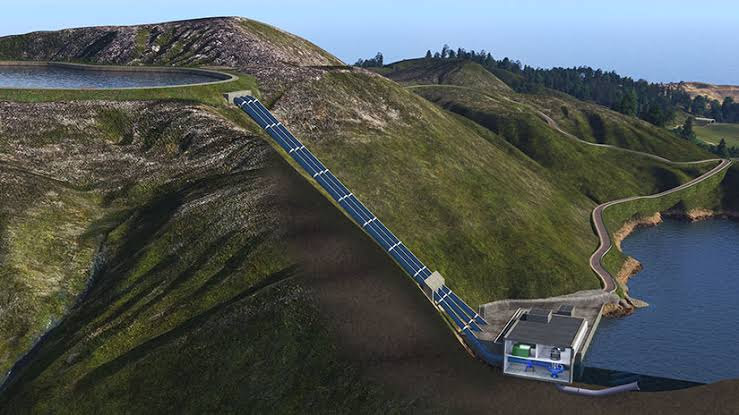
The easiest way to understand pumped hydropower is to imagine a massive rechargeable battery made from water.
1. Electricity is available
Suppose a solar farm is producing more electricity than the grid currently needs at midday.
Instead of wasting that excess electricity or reducing solar generation, the grid can use it to operate the pumps.
2. Water is pumped uphill
The pumps move water from the lower reservoir to the upper reservoir.
The electricity has now been converted into stored gravitational energy.
3. Energy sits in the reservoir
The water can remain in the upper reservoir until the grid needs additional electricity.
Unlike electricity sitting in a transmission line, the stored water can remain there for hours, days, or potentially longer depending on the system’s design and water-management constraints.
4. Demand increases
In the evening, electricity consumption may rise while solar production falls.
The pumped hydro facility can respond by releasing water from the upper reservoir.
5. Water spins turbines
Gravity pulls the water downhill through tunnels or penstocks.
The flowing water turns turbines connected to generators.
6. Electricity returns to the grid
The generated electricity can then help supply homes, businesses, factories, and other electricity consumers.
The cycle can be repeated.
Why Pumped Hydro Is Called a Giant Battery
Pumped hydro and batteries perform the same basic job: they store electricity and release it later.
The difference is how they store energy.
| Feature | Pumped Hydro | Lithium-Ion Battery |
|---|---|---|
| Storage medium | Water + gravity | Electrochemical cells |
| Typical application | Grid-scale | Grid, commercial, residential |
| Response speed | Very fast | Extremely fast |
| Storage duration | Hours to days in suitable designs | Usually hours, with longer systems possible |
| Lifespan | Often many decades | Typically much shorter |
| Energy capacity expansion | Requires large civil works | Add more battery modules |
| Geography | Highly important | Relatively flexible |
| Degradation | Low compared with batteries | Cells degrade over time |
| Materials | Mainly civil infrastructure and machinery | Battery minerals and materials |
| Best use | Large-scale bulk storage | Flexible short-duration storage |
Neither technology wins every category.
Lithium-ion batteries are much easier to deploy in many locations and can be installed quickly.
Pumped hydro, however, can provide enormous storage capacity and very long operating lives.
Why Pumped Hydro Storage Matters for Renewable Energy
Solar and wind have transformed electricity generation, but both are variable.
Solar production naturally falls to zero at night.
Wind generation changes according to weather conditions.
Electricity demand, meanwhile, doesn’t follow the same schedule.
This creates a mismatch.
Consider a typical sunny day.
Solar generation might peak around midday when many people are at work and electricity demand is moderate.
Later, around dinner time, electricity demand can remain high while solar generation rapidly falls.
This is sometimes called the duck curve problem.
Pumped hydro can help bridge that gap.
Instead of shutting down solar farms when electricity production exceeds demand, the grid can use some of that electricity to pump water uphill.
Then, when solar generation falls, the stored water can generate electricity.
This makes pumped hydro particularly useful as renewable generation increases.
Pumped Hydro + Solar
Solar power and pumped hydropower can work exceptionally well together.
During sunny periods:
Solar → Grid + Pumped Hydro
During evening demand:
Pumped Hydro → Grid
This allows excess daytime solar generation to become evening electricity.
A pumped hydro facility can therefore act as a large-scale time-shifting system.
Instead of asking solar power to generate electricity exactly when consumers need it, storage gives the grid more flexibility.
Pumped Hydro + Wind
Wind power presents a different challenge.
Wind farms can generate electricity during periods when demand is low.
For example, strong winds may occur overnight when electricity consumption is relatively low.
Pumped hydro can absorb some of that surplus electricity by pumping water uphill.
When wind generation decreases, stored water can be released.
This makes pumped hydro useful for smoothing the output of variable renewable generation.
Why Pumped Hydro Is So Reliable
One of pumped hydro’s biggest advantages is its maturity.
Hydroelectric technology has been used for well over a century, while pumped storage facilities have operated for many decades.
The fundamental engineering is well understood.
Pumped hydro plants don’t depend on electrochemical cells slowly losing capacity with every cycle in the same way batteries do.
A well-maintained facility can potentially operate for many decades.
The reservoirs, tunnels, turbines, generators, and electrical infrastructure may require maintenance and refurbishment, but the underlying concept is exceptionally durable.
This is one reason pumped hydro continues to occupy such an important position in grid scale energy storage.
Pumped Hydro Can Store Huge Amounts of Energy
One of pumped hydropower’s greatest strengths is scale.
A battery installation can be expanded by adding more battery containers and modules.
Pumped hydro scales differently.
A suitable site can provide a huge volume of stored water and substantial generation capacity.
The amount of energy stored depends primarily on:
- The amount of water
- The vertical height between reservoirs
- System efficiency
- Turbine and pump performance
The physics can be summarized roughly as:
Stored energy = water mass × gravity × height
That means a larger volume of water or a greater elevation difference can dramatically increase storage potential.
This is why mountainous regions and areas with suitable elevation differences have historically been attractive locations for pumped storage.
The Biggest Limitation: Geography
Pumped hydro has one major weakness that batteries don’t share to the same degree:
You need the right site.
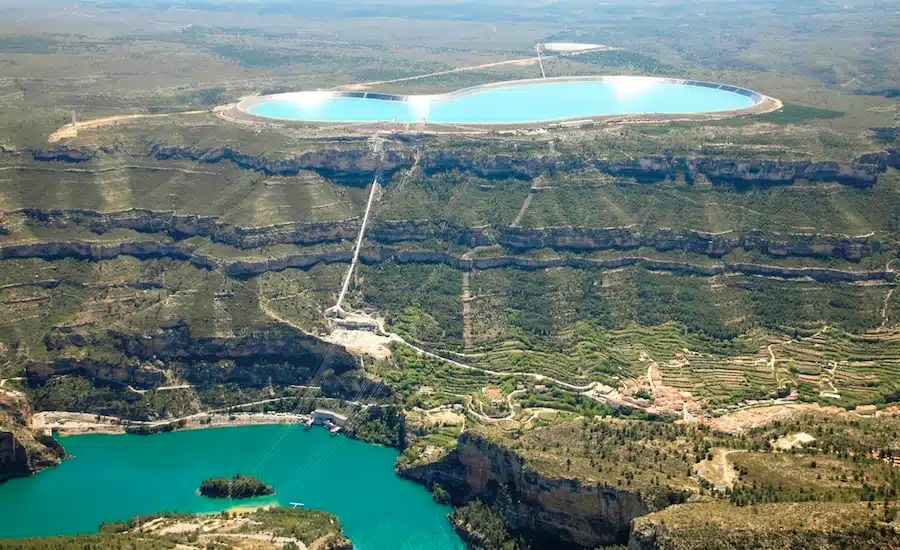
A project needs suitable elevation differences, reservoirs or locations where reservoirs can be constructed, geological conditions that support tunnels and infrastructure, access to transmission networks, and appropriate environmental and regulatory conditions.
Finding all these characteristics in one location can be difficult.
A city cannot simply decide to install a giant pumped hydro plant next to every solar farm.
Traditional projects can require:
- Large amounts of land
- Major tunnels
- Reservoir construction
- Roads and transmission infrastructure
- Significant capital investment
- Long development timelines
- Environmental assessment
- Water-management planning
This geographical constraint is the biggest reason pumped hydro cannot simply replace batteries everywhere.
What Is Closed-Loop Pumped Hydro?
One of the most interesting developments in pumped storage is the growth of closed-loop pumped hydro.
Traditional hydropower projects may be connected to existing rivers and water systems.
Closed-loop pumped storage is different.
Instead of continuously depending on a flowing river, the facility can operate primarily between two reservoirs that are separated from a major natural river system.
The same water is repeatedly circulated between the upper and lower reservoirs.
Think of it as a giant artificial water battery.
Why closed-loop designs matter
Closed-loop systems can potentially expand the number of locations where pumped hydro can be developed.
They can reduce dependence on existing river flows and allow developers to design storage facilities specifically around energy-system needs.
However, closed-loop does not mean environmentally impact-free.
Projects can still require substantial land, excavation, construction, transmission infrastructure, and water management.
The technology solves one geographic problem but doesn’t eliminate every permitting or environmental challenge.
Pumped Hydro vs Lithium-Ion Batteries
The question isn’t necessarily whether pumped hydro or batteries will win.
The more realistic question is:
Where should each technology be used?
Batteries are excellent for:
- Fast response
- Frequency regulation
- Short-duration storage
- Solar-plus-storage projects
- Distributed energy storage
- Urban installations
- Residential energy systems
- Projects that need relatively quick deployment
Pumped hydro is excellent for:
- Very large storage facilities
- Bulk energy shifting
- Long project lifetimes
- Large renewable grids
- Multi-hour storage
- Grid balancing
- Systems where suitable geography is available
A future electricity grid could use both.
Pumped Hydro vs Other Long-Duration Storage
Pumped hydro isn’t the only technology being developed for long-duration energy storage.
Other approaches include:
- Iron-air batteries
- Flow batteries
- Compressed-air energy storage
- Thermal energy storage
- Hydrogen
- Gravity-based systems
- Other mechanical storage technologies
Each has different strengths.
Pumped hydro has an enormous advantage in one area: commercial maturity at massive scale.
New technologies may eventually become cheaper or easier to deploy, but pumped storage already has decades of operational experience.
Major Pumped Hydro Projects Around the World
Pumped storage isn’t simply an old technology sitting in the background.
New projects are being proposed and constructed in countries including Australia, China, the United States, India, and across Europe.
Australia
Australia is becoming an especially interesting market for pumped hydro.
The country’s enormous solar and wind resources create a growing need for storage that can shift electricity across several hours and support the grid when renewable output changes.
Projects such as Snowy 2.0 are designed to provide large-scale pumped storage capacity and strengthen Australia’s renewable electricity system.
Other proposed pumped hydro projects are being developed in different Australian states, taking advantage of abandoned mines, reservoirs, and other potentially suitable sites.
The country’s transition toward a grid dominated by renewable electricity makes long-duration storage increasingly valuable.
China
China has been rapidly expanding pumped storage capacity as it builds enormous amounts of solar and wind generation.
This makes strategic sense.
When a country installs huge quantities of variable renewable generation, storage becomes increasingly important for balancing the system.
China has therefore become one of the world’s most important markets for pumped storage development.
Europe
Europe also has a long history of pumped hydropower.
Mountainous countries such as Switzerland and Austria have particularly favorable conditions.
Pumped storage can help integrate electricity from wind and solar while also supporting interconnected European electricity markets.
The Role of Pumped Hydro in India’s Renewable Future
India is rapidly expanding solar and wind power, making energy storage increasingly important.
Solar generation can be exceptionally strong during daylight hours but falls sharply after sunset.
That makes storage particularly useful for shifting daytime solar electricity toward evening demand.
India has geographical areas with potential for pumped storage development, and several projects have been proposed or are under development.
For India’s electricity system, pumped hydro could complement:
- Solar parks
- Rooftop solar
- Wind farms
- Transmission expansion
- Battery storage
- Hydropower
- Flexible thermal generation
The most effective solution is likely to be a portfolio rather than a single storage technology.
What Are the Advantages of Pumped Hydro Storage?
1. Massive scale
Pumped hydro can support extremely large storage facilities.
2. Long operating life
Major components can operate for decades with proper maintenance and refurbishment.
3. Proven technology
Unlike many emerging storage technologies, pumped storage has extensive real-world operating experience.
4. Fast response
Modern pumped storage plants can respond rapidly to changes in grid conditions.
5. Low self-discharge
Water stored at elevation doesn’t slowly disappear in the way an electrochemical battery gradually loses charge.
6. Renewable energy integration
Pumped storage can absorb excess solar and wind generation and release it later.
7. Grid stability
Pumped hydro can provide valuable grid services in addition to energy storage.
What Are the Disadvantages?
1. Geography
Suitable sites are limited.
2. High upfront costs
Building reservoirs, tunnels, turbines, roads, and transmission infrastructure can require substantial capital.
3. Long development periods
Large infrastructure projects can take many years from planning to operation.
4. Environmental impacts
Reservoir construction and major civil works can affect landscapes, habitats, water systems, and local communities.
5. Transmission requirements
A storage facility needs strong electrical connections to the grid to provide maximum value.
6. Water considerations
Although closed-loop systems can recycle water, projects still need appropriate initial water supplies and must account for evaporation and other losses.
Is Pumped Hydro More Efficient Than Batteries?
Not necessarily.
Modern lithium-ion batteries can achieve very high round-trip efficiencies.
Pumped hydro generally has lower round-trip efficiency because energy is lost during pumping, water movement, turbine operation, and electrical conversion.
However, efficiency is only one part of the equation.
A storage technology must also be evaluated based on:
- Cost per stored megawatt-hour
- Storage duration
- Lifetime
- Maintenance
- Degradation
- Site requirements
- Response time
- Environmental impact
- Grid services
A slightly less efficient technology can still be economically attractive if it lasts decades and stores enormous quantities of energy.
Why Pumped Hydro Isn’t Going Away
It might seem strange that a technology invented generations ago could become more important during the clean-energy transition.
But that is precisely what is happening.
Solar and wind are changing the electricity system.
The challenge is no longer simply generating renewable electricity.
It is increasingly about moving that electricity through time.
Pumped storage does exactly that.
It takes electricity available today and converts it into stored gravitational energy that can be used later.
That makes an old technology highly relevant to a modern grid.
The Future of Pumped Hydro Storage
The future of pumped hydropower will likely look different from its past.
Developers are exploring:
- Closed-loop reservoirs
- Former mining sites
- Existing reservoirs
- Underground storage concepts
- New pump-turbine designs
- Co-location with renewable energy
- Better grid-control systems
- Digital monitoring and predictive maintenance
The objective is not simply to build bigger dams.
It is to identify locations where storage can deliver the greatest value to a renewable electricity system.
This could mean pairing pumped hydro with large solar farms, wind projects, transmission networks, and other forms of energy storage.
The Bigger Picture: A Grid With Many Types of Storage
The clean-energy grid of the future probably won’t depend on one giant battery technology.
Instead, different technologies will perform different jobs.
Seconds: Batteries and grid-control technologies can respond almost instantly.
Hours: Lithium-ion batteries and pumped hydro can shift electricity from periods of high production to periods of high demand.
Longer durations: Pumped hydro, flow batteries, iron-air batteries, compressed air, hydrogen, and other technologies could play larger roles depending on cost and location.
This diversity is important.
A grid needs flexibility at multiple timescales.
Pumped hydro can be one of the foundations of that system.
Frequently Asked Questions About Pumped Hydro Storage
What is pumped hydro storage?
Pumped hydro storage is a form of energy storage that pumps water from a lower reservoir to a higher reservoir when electricity is available. When electricity is needed, the water flows downhill through turbines to generate electricity.
How does pumped hydropower store electricity?
It converts electricity into gravitational potential energy by moving water uphill. When electricity is needed, the water is released downhill and turbines convert its energy back into electricity.
Is pumped hydro the largest form of energy storage?
Yes. Pumped hydropower is widely recognized as the world’s largest form of installed grid-scale electricity storage by capacity, with global installed capacity around the 200 GW scale depending on the dataset and reporting year.
How long can pumped hydro last?
The physical infrastructure of pumped hydro facilities can operate for many decades. Major components can also be refurbished or replaced, extending the useful life of a facility.
Is pumped hydro renewable energy?
Pumped hydro is an energy-storage technology, not an energy source. It can store electricity generated by renewable sources such as solar and wind.
What is closed-loop pumped hydro?
Closed-loop pumped hydro generally uses two reservoirs that circulate water between them rather than relying on a continuously flowing natural river system.
Why isn’t pumped hydro used everywhere?
The biggest obstacle is geography. A project needs suitable elevation, geology, reservoirs, water resources, land, transmission access, and regulatory conditions.
Is pumped hydro better than lithium-ion batteries?
Neither is universally better. Batteries are highly flexible and can be deployed in many locations, while pumped hydro can provide enormous storage capacity and operate for decades. The best choice depends on the project.
Can pumped hydro store solar energy?
Yes. Excess solar electricity can power pumps during the day, moving water into an upper reservoir. The stored water can then generate electricity later, including during evening demand.
Can pumped hydro work with wind power?
Yes. Excess electricity from wind farms can be used to pump water uphill. The stored energy can later be released when wind production falls or electricity demand increases.
Final Verdict
Pumped hydro storage may be one of the most overlooked technologies in the clean-energy transition.
It isn’t new. It isn’t flashy. And it doesn’t receive the same attention as next-generation batteries.
But it solves a problem that every renewable-heavy electricity grid must address: how to store huge amounts of electricity and deliver it when generation and demand don’t match.
Its biggest weakness is also obvious. You can’t build a pumped hydro plant just anywhere.
But where suitable sites exist, the combination of enormous scale, rapid response, long operating life, and decades of operational experience makes pumped hydropower extremely valuable.
The future is unlikely to be pumped hydro versus batteries.
It will be pumped hydro plus batteries plus solar plus wind plus other storage technologies.
As renewable electricity becomes a larger part of the global power system, the giant water batteries already hiding in mountains and valleys may become far more important than they appear today.