
Green Ammonia: The Clean Fuel Powering the Next Energy Transition
As countries race toward net-zero emissions, one major challenge remains: decarbonizing industries that are difficult to electrify. Heavy shipping, fertilizer production, power generation, and long-term energy storage still rely heavily on fossil fuels. Green Ammonia
Green ammonia is emerging as one of the most promising solutions. Produced using renewable electricity instead of natural gas, it offers a carbon-free fuel that is easier to transport than hydrogen and can serve multiple industries.
Many experts now consider green ammonia a cornerstone of the future hydrogen economy because it can store renewable energy, transport hydrogen across continents, and reduce emissions from some of the world’s most polluting sectors. Green Ammonia

What Is Green Ammonia?
Green ammonia (NH₃) is ammonia produced using renewable energy rather than fossil fuels.
Traditional ammonia production depends on hydrogen derived from natural gas through steam methane reforming, releasing large amounts of carbon dioxide. Green Ammonia
Green ammonia replaces fossil-derived hydrogen with hydrogen produced through water electrolysis powered by:
- Solar energy
- Wind power
- Hydropower
- Geothermal energy
Because renewable electricity powers the entire process, greenhouse gas emissions are dramatically reduced.
Why Ammonia Matters
Ammonia is already one of the world’s most important industrial chemicals.
It is mainly used for:
- Fertilizer production
- Industrial chemicals
- Refrigeration
- Pharmaceuticals
- Mining
- Water treatment
Every year, more than 180 million tonnes of ammonia are produced worldwide, making it an established global commodity with existing infrastructure.
This existing supply chain makes green ammonia easier to commercialize than many emerging clean fuels.
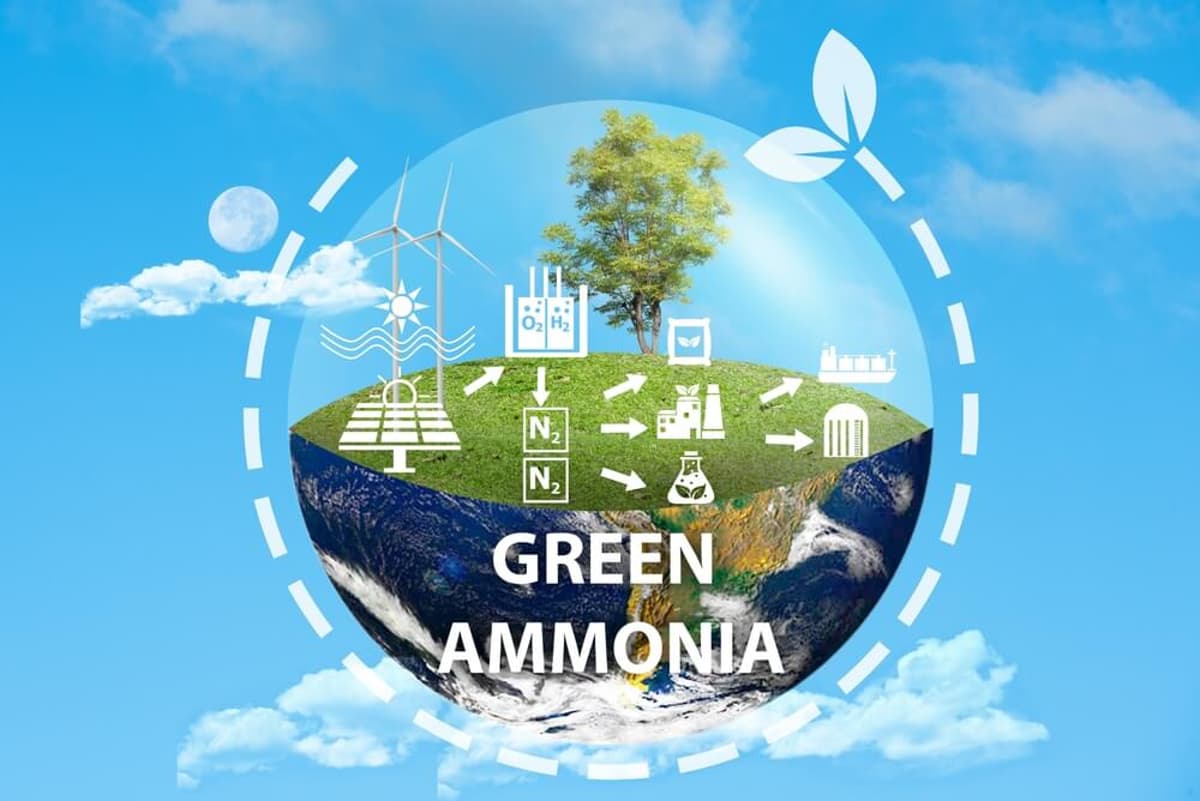
How Green Ammonia Is Produced

The production process involves three major steps.
Step 1: Renewable Electricity
Solar farms, wind farms, or hydroelectric plants generate clean electricity.
↓
Step 2: Green Hydrogen Production
Electricity powers electrolyzers that split water into:
- Hydrogen
- Oxygen
No carbon emissions occur during electrolysis.
↓
Step 3: Nitrogen Extraction
Nitrogen is separated from atmospheric air using air separation units.
↓
Step 4: Haber–Bosch Process
Hydrogen and nitrogen react under:
- High pressure
- High temperature
- Iron catalyst
Result:
NH₃ (Green Ammonia)
The Haber–Bosch process has been used for over 100 years, but green hydrogen makes the final product climate friendly.
Why Green Ammonia Is Important
1. Carbon-Free Fuel
When produced using renewable electricity, green ammonia has a much lower carbon footprint than conventional ammonia.
2. Easier Hydrogen Storage
Hydrogen is difficult to transport because it requires:
- Very low temperatures
- High-pressure tanks
- Specialized infrastructure
Ammonia stores hydrogen more efficiently and is easier to ship using existing infrastructure.
3. Long-Distance Energy Transport
Countries with abundant renewable resources can export green ammonia to energy-importing nations.
Examples include:
- Australia
- Saudi Arabia
- Chile
- Namibia
Potential importers include:
- Japan
- South Korea
- Germany
- Netherlands
4. Seasonal Energy Storage
Renewable electricity can be converted into ammonia during periods of surplus.
The ammonia can later be converted back into electricity when renewable generation is low.
This enables long-duration energy storage.
Green Ammonia in the Hydrogen Economy
Hydrogen is expected to become a major clean energy carrier.
However, transporting pure hydrogen remains expensive.
Green ammonia solves this problem by acting as a hydrogen carrier.
The process works as follows:
Renewable electricity
↓
Green hydrogen
↓
Green ammonia
↓
International shipping
↓
Ammonia cracking
↓
Hydrogen for industry or transportation
This allows renewable energy to be traded globally.
Applications of Green Ammonia
1. Shipping Fuel
Shipping accounts for nearly 3% of global CO₂ emissions.
Green ammonia offers several advantages:
- Zero carbon emissions at the point of use
- High energy density
- Existing global storage infrastructure
- Suitable for large cargo vessels
Major shipping companies are already ordering ammonia-ready vessels.
2. Fertilizer Industry
Traditional fertilizer manufacturing produces significant CO₂ emissions.
Replacing grey ammonia with green ammonia could substantially reduce emissions while maintaining agricultural productivity.
3. Power Generation
Green ammonia can be:
- Burned directly in turbines
- Co-fired with coal
- Used in gas power plants
- Converted into hydrogen for fuel cells
Several countries are testing ammonia-fired power stations.
Green Ammonia
4. Industrial Heat
Industries requiring high-temperature heat include:
- Cement
- Steel
- Chemicals
- Glass
Green ammonia could replace fossil fuels in these sectors.
5. Hydrogen Transport
Instead of shipping liquid hydrogen, companies can transport ammonia and convert it back into hydrogen at the destination. Green Ammonia
This significantly reduces transportation costs.
Global Investments in Green Ammonia
Governments and private companies are investing billions in green ammonia projects.
Australia
Large-scale renewable energy projects aim to become leading exporters of green ammonia to Asia.
Saudi Arabia
Massive integrated renewable hydrogen projects include green ammonia production for export markets.
India
India’s National Green Hydrogen Mission promotes domestic green ammonia production for fertilizers and exports.
Japan
Japan is investing heavily in ammonia co-firing technology for thermal power plants.
Europe
Germany and the Netherlands are developing import terminals and long-term supply agreements.
Benefits of Green Ammonia
- Near-zero lifecycle emissions
- Supports renewable energy integration
- Enables international hydrogen trade
- Existing global shipping infrastructure
- Long-term energy storage
- Reduces dependence on fossil fuels
- Helps decarbonize hard-to-abate industries
- Large export opportunity for renewable-rich countries
- Green Ammonia
Challenges
High Production Costs
Renewable hydrogen remains more expensive than fossil-derived hydrogen.
Electrolyzer Availability
Scaling production requires significant expansion of electrolyzer manufacturing.
Renewable Power Requirements
Large quantities of low-cost renewable electricity are needed.
Safety Concerns
Ammonia is toxic and requires careful handling, storage, and transportation.
Engine Development
Marine engines capable of efficiently using ammonia are still being commercialized.
Green Ammonia vs Grey Ammonia
| Feature | Green Ammonia | Grey Ammonia |
|---|---|---|
| Hydrogen Source | Water electrolysis | Natural gas |
| Carbon Emissions | Very low | High |
| Renewable Energy | Yes | No |
| Sustainability | Excellent | Poor |
| Production Cost | Higher today | Lower today |
Market Outlook
Global demand for green ammonia is expected to grow rapidly as countries pursue net-zero goals.
Key growth drivers include:
- Hydrogen exports
- Shipping decarbonization
- Renewable energy storage
- Fertilizer industry transformation
- Government incentives
- Carbon pricing mechanisms
As renewable electricity and electrolyzer costs continue to decline, green ammonia is expected to become increasingly cost-competitive. Green Ammonia
- Ammonia made by fossil fuels accounts for approximately 5% of world’s gas consumption.
- Industry reliance on ammonia necessitates shift to ‘green ammonia’ – produced using renewable hydrogen.The world is already completely dependent on ammonia. In fact, half of the world’s food production depends on it as it is a key component of mineral fertilizer.Green Ammonia
- Today, ammonia accounts for about 5% of the world’s gas consumption. If we can make ammonia from renewable energy (green ammonia) profitable, we will help decarbonize food and take a big step towards a hydrogen economy.
- But we won’t just decarbonize food with green fertilizer; we will also be able to decarbonize fuel for shipping.Green Ammonia
- What is green ammonia?
- The equation for ammonia looks something like this:Green Ammonia
- Power (gas or other source) + water (electrolysis) = hydrogen + nitrogen = ammonia
- If we swap the gas currently used as a power source to make hydrogen with renewable energy—hydro-electric, solar power or wind turbines—we have the equation for green ammonia.

Frequently Asked Questions (FAQs)
Is green ammonia carbon neutral?
Green ammonia can achieve very low lifecycle emissions when produced using renewable electricity and green hydrogen. Green Ammonia
Why is ammonia easier to transport than hydrogen? Green Ammonia
Ammonia liquefies at much higher temperatures than hydrogen, making storage and shipping simpler and less expensive.
Can green ammonia be used as fuel?
Yes. It can power ships, turbines, industrial boilers, and can also be converted back into hydrogen for fuel cells.
Is green ammonia safe?
Ammonia is toxic and requires strict safety procedures, but it has been transported safely worldwide for decades using established infrastructure.Green Ammonia
Which countries are leading green ammonia development?
Australia, Saudi Arabia, India, Japan, Germany, the Netherlands, and Chile are among the leading nations investing in green ammonia projects.
Conclusion
Green ammonia is rapidly emerging as one of the most versatile clean fuels for the global energy transition. By combining renewable electricity, green hydrogen, and established ammonia production methods, it provides a practical pathway to decarbonize shipping, fertilizer manufacturing, industrial heat, and long-duration energy storage.Green Ammonia
While challenges such as production costs, infrastructure expansion, and safety remain, accelerating investments and technological advancements are making green ammonia increasingly competitive. As nations strengthen their net-zero commitments and renewable energy capacity continues to grow, green ammonia is poised to become a critical link between clean power generation, global hydrogen trade, and sustainable industrial development.
Green Ammonia, Green Hydrogen, Renewable Energy, Hydrogen Economy, Clean Fuel, Sustainable Energy, Energy Storage, Shipping Fuel, Fertilizer Industry, Net Zero, Decarbonization, Renewable Technology, Future Fuels, Industrial Energy, Clean Technology
Green Ammonia, Green Hydrogen, Renewable Energy, Hydrogen Economy, Clean Fuel, Sustainable Energy, Energy Storage, Shipping Fuel, Fertilizer Industry, Net Zero, Decarbonization, Renewable Technology, Future Fuels, Industrial Energy, Clean Techn