
The Missing Piece of Renewable Energy: Long-Duration Energy Storage
Renewable energy is transforming the global electricity sector. Solar panels and wind turbines are now among the cheapest sources of new electricity generation. However, renewable energy has one major limitation—it doesn’t produce power continuously. follow for more
Solar power disappears after sunset, and wind generation depends on weather conditions. As countries increase their reliance on renewable energy, balancing electricity supply and demand becomes increasingly difficult.
This is where Long-Duration Energy Storage (LDES) becomes one of the most important technologies of the clean energy transition.
Unlike conventional batteries designed for a few hours of backup, LDES systems can store electricity for 8 hours, 24 hours, several days, or even weeks, ensuring reliable clean energy whenever it is needed.
In this guide, we’ll explore how long-duration energy storage works, the leading technologies, real-world applications, economic benefits, challenges, and why experts consider it essential for achieving global net-zero emissions.
What Is Long-Duration Energy Storage?
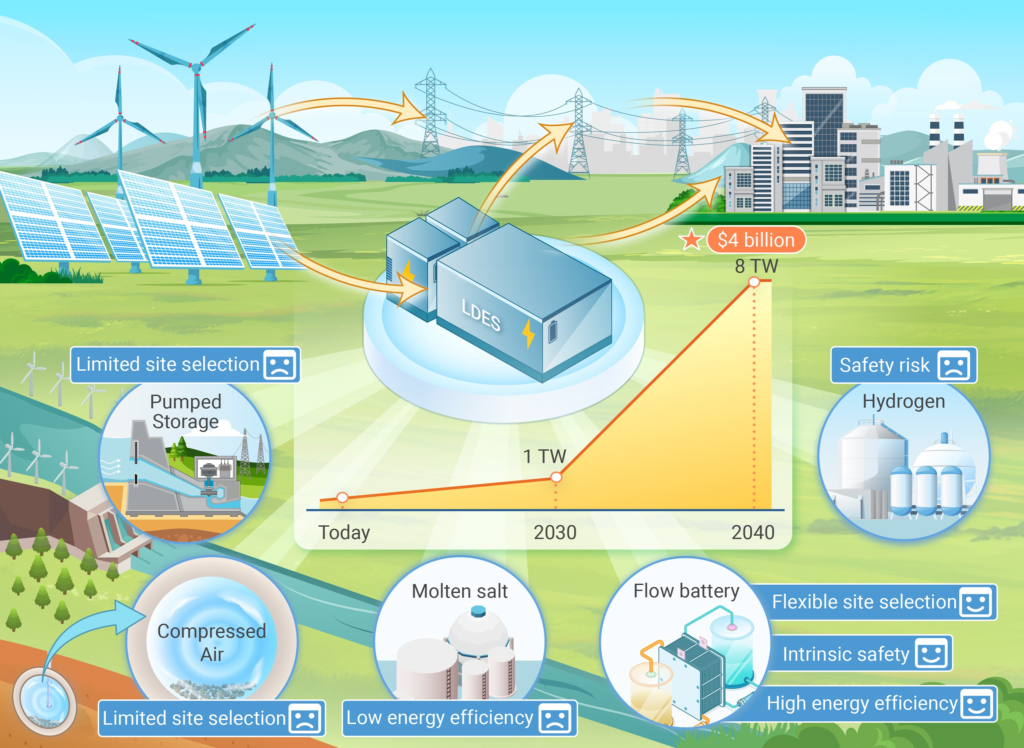
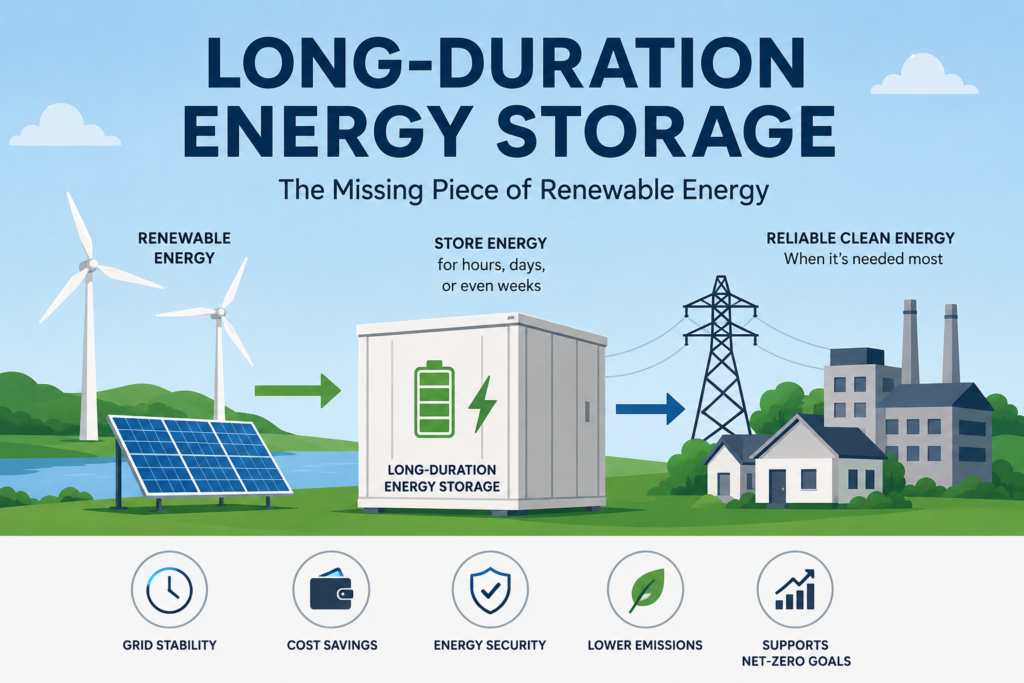
Long-Duration Energy Storage refers to technologies capable of storing electricity for more than eight hours, with some systems capable of delivering power for multiple days.
The stored energy can later be discharged when renewable generation drops or electricity demand peaks.
LDES helps transform intermittent renewable energy into dependable, around-the-clock electricity.
Why Renewable Energy Needs Long-Duration Storage
Renewable energy production rarely matches electricity demand.
For example:
- Solar farms generate maximum electricity during midday.
- Electricity demand usually peaks in the evening.
- Wind farms often produce excess electricity overnight.
- Seasonal weather changes affect renewable generation.
Without adequate storage:
- Renewable electricity is wasted (curtailment)
- Fossil-fuel power plants remain on standby
- Electricity prices become volatile
- Grid reliability decreases
Long-duration storage solves these problems by shifting renewable electricity across hours, days, or even seasons.
Types of Long-Duration Energy Storage Technologies
1. Pumped Hydroelectric Storage
Pumped hydro is currently the world’s largest form of energy storage.
How it works
During periods of excess electricity:
- Water is pumped uphill into a reservoir.
When electricity is needed:
- Water flows downhill.
- Turbines generate electricity.
Advantages
- Proven technology
- Very large capacity
- Low operating costs
- Lifespan exceeding 50 years
- High efficiency
Limitations
- Requires suitable geography
- High construction costs
- Long permitting process
2. Flow Batteries
Flow batteries store energy inside liquid electrolytes contained in external tanks.
Unlike lithium-ion batteries, increasing storage capacity simply requires larger electrolyte tanks.
Advantages
- Long lifespan
- Minimal degradation
- Non-flammable
- Easy scalability
- Suitable for 10–24 hours of storage
Challenges
- Lower energy density
- Higher upfront cost
3. Compressed Air Energy Storage (CAES)
CAES stores electricity by compressing air into underground caverns or pressure vessels.
When power is needed:
- Compressed air is released.
- It drives turbines that generate electricity.
Benefits
- Very large storage capacity
- Long operating life
- Low storage cost
Challenges
- Limited suitable locations
- Moderate efficiency
4. Liquid Air Energy Storage (LAES)
Electricity is used to cool air into a liquid at extremely low temperatures.
Later:
- Liquid air warms.
- Expands rapidly.
- Drives turbines.
Advantages include:
- No geographical constraints
- Uses readily available materials
- Suitable for grid-scale storage
5. Thermal Energy Storage
Instead of storing electricity directly, thermal systems store heat or cold.
Common materials include:
- Molten salt
- Rocks
- Sand
- Concrete
- Phase-change materials
Thermal storage is widely used with concentrated solar power plants and industrial heating.
6. Hydrogen Energy Storage

Excess renewable electricity powers electrolyzers that split water into hydrogen.
The hydrogen can later be:
- Burned in turbines
- Used in fuel cells
- Stored for months
- Transported long distances
Hydrogen is particularly valuable for seasonal energy storage.
7. Gravity Energy Storage
Gravity storage lifts heavy blocks or weights using excess electricity.
When electricity is required:
- The weights descend.
- Their movement drives generators.
This emerging technology offers:
- Long life
- Low maintenance
- Minimal environmental impact
Comparison of Major LDES Technologies
| Technology | Typical Duration | Best Use Case |
|---|---|---|
| Pumped Hydro | 8–100+ hours | Grid balancing |
| Flow Batteries | 8–24 hours | Renewable integration |
| Compressed Air | 10–100 hours | Utility-scale storage |
| Liquid Air | 10–100 hours | Large grids |
| Thermal Storage | Hours to days | Industrial heat & solar |
| Hydrogen Storage | Days to months | Seasonal storage |
| Gravity Storage | 8–24 hours | Renewable backup |
Applications of Long-Duration Energy Storage
Renewable Energy Integration
LDES stores surplus solar and wind electricity that would otherwise be wasted.
Peak Demand Management
Stored electricity is supplied during evening demand peaks, reducing reliance on expensive peaker plants.
Grid Stability
Storage provides:
- Frequency regulation
- Voltage support
- Backup power
- Black-start capability
Disaster Resilience
LDES improves resilience during:
- Hurricanes
- Wildfires
- Snowstorms
- Grid failures
Industrial Energy Supply
Large industries require continuous electricity.
Long-duration storage enables factories to operate using renewable energy even when weather conditions change.
Microgrids

Remote communities and islands can operate with solar, wind, and storage instead of diesel generators.
Economics of Long-Duration Energy Storage
Historically, LDES systems were expensive.
However, costs are declining due to:
- Improved manufacturing
- Larger deployments
- Better materials
- Increased competition
Economic benefits include:
- Lower electricity prices
- Reduced renewable energy curtailment
- Deferred grid upgrades
- Reduced fossil fuel consumption
- Increased renewable energy utilization
Many analysts expect LDES to become a multi-trillion-dollar global industry over the coming decades.
Challenges Facing Long-Duration Storage
Despite enormous potential, several barriers remain.
High Initial Investment
Many technologies require significant capital expenditure.
Policy Support
Electricity markets often reward power generation rather than storage services.
Technology Maturity
Some emerging storage technologies remain at demonstration or pilot stages.
Infrastructure Requirements
Large-scale deployment requires:
- New transmission
- Grid modernization
- Updated regulations
Role in Achieving Net-Zero Emissions
Most climate models show that achieving net-zero emissions requires:
- Massive renewable energy deployment
- Electrification of transport
- Electrification of industry
- Flexible electricity systems
Without long-duration storage, renewable energy alone cannot provide reliable electricity 24/7.
LDES reduces dependence on natural gas and coal while enabling a cleaner, more resilient energy system.
Future Outlook
Governments and private companies are investing billions of dollars in long-duration storage technologies.
Future trends include:
- Lower storage costs
- New battery chemistries
- Green hydrogen expansion
- AI-powered energy management
- Grid-scale deployment worldwide
- Increased renewable penetration
Experts predict LDES will become one of the most important components of future power systems.
Conclusion
Long-Duration Energy Storage is the missing link between renewable energy generation and reliable electricity supply. By storing excess solar and wind power for hours, days, or even months, these technologies make clean energy available whenever it is needed.
Whether through pumped hydro, flow batteries, compressed air, hydrogen, thermal storage, or gravity-based systems, LDES will play a central role in building resilient, affordable, and carbon-free power grids.
As the world accelerates toward net-zero emissions, long-duration energy storage will no longer be an optional technology—it will become a fundamental pillar of the global energy transition.
Frequently Asked Questions (FAQs)
What is long-duration energy storage?
It refers to energy storage technologies that can deliver electricity for more than eight hours, helping balance renewable energy supply and demand.
Why is long-duration storage important?
It enables renewable energy to provide reliable electricity even when the sun isn’t shining or the wind isn’t blowing.
Which technology is most widely used today?
Pumped hydroelectric storage remains the most common long-duration energy storage technology worldwide.
Can hydrogen be used for long-duration storage?
Yes. Green hydrogen can store renewable energy for weeks or even months, making it ideal for seasonal energy storage.
Will long-duration storage replace lithium-ion batteries?
Not entirely. Lithium-ion batteries are ideal for short-duration applications, while long-duration storage complements them by providing backup over extended periods.