
What Is Net Metering?
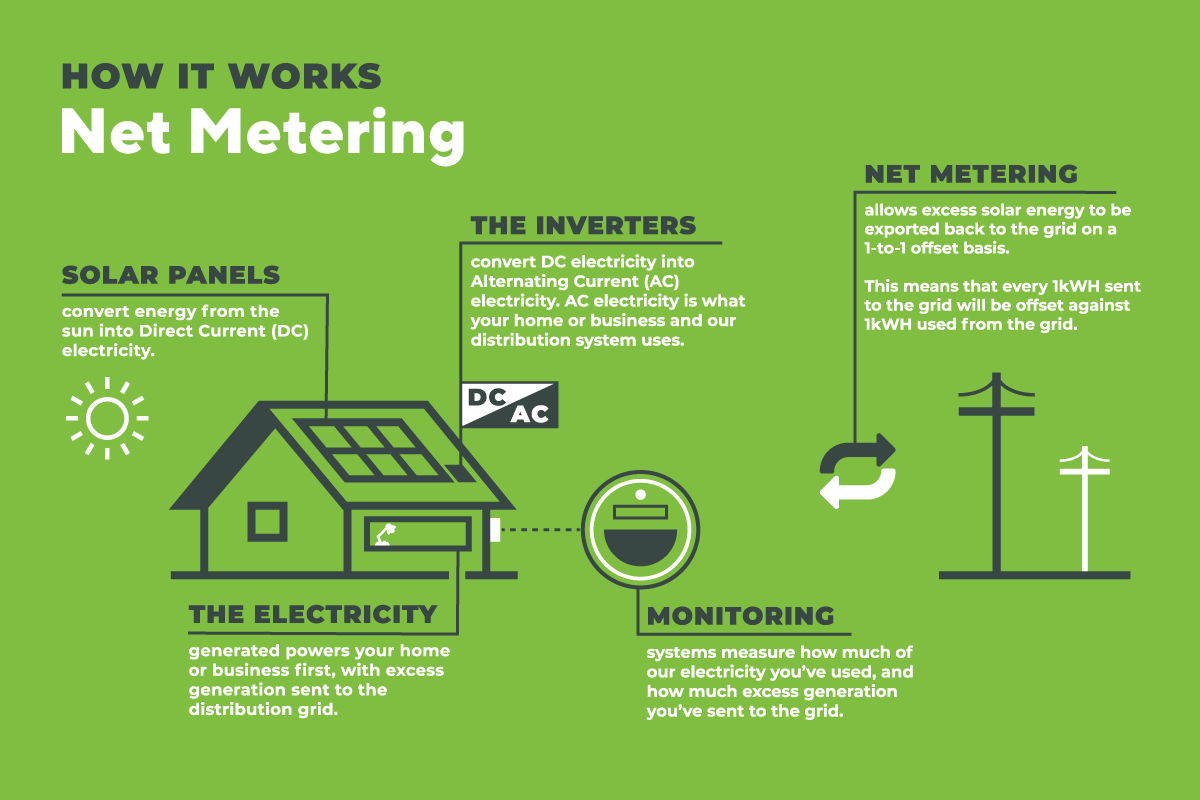
If you are considering rooftop solar, you have probably heard the term net metering.
But what is net metering, exactly?
Net metering is a billing arrangement that allows a rooftop solar owner to send unused electricity to the power grid and receive credits for that exported electricity. Those credits can then reduce the amount you owe on your electricity bill.
In simple terms:
Solar panels produce electricity → your home uses what it needs → extra electricity goes to the grid → your meter records the export → you receive a bill credit.
The important detail is that net metering rules are not the same everywhere. Your savings depend on your electricity provider, state or country, system size, export rate, credit rules, and the type of solar billing program available to you.
The U.S. Department of Energy notes that whether a solar customer qualifies for net-metering payments depends on state and utility policies, including system-size limits, eligible customer types, rates and bill-credit structures. (The Department of Energy’s Energy.gov)
How Does Net Metering Work?
Understanding how net metering works is easier if you imagine your home connected to two energy sources:
- Your rooftop solar system
- The electricity grid
Your solar panels generate electricity during daylight hours.
Step 1: Your solar panels generate electricity
During sunny hours, your solar panels produce electricity.
For example, suppose your solar system generates:
20 kWh per day
Your home may use:
12 kWh
That leaves:
8 kWh of excess electricity.
Step 2: Your home uses solar power first
The electricity generated by your panels is normally used by your appliances first.
For example:
- Refrigerator → solar power
- Fans → solar power
- Air conditioner → solar power
- Washing machine → solar power
Using your own solar electricity is generally valuable because you avoid buying that electricity from the grid.
Step 3: Excess electricity goes to the grid
If your solar panels produce more electricity than your home needs at that moment, the excess electricity can flow into the electricity network.
This is called exporting electricity.
For example:
Solar generation: 20 kWh
Home consumption: 12 kWh
Export: 8 kWh
Step 4: A bidirectional meter records electricity flow

A traditional electricity meter primarily records electricity coming into your home.
A solar installation may use a bidirectional meter, which can measure electricity flowing in both directions:
Grid → Home
and
Home → Grid
This allows the utility to calculate how much electricity you consumed from the grid and how much your solar system exported.
The old idea of net metering involved the meter literally “running backward,” but modern systems generally use digital meters that separately measure imports and exports. (The Department of Energy’s Energy.gov)
How Net Metering Affects Your Electricity Bill
Here’s a simplified example.
Imagine that during one billing period:
| Electricity activity | Amount |
|---|---|
| Electricity imported from grid | 500 kWh |
| Solar electricity exported | 300 kWh |
| Net electricity | 200 kWh |
Under a traditional retail-rate net-metering structure, you may effectively be billed based on the net amount:
500 kWh − 300 kWh = 200 kWh
If your applicable energy rate were $0.15/kWh:
200 × $0.15 = $30
That’s a simplified illustration. Real bills can include fixed charges, taxes, demand charges, time-of-use rates and other fees.
This is why having solar does not necessarily mean your electricity bill becomes zero.
Net Metering vs. Net Billing
One of the most important things to understand before buying solar is the difference between net metering and net billing.
They sound similar, but they can produce very different savings.
| Feature | Net Metering | Net Billing |
|---|---|---|
| Solar used at home | Offsets electricity purchases | Offsets electricity purchases |
| Excess solar | Exported to grid | Exported to grid |
| Export compensation | Often close to retail electricity rate | Often lower than retail rate |
| Bill savings | Usually higher | Often lower |
| Battery value | Helpful | Can be especially valuable |
| Availability | Depends on location | Increasingly common in some markets |
Net metering
With net metering, exported electricity may receive credits based on the retail electricity rate, depending on the local rules.
For example:
Grid electricity price = $0.20/kWh
If exported solar receives:
$0.20/kWh
then exporting 10 kWh could create:
10 × $0.20 = $2.00 in credits
Net billing
Under net billing, your exported electricity is generally valued separately from the electricity you purchase.
The export rate could be significantly lower than the retail electricity price.
For example:
Electricity you buy = $0.25/kWh
but:
Electricity you export = $0.08/kWh
In that situation, using solar electricity directly in your home is much more valuable than exporting it.
California provides a useful real-world example. New customers under its current Net Billing Tariff receive export credits based on the value of exported electricity to the grid, and those credits are generally lower than retail electricity prices. (webtest.cpuc.ca.gov)
Net Metering Explained With a Simple Example
Suppose you have a rooftop solar system producing 600 kWh in a month.
Your home consumes 700 kWh.
Of the solar electricity:
- 400 kWh is used directly in your home
- 200 kWh is exported to the grid
You then import 300 kWh from the grid.
So:
700 kWh consumption − 400 kWh direct solar = 300 kWh grid imports
Under a simple net-metering model where exports and imports receive equal energy credits, the exported 200 kWh can offset part of your grid purchases.
The exact bill calculation depends on the local tariff.
How Much Can You Save With Net Metering?
There isn’t one universal answer.
Your savings depend on several factors:
- Solar system size
- Electricity production
- Household electricity consumption
- Retail electricity rate
- Export compensation
- Net-metering rules
- Fixed monthly charges
- Time-of-use rates
- System export limits
- Battery storage
- Utility fees
A simple calculation is:
Solar savings from self-consumption
Solar electricity used at home × electricity purchase rate
For example:
400 kWh × $0.20 = $80
You avoided buying $80 worth of electricity.
Export credit
If you export 200 kWh and receive $0.10/kWh:
200 × $0.10 = $20
Your approximate energy-related benefit would therefore be:
$80 + $20 = $100
This is before fixed charges, taxes and other bill components.
A Simple Formula for Solar Savings
You can estimate your monthly solar benefit using:
Solar savings = self-consumed solar × retail electricity rate + exported solar × export rate
For example:
- Self-consumed solar = 400 kWh
- Retail electricity rate = $0.20/kWh
- Exported solar = 200 kWh
- Export rate = $0.10/kWh
Calculation:
400 × $0.20 = $80
200 × $0.10 = $20
Estimated monthly benefit = $100
Over one year:
$100 × 12 = $1,200
Again, this is an example rather than a guaranteed return. Electricity prices, solar generation and export rates can change.
Net Metering in India
India’s rooftop solar market uses a mixture of regulatory approaches, and the exact rules can vary by state and distribution company.
The Ministry of New and Renewable Energy maintains state-level policy and regulatory information, illustrating why consumers should check their local electricity regulator and distribution company rather than assuming one nationwide billing arrangement applies everywhere. (Ministry of New and Renewable Energy)
India has also seen rapid growth in grid-connected rooftop solar. MNRE reported approximately 30.11 GW of grid-connected rooftop solar capacity as of June 30, 2026. (Ministry of New and Renewable Energy)
For an Indian homeowner, the important questions are:
- Is net metering available for my connection?
- What is the maximum eligible system size?
- What happens to excess generation?
- What is the applicable export-credit mechanism?
- Are there fixed charges on the bill?
- Is a bidirectional meter required?
- What approvals are required?
- Are there state-specific limits?
- What happens to unused credits at the end of the billing period?
These rules can change, so check your state electricity regulatory commission and DISCOM before signing a solar contract.
Net Metering in the United States
The United States does not have one single nationwide net-metering policy.
Instead, rules can differ between:
- States
- Utilities
- Electricity cooperatives
- Municipal utilities
The U.S. Department of Energy specifically recommends checking your local utility’s rules for availability, system-size eligibility, rates and bill-credit design. (The Department of Energy’s Energy.gov)
The policy landscape has also been changing.
Research from the National Laboratory of the Rockies found that 12 U.S. states had replaced traditional net metering with alternative structures by the end of 2023, reducing the bill savings available to some solar customers. The share of U.S. households living in states requiring net metering fell from about 84% in 2014 to about 57% by the end of 2023. (Research Hub)
California is a well-known example of this transition. Its current Net Billing Tariff replaced the previous standard NEM structure for new interconnections beginning April 15, 2023. (webtest.cpuc.ca.gov)
Net Metering in Australia
Australia generally uses feed-in tariffs rather than relying on a single nationwide net-metering system.
When a rooftop solar system produces more electricity than the home is using, the excess can be exported to the grid. The electricity retailer then provides a credit based on the applicable feed-in tariff.
The Australian Government explains that feed-in tariffs vary between retailers, states and territories. (Energy.gov.au)
This creates an important difference from traditional retail-rate net metering.
Suppose:
Grid electricity price = 30 cents/kWh
but:
Solar feed-in tariff = 8 cents/kWh
Using 1 kWh of solar electricity yourself could avoid purchasing 30 cents of electricity, while exporting that same 1 kWh might earn only 8 cents.
That’s why Australian government guidance recommends maximizing solar self-consumption where possible. (Energy.gov.au)
Why Are Utilities Changing Net-Metering Policies?
This is one of the biggest debates surrounding rooftop solar.
Traditional net metering can provide significant value to solar owners because exported electricity receives relatively generous credits.
Utilities and regulators have argued that electricity grids have costs that don’t disappear when customers install solar, including:
- Transmission infrastructure
- Distribution networks
- Grid maintenance
- Metering
- Backup generation
- Customer service
- System reliability
Utilities may therefore argue that customers exporting electricity should not receive the full retail electricity rate.
Solar advocates, meanwhile, argue that rooftop solar can provide benefits to the grid, including generating electricity close to where it is consumed and reducing demand for some centralized generation.
Research does not support a simple “solar is always raising everyone’s bills” conclusion. A 2025 NREL study found that estimated rate impacts from net metering were below 1% of typical customer bills in 37 of 44 states that had offered net metering at the end of 2023, and it found no clear consistent relationship between the timing of policy revisions and estimated rate impacts. (Research Hub)
The debate is therefore more complicated than simply saying “utilities are eliminating net metering because solar is bad for the grid.”
Policy changes can reflect different priorities, electricity-market conditions and regulatory decisions.
Does Net Metering Still Make Solar Worth It?
Yes, it can—but you should not assume that installing solar automatically guarantees the same savings it did under older net-metering programs.
The economics are increasingly influenced by when you generate electricity and when you use it.
For example, a household that uses most electricity during the afternoon may directly consume a large portion of its solar production.
Another household that uses most electricity at night may export a lot of solar electricity during the day and then buy electricity back from the grid later.
If exported electricity receives a low credit, the second household may benefit more from:
- Battery storage
- Smart appliances
- Electric vehicle charging during solar hours
- Running washing machines during the day
- Water heating during solar production
- Load shifting
Australia’s government guidance similarly notes that self-consumed solar generally provides greater savings than exported electricity when feed-in tariffs are below retail electricity rates. (Energy.gov.au)
What Should You Check Before Buying Solar?
Don’t choose a solar system based only on the panel price.
Before signing a contract, ask for the following information in writing.
1. What is the export rate?
Find out exactly how much you receive for each kWh exported.
2. Is it true net metering?
Don’t assume that “solar credits” automatically mean traditional net metering.
Ask whether exported electricity receives:
- Retail-rate credits
- Wholesale-rate credits
- A fixed feed-in tariff
- Time-based credits
- Another compensation rate
3. What happens to unused credits?
Some programs allow credits to roll over.
Others may reset them after a specific period or compensate them differently.
4. Are there export limits?
Your utility may restrict how much solar electricity your system can send to the grid.
Australia’s government guidance notes that electricity above an agreed export limit can be curtailed, meaning you may not receive a credit for it. (Energy.gov.au)
5. Are there fixed charges?
Even with a large amount of solar generation, you may still have:
- Connection charges
- Meter charges
- Service fees
- Taxes
- Other fixed charges
6. What happens if the rules change?
Ask whether your existing tariff is protected for a particular period or whether future regulatory changes could affect your compensation.
7. Would a battery improve your economics?
A battery isn’t automatically worthwhile.
But if export compensation is low and you use lots of electricity after sunset, storage can potentially increase the amount of solar electricity you use yourself.
Net Metering: Pros and Cons
Advantages
Lower electricity bills: Solar generation can offset electricity purchases.
Better value for excess solar: Traditional net metering can provide relatively generous credits.
Simple concept: Your imported and exported electricity are measured through the billing system.
Greater solar ROI: Higher export compensation can shorten the payback period.
Encourages rooftop solar: Net metering can make residential solar financially attractive.
Disadvantages
Rules vary: Your neighbor may have a different tariff from you.
Policies can change: New solar customers may receive different compensation from earlier customers.
Export rates may be lower: Net billing and feed-in tariffs can pay less than retail electricity prices.
Fixed charges remain: Solar doesn’t necessarily eliminate every part of your electricity bill.
Export limits: Your utility may restrict how much electricity you can send to the grid.
Battery economics can change: A lower export rate may make battery storage more attractive, but batteries also add upfront cost.
Frequently Asked Questions About Net Metering
What is net metering in simple terms?
Net metering is a billing system that gives rooftop solar owners credits for electricity they send to the grid. Those credits can reduce electricity charges, depending on local rules.
Does net metering mean the utility pays me cash?
Not necessarily.
In many programs, excess solar creates bill credits rather than a direct cash payment. The treatment of unused credits depends on the local utility or regulator.
Is net metering the same as net billing?
No.
Traditional net metering generally provides credits for exported electricity that can be close to the retail electricity rate. Net billing usually compensates exported electricity using a separate export rate that can be lower.
Do I need a bidirectional meter?
For a grid-connected solar system that imports and exports electricity, a meter capable of measuring both directions is generally required.
Your utility or distribution company determines the approved meter and installation process.
Can net metering make my electricity bill zero?
It can potentially reduce the energy portion of your bill substantially, but a zero bill is not guaranteed.
Fixed charges, taxes, minimum charges and other fees may remain.
Is net metering available everywhere?
No.
Availability, system-size limits, export compensation and credit rules depend on the country, state, regulator and electricity provider.
Is net metering better than a feed-in tariff?
It depends on the rates.
If net metering gives you a retail-rate credit while a feed-in tariff pays a much lower export rate, net metering can be more valuable.
But the actual answer depends on your electricity consumption and local tariff.
Does a battery replace net metering?
No.
A battery stores electricity so you can use it later. Net metering or another export-compensation program determines how exported electricity is valued.
You can potentially use both.
Final Takeaway: Is Net Metering Good for Solar Owners?
Net metering can significantly improve the economics of rooftop solar, but the exact benefit depends on your local electricity rules.
The basic idea is simple:
Generate solar power → use it at home → export excess → receive credits → reduce your electricity bill.
But modern solar billing is becoming more complicated.
Some markets continue to offer traditional net metering, while others are moving toward net billing, feed-in tariffs or time-based export compensation. In Australia, for example, feed-in tariffs vary by retailer and location, while in the U.S., net-metering policies vary by state and utility. India also has state- and DISCOM-specific regulatory considerations. (Energy.gov.au)
The biggest mistake is buying solar before understanding your electricity tariff.
Before investing, find out:
How much do I pay for electricity?
How much will I receive for exported solar?
How long do credits last?
Is there an export limit?
What fixed charges remain?
Would a battery or more self-consumption improve the savings?
Once you know those numbers, you can calculate a much more realistic solar payback period instead of relying on a generic “solar saves money” estimate.
SEO Tags
net metering, net metering explained, what is net metering, how net metering works, net metering vs net billing, rooftop solar net metering, solar electricity bill, solar bill credits, solar export rate, rooftop solar savings, solar net billing, solar feed in tariff, solar energy, solar panels
Suggested Internal Links
For a solar-focused website, link this article to related pages such as:
- How Solar Panels Work
- Rooftop Solar Cost in 2026
- Solar Panel Payback Period
- On-Grid vs Off-Grid vs Hybrid Solar Systems
- Solar Battery Storage Cost
- Rooftop Solar Grid Connection Rules in India
- Best Solar Panel Brands in India 2026
This gives the article a strong internal-linking structure while targeting several related search queries.