
Introduction: The Next Big Step in Offshore Wind
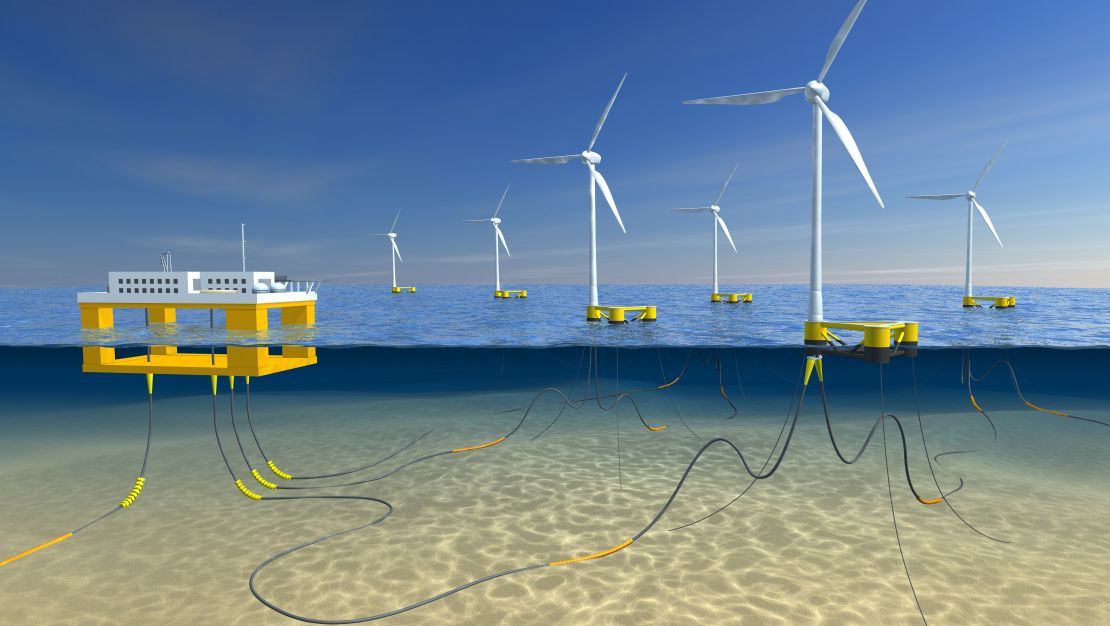
Offshore wind has already transformed the renewable energy industry. Huge turbines installed in the sea can capture stronger and more consistent winds than many land-based projects. But conventional offshore wind has an important limitation: the seabed eventually becomes too deep and expensive for fixed foundations.
That is where floating offshore wind comes in.
Instead of permanently fixing a turbine to the seabed, a floating wind turbine sits on a buoyant platform that is held in position by mooring cables and anchors. This allows turbines to operate much farther offshore and in waters hundreds of metres deep.
The opportunity is enormous. Industry and government studies have estimated that roughly 80% of the world’s offshore wind resource is located in waters better suited to floating technology, although the exact percentage varies depending on the depth threshold and methodology used. (Springer)
In other words, floating wind could open an entirely new part of the world’s offshore energy map.
What Is Floating Offshore Wind?
Floating offshore wind is a form of offshore wind power in which turbines are mounted on floating platforms instead of foundations attached directly to the seabed.
A traditional offshore turbine typically uses a monopile, jacket or another fixed foundation. These structures work particularly well in relatively shallow water.
A floating wind turbine works differently:
Wind → Turbine → Floating platform → Mooring system → Subsea cable → Electricity grid
The platform floats on the ocean surface while anchors and mooring lines keep it within a defined area.
The technology is especially attractive in countries where deep water begins relatively close to shore. Japan, Portugal, parts of the United States, Norway and the western coastlines of Europe are examples where floating wind can expand the usable offshore resource. The International Energy Agency notes that some of the richest offshore wind resources are in deep water where seabed-mounted turbines are impractical. (IEA)
Why Go Floating?

The basic reason is simple: deep water often means better access to wind.
As you move farther offshore, several advantages can appear:
- Stronger average wind speeds
- More consistent wind conditions
- Larger areas available for wind farms
- Less competition with coastal land uses
- Greater distance from populated shorelines
- Access to offshore regions unsuitable for fixed foundations
Research and government assessments commonly use approximately 50–60 metres of water depth as the point where floating technology becomes increasingly relevant, although the economic crossover depends heavily on location, seabed conditions, turbine size and project design. (ATB)
This means floating technology isn’t simply a different type of offshore foundation. It can fundamentally expand where offshore wind farms can be built.
How Does a Floating Wind Turbine Work?
A floating offshore wind turbine has several major components.
1. Wind Turbine
At the top is the familiar wind turbine:
- Rotor blades
- Hub
- Nacelle
- Generator
- Tower
The turbine converts the kinetic energy of moving air into electricity.
Modern offshore turbines are becoming enormous, with individual machines reaching many megawatts of generating capacity.
2. Floating Platform
Instead of a foundation driven into the seabed, the turbine tower is attached to a floating structure.
Several platform designs are being developed, including:
- Spar-buoy platforms
- Semi-submersible platforms
- Tension-leg platforms (TLPs)
- Barge-type platforms
Each design balances stability, weight, manufacturing requirements, installation methods and cost differently.
3. Mooring Lines
The platform is connected to the seabed using strong mooring lines.
These can use steel chains, wire rope, synthetic rope or combinations of materials.
The lines prevent the floating turbine from drifting away while still allowing the platform to move naturally with waves and wind.
4. Anchors
At the bottom, anchors secure the mooring system to the seabed.
Different seabed conditions can require different anchoring technologies.
5. Dynamic Power Cable
One of the most important differences from fixed-bottom offshore wind is the cable.
Because the floating platform moves, the electrical cable between the turbine and seabed must tolerate bending and movement.
This dynamic cable carries electricity from the floating turbine toward the export cable and eventually to land.
The Main Types of Floating Wind Platforms
1. Spar-Buoy
A spar platform uses a long, slender floating structure extending deep below the water.
Much of its stability comes from its deep draft and ballast.
The concept was demonstrated dramatically by Hywind Scotland, which used five spar-type platforms in waters approximately 95–120 metres deep. The 30 MW project became operational in 2017 and was one of the world’s earliest grid-connected floating wind farms. (IRENA)
Advantages
- Excellent stability
- Proven offshore experience
- Suitable for deep water
Challenges
- Very deep draft
- Requires suitable ports and assembly facilities
- Transportation can be complicated
2. Semi-Submersible Platform
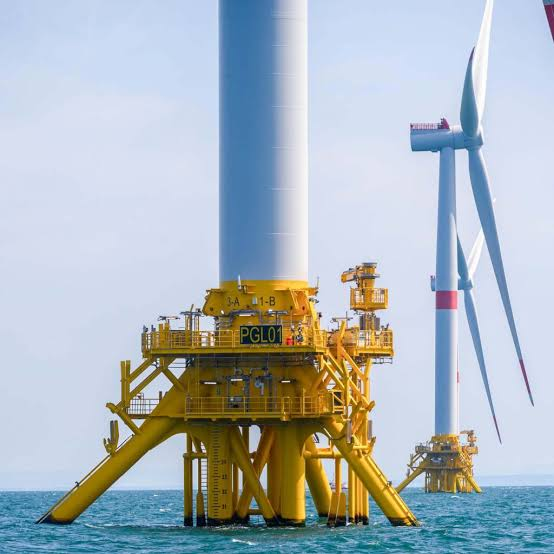
A semi-submersible platform uses several buoyant columns connected by structural members.
Because much of the structure remains near the surface, it can potentially be assembled and launched using ports with fewer depth restrictions than some spar designs.
The WindFloat concept is an important example of this approach.
Semi-submersible platforms are attractive because they can potentially be manufactured in sections and assembled closer to shore before being towed offshore.
3. Tension-Leg Platform
A tension-leg platform uses relatively taut mooring tendons connected to seabed anchors.
The tension helps keep the platform stable and limits its movement.
TLP designs can potentially use less material than some alternatives, but their anchoring and installation requirements are technically demanding.
4. Barge Platforms
Barge-type platforms rely on a broad floating structure to provide stability.
Their relatively shallow draft can make certain manufacturing and port operations easier.
However, controlling platform movement in large waves remains an important engineering challenge.
Fixed-Bottom vs Floating Offshore Wind
| Feature | Fixed-Bottom Wind | Floating Offshore Wind |
|---|---|---|
| Foundation | Attached to seabed | Floating platform |
| Typical water depth | Shallower water | Deep water |
| Mooring | Foundation itself | Cables and anchors |
| Installation | Often offshore installation vessels | Can be assembled and towed |
| Deep-water potential | Limited | High |
| Technology maturity | Highly mature | Emerging |
| Current cost | Generally lower | Generally higher |
| Future opportunity | Large | Potentially enormous |
The key point is that floating wind does not necessarily replace fixed-bottom offshore wind.
Instead, the two technologies can operate in different parts of the offshore resource.
How Much Floating Wind Exists Today?
Floating offshore wind remains a small industry compared with conventional offshore wind.
That is important context.
The International Renewable Energy Agency reported approximately 270 MW of operational floating wind capacity at the end of 2023, alongside a development pipeline of roughly 244 GW. Other datasets use different project-counting and commissioning dates, so figures around the mid-200-MW range are commonly reported for the 2023–2024 period. (IRENA)
This helps explain why floating offshore wind is still considered an emerging technology.
The industry has already demonstrated that floating turbines can work. The challenge now is proving that they can be built at commercial scale and competitive cost.
Leading Floating Offshore Wind Projects
Hywind Scotland: The Project That Changed the Conversation
One of the most important milestones in floating offshore wind was Hywind Scotland.
Located off the coast of Aberdeenshire, the project consists of five floating turbines with a combined capacity of 30 MW.
The turbines use spar-type floating foundations and operate in water depths of roughly 95–120 metres. The project became operational in 2017. (IRENA)
Its significance goes beyond its relatively small capacity.
Hywind Scotland demonstrated that:
A commercial-scale wind turbine could generate electricity while floating in deep offshore water.
That proof-of-concept helped accelerate the global floating wind industry.
Hywind Tampen: Moving Toward Larger Projects
Norway has also become an important floating wind market.
Hywind Tampen, developed by Equinor, reached full commissioning in 2023 with approximately 88 MW of capacity.
According to NREL, it became the world’s largest operational floating offshore wind plant at that time. (NREL)
The project is particularly interesting because its electricity is used to supply offshore oil and gas installations.
That demonstrates another potential role for floating wind: supplying clean electricity directly to offshore industrial operations.
Kincardine: Scotland’s Other Major Demonstration
The Kincardine Offshore Wind Farm off Scotland uses semi-submersible WindFloat technology.
The project became operational in 2021 and demonstrated another approach to floating wind platform design. (IRENA)
Projects such as Hywind Scotland, Kincardine and Hywind Tampen have provided the industry with valuable real-world experience in:
- Turbine operation
- Mooring systems
- Dynamic cables
- Platform stability
- Maintenance
- Towing
- Offshore weather conditions
WindFloat Atlantic: Portugal’s Deep-Water Opportunity
Portugal is another country where floating offshore wind makes particular sense.
The country’s continental shelf becomes deep relatively close to shore, limiting the amount of suitable seabed for conventional fixed-bottom wind farms.
The WindFloat Atlantic project demonstrated how floating platforms could be deployed in these conditions.
This is one reason Portugal has become an important European testbed for floating wind technology.
Japan: A Natural Market for Floating Wind
Japan has strong offshore wind potential but relatively limited shallow-water areas suitable for conventional fixed-bottom turbines.
That makes floating offshore wind particularly attractive.
Japan has experimented with several floating wind concepts and demonstration projects, helping develop knowledge around:
- Floating platforms
- Mooring systems
- Typhoon resilience
- Deep-water installation
- Offshore grid connections
Japan’s experience is particularly valuable because future floating wind farms must be capable of surviving difficult ocean conditions, not simply producing electricity in moderate weather.
Why 2026–2030 Could Be a Turning Point
The floating wind industry has spent much of the last decade proving that the technology works.
The next challenge is much harder:
Can it become an industry?
That means moving from individual demonstration projects to standardized, repeatable production.
Several developments make the 2026–2030 period particularly important.
1. Bigger Turbines
The first floating projects used relatively small turbines compared with today’s largest offshore machines.
Larger turbines can generate more electricity from each floating foundation.
That potentially means:
- Fewer turbines per GW
- Fewer foundations
- Fewer electrical connections
- Lower maintenance requirements per unit of capacity
But larger turbines also increase engineering challenges.
The floating structure must support greater weight while handling stronger aerodynamic and wave-induced forces.
2. Industrialized Floating Platforms
A floating wind farm cannot be built economically if every platform is effectively a one-off engineering project.
The industry therefore needs standardization.
Instead of designing each platform from scratch, manufacturers are working toward repeatable platform designs that can be produced in factories or large port facilities.
This could create a manufacturing model more similar to shipbuilding than traditional offshore foundation installation.
3. Port Infrastructure
Ports could become one of the most important pieces of the floating wind puzzle.
A floating turbine can potentially be assembled in a port and then towed to its offshore location.
But modern turbines are huge.
Ports need:
- Large assembly areas
- Deep water
- Heavy-lift capacity
- Strong quaysides
- Storage space
- Specialized cranes
- Electrical infrastructure
- Fabrication facilities
The UK, for example, has identified port infrastructure and floating wind manufacturing as major investment opportunities. (GOV.UK)
4. Better Mooring and Anchor Systems
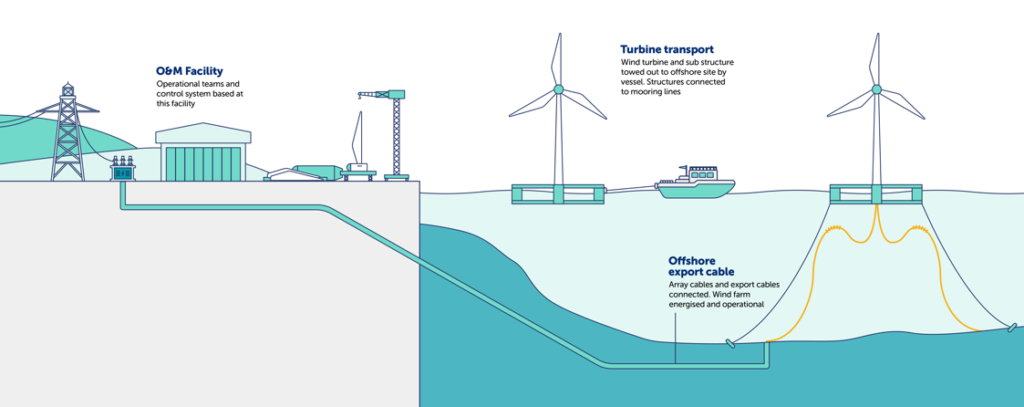
A floating turbine is constantly exposed to:
- Waves
- Wind
- Currents
- Platform movement
- Cyclic loads
Its mooring system therefore has to survive decades of repeated loading.
Improved anchors, synthetic ropes, chain systems and monitoring technologies could reduce installation and maintenance costs.
5. Dynamic Cables
Dynamic cables are another critical technology.
A fixed-bottom turbine can use a relatively stationary cable arrangement.
A floating turbine moves.
The cable must therefore bend and flex repeatedly without suffering premature failure.
As turbine capacities increase, higher-voltage dynamic cables will become increasingly important. UK research programmes have specifically identified next-generation dynamic cables as a technology area requiring development. (GOV.UK)
The Biggest Challenge: Cost
Floating offshore wind has a huge resource advantage, but it currently has an economic disadvantage.
Floating wind is generally more expensive than mature fixed-bottom offshore wind.
There are several reasons.
More complex foundations
A floating platform needs substantial material to remain stable.
More complicated mooring systems
Each turbine requires anchors and mooring lines.
Dynamic electrical connections
Moving cables require specialized engineering.
New installation methods
The industry needs specialized vessels, ports and towing systems.
Limited economies of scale
The industry has not yet produced floating foundations in the enormous volumes that fixed-bottom offshore wind has achieved.
This is the classic problem facing emerging technologies:
Costs are high partly because production volumes are low.
The goal for the late 2020s is to reverse that relationship.
More projects → larger factories → standardized designs → larger supply chains → lower costs → more projects.
Can Floating Wind Become Cheaper?
Potentially, yes.
Several cost reductions could happen simultaneously.
Standardized platform designs
Instead of dozens of unique concepts, the market could converge around a smaller number of proven designs.
Mass manufacturing
Large factories could produce floating foundations repeatedly.
Port-based assembly
More turbine installation work could happen onshore.
Towing instead of heavy-lift installation
Completed units could potentially be towed offshore instead of assembled entirely at sea.
Larger turbines
More generation from each platform could improve project economics.
Better maintenance
Platforms that can be disconnected and towed back to port could potentially reduce some offshore maintenance requirements.
The economics will vary significantly by project, however. Floating wind is not automatically cheaper simply because a turbine can be towed to shore.
Why Floating Wind Could Be a Huge Deal for the United States
The United States has enormous offshore wind potential, but much of the resource is in deep water.
The U.S. Department of Energy estimates total U.S. offshore wind technical resource potential at approximately 4.2 terawatts, with about two-thirds located in areas too deep for conventional fixed-bottom technology under a 60-metre threshold. (The Department of Energy’s Energy.gov)
That makes floating wind particularly relevant to regions such as:
- California
- Oregon
- Washington
- Gulf of Maine
- Deeper waters along other U.S. coastlines
Floating wind could therefore become essential if the United States wants to develop large-scale offshore wind on the Pacific Coast.
Floating Wind Could Change Where Wind Farms Are Built
Traditional offshore wind development often starts with a simple question:
Where can we install a foundation?
Floating wind changes the question to:
Where is the best wind resource, and can we engineer a floating system for it?
That is a major shift.
Developers could potentially move farther offshore to reach areas with stronger and more consistent winds.
The trade-off is that farther offshore usually means:
- Longer transmission cables
- Greater distance for maintenance
- More challenging weather
- Higher construction costs
But if the wind resource is substantially better, the additional cost could be justified.
Environmental Considerations
Floating offshore wind isn’t impact-free.
Projects can affect:
- Marine habitats
- Birds
- Marine mammals
- Fisheries
- Shipping
- Seabed environments
- Local ecosystems
However, floating foundations can have a smaller direct seabed footprint than some fixed-bottom structures because they do not require large foundations extending deeply into the seabed.
IRENA identifies potentially lower environmental impacts as one advantage of floating foundations, while emphasizing that environmental impacts still need to be assessed project by project. (IRENA)
Good planning will therefore be essential.
Future floating wind farms will need to coexist with fishing, shipping, conservation areas and other ocean industries.
Floating Offshore Wind and the Future Energy System
Floating wind could eventually do more than simply generate electricity.
Large floating wind farms could potentially be connected with:
Green Hydrogen
Offshore electricity could be used to produce hydrogen, either onshore or potentially offshore.
Offshore Oil and Gas Electrification
Projects such as Hywind Tampen demonstrate how floating wind can supply electricity to offshore industrial facilities.
Desalination
Renewable electricity could power desalination systems in water-stressed coastal regions.
Offshore Energy Hubs
Future projects could combine:
- Floating wind
- Hydrogen
- Energy storage
- Offshore transmission
- Marine industry
This could turn offshore areas into major renewable-energy production zones.
What Does the Future of Floating Wind Look Like?
The industry’s long-term potential is much larger than its current installed capacity suggests.
IRENA reported a global floating wind project pipeline of approximately 244 GW in 2024, compared with only around 270 MW operational at the end of 2023. That enormous difference illustrates both the opportunity and the uncertainty: many pipeline projects will change, be delayed or never be built. (IRENA)
The late 2020s will therefore be an important test.
If developers can demonstrate that large projects can be delivered reliably and at improving costs, floating wind could move from demonstration technology toward a mainstream offshore power technology.
The UK’s 2024 Contracts for Difference auction was already an important milestone: it awarded a contract to the 400 MW Green Volt project, described by the UK government as the world’s largest floating offshore wind project to reach the market at that time. (GOV.UK)
That is exactly the type of project progression the industry needs.
Floating Offshore Wind: Pros and Cons
Advantages
- Access to deep-water wind resources
- Stronger offshore wind conditions in many locations
- Opens new areas for offshore wind farms
- Potentially easier port-based assembly
- Can be towed for some maintenance operations
- Smaller direct seabed footprint in some designs
- Particularly valuable for countries with narrow shallow-water zones
- Huge long-term global resource potential
Disadvantages
- Higher costs than mature fixed-bottom wind
- Complex platform engineering
- Expensive mooring and anchoring systems
- Dynamic cable challenges
- Limited specialist port infrastructure
- Offshore maintenance remains difficult
- Large-scale supply chains are still developing
- Exposure to extreme waves and storms
- Financing large first-of-a-kind projects can be challenging
Frequently Asked Questions
What is floating offshore wind?
Floating offshore wind is a type of offshore wind power where turbines are installed on floating platforms rather than fixed directly to the seabed. Mooring lines and anchors keep the platform in position.
How deep can floating wind turbines operate?
Floating wind turbines can operate in water much deeper than fixed-bottom turbines. The practical depth depends on the platform, mooring system, seabed conditions and project economics. Some existing projects operate in water depths around 100 metres or more.
Why is floating offshore wind important?
Floating wind can access deep-water regions with strong and consistent wind resources that are difficult or uneconomic to develop using fixed foundations.
Is floating wind better than fixed offshore wind?
Not necessarily. Fixed-bottom offshore wind is currently more mature and generally cheaper in suitable shallow waters. Floating wind becomes especially valuable where water is too deep for economical fixed foundations.
How does a floating wind turbine stay in place?
Floating turbines use mooring lines connected to anchors on the seabed. The mooring system restrains the platform while allowing controlled movement caused by waves and wind.
What are the main types of floating wind platforms?
The major concepts include spar-buoy, semi-submersible, tension-leg platform and barge designs.
Where is floating offshore wind being developed?
Important activity has occurred in countries including the United Kingdom, Norway, Portugal and Japan, as well as France, Spain and the United States.
What is the largest floating wind farm?
The answer depends on the date and whether the project is operational or contracted. Hywind Tampen, at about 88 MW, was the world’s largest operational floating wind farm after its 2023 commissioning. The UK’s 400 MW Green Volt project became the largest floating project to reach the market through the 2024 CfD auction. (NREL)
Will floating offshore wind become cheaper?
The industry expects costs to fall through larger turbines, standardized platforms, manufacturing scale, improved installation methods and better supply chains. However, the pace of cost reduction remains uncertain.
Why are 2026–2030 important for floating wind?
This period is expected to be important because the industry is moving from demonstration projects toward larger commercial developments. The success of projects awarded, financed and constructed during the late 2020s will help determine whether floating wind can achieve meaningful economies of scale.
Final Verdict: Is Floating Wind the Future?
Floating offshore wind may be one of the most important technologies in the next generation of renewable energy.
Its biggest advantage isn’t simply that turbines can float.
Its real advantage is that floating foundations can move offshore wind beyond the shallow-water boundary.
For countries with deep coastal waters, that could completely change their offshore energy potential.
The technology has already passed its first test: floating turbines can work.
The next test is economic.
Between 2026 and 2030, developers, manufacturers, governments and investors will need to prove that hundreds of megawatts can become gigawatts—and eventually tens or hundreds of gigawatts—through standardized platforms, better ports, stronger supply chains and lower costs.
If they succeed, the future offshore wind map could look very different.
Instead of limiting wind farms to areas where turbines can be fixed to the seabed, floating wind turbines could allow the industry to chase the world’s strongest offshore winds wherever they are found.
That is why floating offshore wind, floating wind turbines, and deep water wind farms could become some of the most important keywords—not only for renewable-energy researchers, but for the future of global electricity.
SEO Keywords to Target
Primary keywords:
- floating offshore wind
- floating wind turbine
- deep water wind farm
Secondary keywords:
- floating offshore wind farm
- floating wind technology
- floating wind turbines
- deep water offshore wind
- offshore floating wind turbines
- floating wind platforms
- floating wind energy
- offshore wind technology
- floating wind farm
- future of offshore wind
- floating offshore wind 2026
- floating wind energy projects
- deep water wind energy
Long-tail SEO keywords:
- how floating offshore wind turbines work
- what is floating offshore wind
- floating vs fixed offshore wind
- advantages of floating wind turbines
- floating offshore wind projects
- cost of floating offshore wind
- largest floating wind farm
- floating wind turbine technology
- future of floating offshore wind
- why floating offshore wind is important
Suggested SEO Title
Floating Offshore Wind: How Floating Turbines Could Unlock Deep-Water Wind
Suggested H1
Floating Offshore Wind: The Technology That Could Unlock 80% of the World’s Best Wind Resources
Suggested Meta Description
Learn how floating offshore wind turbines work, why deep-water wind farms matter, leading projects worldwide, major challenges, and why 2026–2030 could transform floating wind.