
How Solar PV Panels Actually Work: From Sunlight to Electricity (2026)
A single solar panel on your roof doesn’t “burn” anything, has no moving parts, and can still keep working for over 25 years with almost zero maintenance. Yet in 2024, the world installed enough new solar capacity to push global cumulative installations past 2,260 gigawatts — a 29% jump in just one year, according to the IEA’s Trends in Photovoltaic Applications 2025 report. India alone added 32 GW that year, making it one of the fastest-growing solar markets in the world. This article breaks down exactly what happens inside a solar panel, in plain language, from the moment sunlight hits it to the moment electricity reaches your switchboard.How Solar PV Panels Actually Work
The Core Idea: Turning Light Into Electricity
Here’s the simple version first. Sunlight is made of tiny packets of energy. When these packets hit certain materials, they knock electrons loose. If you arrange the material correctly, those loose electrons flow in one direction — and a flow of electrons in one direction is exactly what electricity is.
The technical term for this is the photovoltaic effect (photo = light, voltaic = electricity). It was first observed in 1839, but it took until the 1950s for engineers to build a material efficient enough to generate usable amounts of power.
The material that makes this possible is called a semiconductor — a substance (almost always silicon in commercial panels) that normally doesn’t conduct electricity well, but starts conducting when it absorbs enough light energy. Silicon is the second-most abundant element in the Earth’s crust, which is one reason solar panels have become so cheap to manufacture.
To make silicon useful for solar panels, manufacturers add tiny amounts of other elements to it — a process called doping. This creates two layers with different electrical properties:
- A layer with extra electrons (called the n-type layer)
- A layer missing electrons, creating “holes” (called the p-type layer)
Where these two layers meet, you get a p-n junction — the heart of every solar cell. This junction creates a built-in electric field that pushes loose electrons in one direction, generating a flow of current the moment light hits it.
Step-by-Step: The Energy Conversion Process
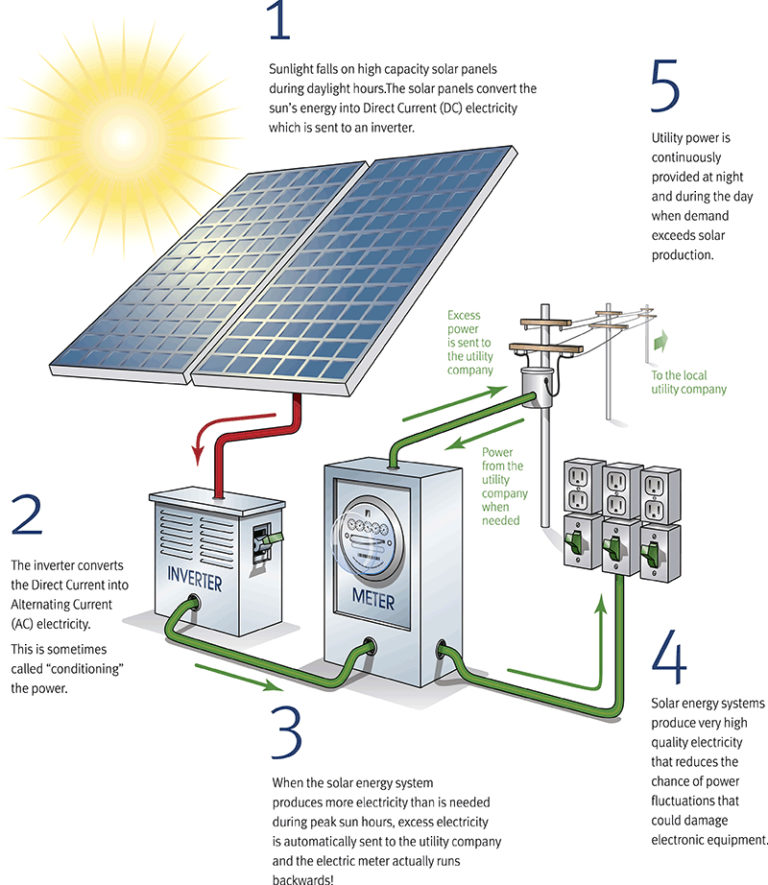
Here’s exactly what happens, in order, from sunlight to a working appliance in your home:
- Sunlight hits the panel. Photons (light particles) strike the silicon cells inside the panel’s protective glass layer.
- Electrons get knocked loose. Photons with enough energy dislodge electrons from silicon atoms, freeing them to move.
- The p-n junction directs the flow. The built-in electric field at the p-n junction pushes these free electrons toward the n-type layer and the holes toward the p-type layer, creating a one-directional flow — direct current (DC) electricity.
- Metal contacts collect the current. Thin metal strips on the cell’s surface gather this current and route it out of the cell.
- Cells connect into a panel. A typical panel wires 60–144 individual cells together in a grid to add up their small individual currents into usable power.
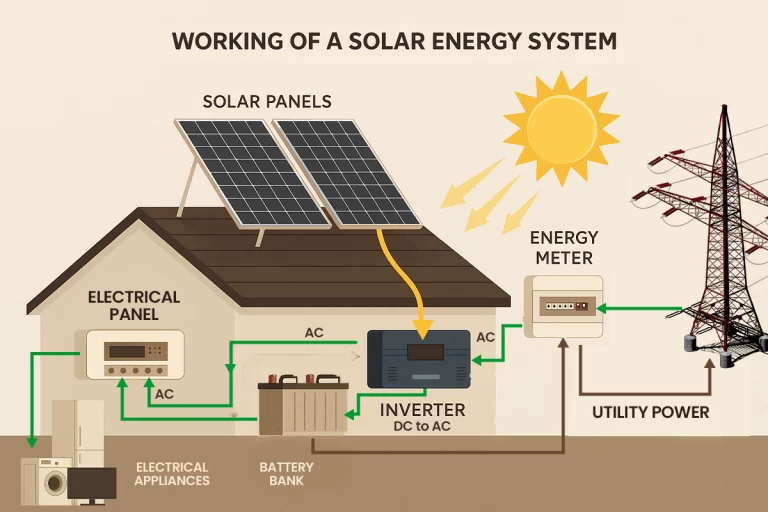
- An inverter converts DC to AC. Since homes and the grid run on alternating current (AC), an inverter — a separate electronic device — flips the DC output back and forth rapidly to match the AC standard.
- Electricity flows to your load or the grid. The converted AC power runs your appliances directly or feeds excess power back into the grid (in grid-tied systems), often earning you bill credits.
Each step loses a small amount of energy as heat or resistance — which is why panel efficiency is never 100%, a topic explained next.
How Efficiency Is Measured
People often confuse two very different numbers when judging solar panels: module efficiency and capacity factor. Understanding the difference matters if you’re comparing quotes or trying to size a system correctly.
How Solar PV Panels Actually Work
Module efficiency tells you what percentage of the sunlight hitting a panel actually converts into electricity under lab-controlled conditions. Commercial panel efficiency improved from around 16–18% in early multi-silicon and PERC panels to 21–23% in newer n-type TOPCon and HJT panels by 2024–2025, according to a 2025 study published in the International Education and Research Journal.
Capacity factor (or CUF — Capacity Utilization Factor) is the more practical number for real-world planning. It measures actual energy produced over a year compared to the maximum possible if the panel ran at full rated output 24/7. A field study of an operational utility-scale solar project in India found a CUF of just 19%, reflecting how actual annual output compares to theoretical maximum capacity — this is normal and expected, not a sign of a faulty system, since the sun isn’t shining at full intensity all day and night.
What pulls capacity factor down from module efficiency:
- Sun hours per day — no power is generated at night, and intensity is lower at dawn/dusk
- Cloud cover and seasonal weather — monsoon months reduce output across most of India
- Panel temperature — silicon cells actually lose efficiency as they get hotter, counterintuitively
- Dust and soiling — common in Indian conditions, can cut output by several percentage points if panels aren’t cleaned regularly
- Shading and panel orientation — even partial shade on one cell can drag down an entire string’s output
- Inverter and wiring losses — typically 2–5% of total generated energy
For homeowners, the practical takeaway: a 1 kW system in most of India will realistically generate around 4–5 units (kWh) of usable electricity per day on average across the year, not a flat 24 units (1 kW × 24 hours).
The Full Lifecycle: From Factory to Decommissioning
A solar installation isn’t a one-time event — it’s a multi-decade process with distinct stages:
- Manufacturing (ongoing, factory-based): Raw silicon is purified, formed into wafers, doped to create p-n junctions, and assembled into cells, then panels. Newer n-type technologies now make up 70% of global production, alongside bifacial modules — panels that capture light on both sides — which account for over 75% of production, according to the IEA’s 2025 PV trends report.
- Site assessment (1–4 weeks): Engineers check roof or land orientation, shading, structural load capacity, and electrical connection points before designing the system.
- Installation (1 day to a few weeks): Residential rooftop systems are often installed in 1–3 days; large utility-scale plants can take months depending on size.
- Commissioning (a few days to 2 weeks): The system is tested, connected to the grid or meter, and certified by local electrical authorities before going live.
- Operation (20–30 years): Most manufacturers guarantee at least 80% output after 25 years. Maintenance during this period mainly involves periodic cleaning and occasional inverter replacement (inverters typically last 10–15 years, shorter than panels).
- Decommissioning and recycling (end of life, year 25–30+): Old panels are dismantled and increasingly recycled to recover glass, aluminum, and silicon. Several countries are now starting to factor decommissioned capacity into their official installation statistics, an emerging practice noted in IEA-PVPS’s 2025 global market snapshot, though standardized reporting on this is still developing.
Solar vs. Wind: A Direct Comparison
Solar and wind are the two renewable technologies driving almost all new capacity additions worldwide. In 2025, solar PV alone accounted for more than three-quarters of new global renewable capacity additions, with wind contributing about 20%, according to the IEA’s Global Energy Review 2026. In India specifically, solar additions reached almost 50 GW in 2025, while wind additions — though growing fast — doubled to just over 6 GW in the same year, per the same IEA report.
| Factor | Solar PV | Wind |
|---|---|---|
| Typical capacity factor | ~15–22% (India average) | ~25–35% (onshore) |
| Energy source variability | Daily (zero at night) | Continuous but variable |
| Land/space efficiency | High per rooftop, lower utility-scale | Lower for same output, but land below turbines stays usable |
| Maintenance | Minimal, no moving parts | Higher, due to mechanical components |
Wind generally achieves a higher capacity factor per installed megawatt because turbines can generate around the clock when wind is available, while solar is fundamentally limited to daylight hours. Solar, however, has much lower maintenance needs and scales more easily to small rooftop installations — which is why it dominates in distributed, residential applications across India.
Key Takeaways
- Solar panels generate electricity through the photovoltaic effect, where sunlight knocks electrons loose in a silicon semiconductor and a built-in p-n junction directs their flow.
- Panels produce direct current (DC), which must pass through an inverter to become the alternating current (AC) that homes and the grid use.
- Module efficiency (lab rating, ~21–23% for current top panels) and capacity factor (real-world output, often ~19% in Indian utility projects) are different metrics — don’t confuse them when comparing systems.
- A typical solar installation lifecycle spans 25–30 years, with manufacturing, site assessment, installation, and commissioning happening upfront, followed by decades of low-maintenance operation.
- Solar leads global renewable additions by volume, but wind typically achieves a higher capacity factor per installed megawatt — the two technologies are complementary, not competing.
Frequently Asked Questions
Do solar panels work on cloudy days? Yes, but at reduced output. Diffused sunlight still contains enough energy to generate electricity, typically 10–25% of clear-sky output depending on cloud thickness. Panels don’t shut off in clouds — they simply produce less.
Will solar panels stop working as soon as they hit their 25-year warranty? No. The warranty typically guarantees a minimum output level (often 80% of original capacity) at the 25-year mark, not a shutdown date. Many panels installed decades ago still generate usable electricity well beyond their rated warranty period, just at reduced efficiency.
Does a higher efficiency rating always mean more electricity for my home? Not necessarily. A higher module efficiency means more power per square meter of panel, which matters if roof space is limited. But total electricity output also depends on capacity factor, shading, orientation, and system size — a slightly lower-efficiency panel installed in better conditions can still outperform a high-efficiency panel installed poorly.
This article covers general engineering principles. For sizing, subsidy eligibility, or installer recommendations specific to your location, consult a certified solar installer or MNRE-empanelled vendor.
How Solar Panels Work,How do solar panels work Solar panel working principle Solar energy conversion Solar power generation How solar energy works Solar electricity generation Photovoltaic solar panels Solar PV system Solar panel technology Solar power system,How do solar panels generate electricity How sunlight becomes electricity Step-by-step solar panel working Solar panel working explained Beginner’s guide to solar panels Solar panel process explained How photovoltaic cells work How solar cells produce electricity Residential solar panel system Rooftop solar panel working,Solar panels
Solar energy
Solar power
Solar electricity
Rooftop solar
Home solar system
Solar panel installation
Solar panel benefits
Solar power for homes
Renewable energy solutions
Solar energy system
Solar panel guide