
Solid-State Batteries: The Technology That Could Change Clean Energy Forever
As the world moves toward cleaner transportation and renewable electricity, one technology is attracting enormous attention: solid-state batteries.
For decades, lithium-ion batteries have powered smartphones, laptops, electric vehicles (EVs), and energy storage systems. While they have revolutionized modern electronics, they still face limitations such as fire risks, limited energy density, gradual degradation, and relatively slow charging.
Solid-state batteries promise to overcome many of these challenges. By replacing the liquid electrolyte with a solid material, these next-generation batteries could deliver safer operation, longer lifespan, faster charging, and significantly higher energy density.
Many experts believe solid-state technology could become one of the biggest breakthroughs in clean energy over the next decade.
In this guide, we’ll explore how solid-state batteries work, their benefits and limitations, applications in electric vehicles and renewable energy, major companies investing in the technology, and what the future holds.
A solid-state battery (SSB) is an electrical battery that uses a solid electrolyte to conduct ions between the electrodes, instead of the liquid or gel polymer electrolytes found in conventional batteries.[3] Theoretically, solid-state batteries offer much higher energy density than the typical lithium-ion or lithium polymer batteries.[4][5]
While solid electrolytes were first discovered in the 19th century, several problems prevented widespread application. Developments in the late 20th and early 21st century generated renewed interest in the technology, especially in the context of electric vehicles. As of 2026, the solid-state battery market has yet to reach scalability and commercialization.[6][7][8]
Solid-state batteries can use metallic lithium for the anode and oxides or sulfides for the cathode, thereby enhancing energy density. The solid electrolyte acts as an ideal separator that allows only lithium ions to pass through. For that reason, solid-state batteries can potentially solve many problems of currently used liquid electrolyte Li-ion batteries, including flammability, limited voltage, unstable solid-electrolyte interface formation, poor cycling performance, and strength.[9]
Materials proposed for use as electrolytes include ceramics (e.g., oxides, sulfides, phosphates), and solid polymers. Solid-state batteries are found in pacemakers and in RFID and wearable devices.[10] These batteries offer enhanced safety and higher energy densities. Challenges to widespread adoption include energy and power density, durability, material costs, sensitivity, and stability.[11]

History
Origin
Between 1831 and 1834, Michael Faraday discovered the solid electrolytes silver sulfide and lead(II) fluoride, which laid the foundation for solid-state ionics.[12][13] Through his research, Michael Faraday took note of these solid compounds transitioning from insulators to conductors after being heated.[14] While this would take almost another century to be acknowledged by Michael O’Keeffe[15] in 1976, this mixed ionic/electronic conductions became the first record of a solid-state battery.[15]
By the late 1950s, several silver-conducting electrochemical systems employed solid electrolytes, at the price of low energy density and cell voltages, and high internal resistance.[16][17] In 1967, the discovery of fast ionic conduction β-alumina for a broad class of ions (Li+, Na+, K+, Ag+, and Rb+) kick-started the development of solid-state electrochemical devices with increased energy density.[18][17][19] The first were molten sodium / β-alumina / sulfur cells developed at Ford Motor Company in the US,[20] and NGK in Japan.[17] This excitement manifested in the discovery of new systems in both organics, i.e. poly(ethylene) oxide (PEO), and inorganics such as NASICON.[17] However, many of these systems required operation at temperatures greater than 300 °C (or 572 °F) and were expensive to produce, limiting commercial deployment and funding towards research efforts in the space.[17]
1990s and 2000s
A new class of solid-state electrolyte developed by Oak Ridge National Laboratory, lithium–phosphorus oxynitride (LiPON), emerged in the 1990s. LiPON was successfully used to make thin-film lithium-ion batteries,[21] although applications were limited due to the cost associated with deposition of the thin-film electrolyte, along with the small capacities that could be accessed using the thin-film format.[22][23]
2010s
Kamaya et al. demonstrated in 2011 the first solid-electrolyte, Li10GeP2S12 (LGPS), capable of achieving a bulk ionic conductivity in excess of liquid electrolyte counterparts at room temperature.[24] With this advancement, bulk solid-ion conductors could compete technologically with Li-ion counterparts.
Automotive companies researched the technology in the 2010s. Bolloré launched in 2011 a fleet of their BlueCar model cars featuring a 30kWh lithium metal polymer (LMP) battery with a polymeric electrolyte, created by dissolving lithium salt in polyoxyethylene co-polymer.[25] Toyota began conducting in 2012 research into automotive applications of solid-state batteries.[26] At the same time, Volkswagen began partnering with small technology companies specializing in the technology.[citation needed] Researchers at the University of Colorado Boulder announced in 2013 the development of a solid-state lithium battery, with a solid iron–sulfur composite cathode that promised higher energy.[27] Toyota extended its decades-long partnership with Panasonic in 2017 to include collaboration on solid-state batteries.[28] As of 2019 Toyota held the most SSB-related patents.[29] The following years similar research efforts into solid-state batteries was separately announced by BMW,[30] Honda,[31] Hyundai[32] (with Solid Power and Samsung),[33][34] and Nissan.[35]
Outside of the automotive sector, other research and development in the 2010s included: solid-state batteries for electronics by Qing Tao announced in 2018;[36] and a solid-state glass battery by John Goodenough, the co-inventor of Li-ion batteries, unveiled in 2017, featuring a glass electrolyte and an alkali-metal anode consisting of lithium, sodium or potassium.[37]
2020s
Many companies have announced readiness to commercialize solid-state batteries at the GWh scale in the 2020s, but their batteries’ feasibility or technology readiness is unknown. These announcements include: ProLogium – GWh production capacity by 2022; QuantumScape – GWh production capacity by 2024; Qing Tao – GWh production capacity by 2020; Ampcera – commercial availability by 2021; Panasonic and Toyota – market maturity by 2025; Solid Power, BMW, and Ford – market maturity by end of 2020s; WeLion – GWh production capacity by 2022; StoreDot; Honda – market maturity by 2030; Ionic Materials and Hyundai – market maturity in the 2030s; and others.[38] Many of these companies have not commercialized their product as of January 2026, and the solid-state battery market has yet to reach scalability and commercialization.[39]
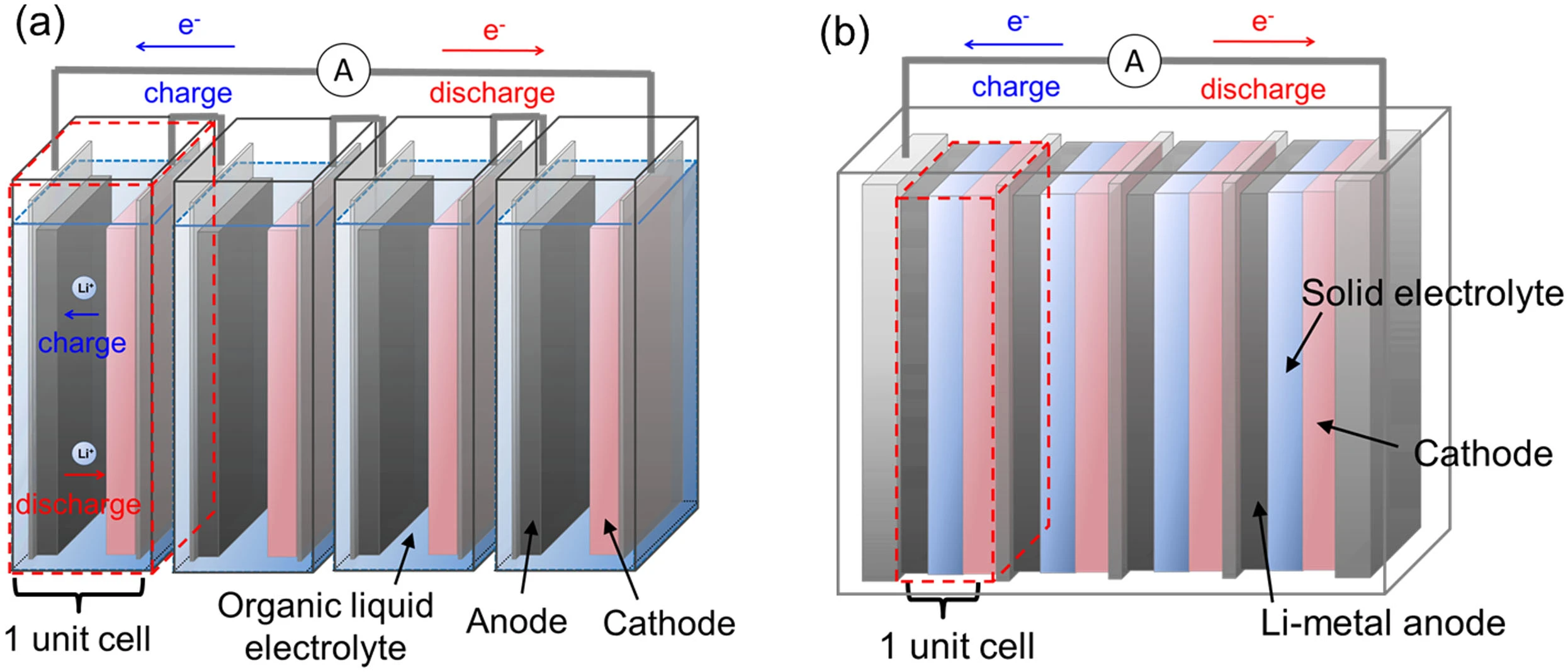
What Are Solid-State Batteries?
A solid-state battery is a rechargeable battery that uses a solid electrolyte instead of the liquid or gel electrolyte found in conventional lithium-ion batteries.
Traditional lithium-ion batteries contain:
- Cathode
- Anode
- Liquid electrolyte
- Separator
Solid-state batteries replace the liquid electrolyte with a solid material made from:
- Ceramic
- Glass
- Sulfide compounds
- Polymer materials
The solid electrolyte transports lithium ions while reducing leakage and improving safety.
How Do Solid-State Batteries Work?
The charging process remains similar to lithium-ion batteries.
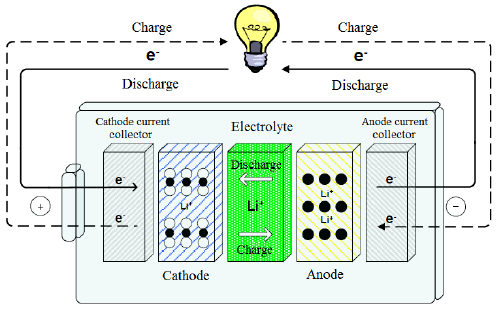
During Charging
- Lithium ions move from the cathode
- Pass through the solid electrolyte
- Reach the anode
During Discharging
The ions travel back to the cathode while releasing electrical energy.
Unlike liquid electrolytes, the solid electrolyte:
- Doesn’t leak
- Doesn’t evaporate
- Is much less flammable
- Enables higher energy storage
Key Components
1. Cathode
Stores lithium ions during discharge.
Common materials include:
- Lithium nickel manganese cobalt oxide (NMC)
- Lithium iron phosphate (LFP)
- High-nickel cathodes
2. Solid Electrolyte
The heart of the battery.
Common types include:
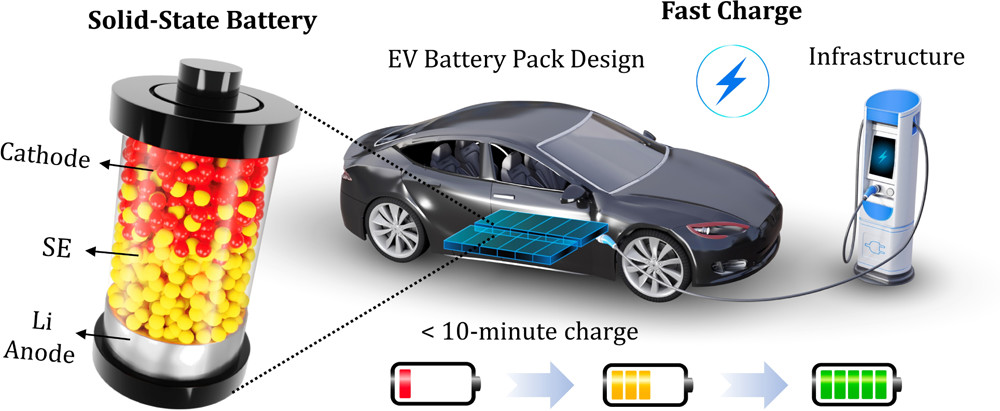
Ceramic Electrolytes
- Excellent conductivity
- Highly stable
- Fire resistant
Sulfide Electrolytes
- Extremely high ionic conductivity
- Flexible manufacturing
- Sensitive to moisture
Polymer Electrolytes
- Lightweight
- Easier manufacturing
- Lower conductivity at room temperature
3. Lithium Metal Anode
One major advantage is the ability to use pure lithium metal.
Benefits include:
- Higher energy density
- Lower battery weight
- Faster charging
- Increased capacity
Advantages of Solid-State Batteries
1. Higher Energy Density
Solid-state batteries can store significantly more energy than current lithium-ion batteries.
Potential improvements:
- 30–80% higher energy density
- Longer driving range
- Smaller battery packs
For EVs, this could mean:
- 700–1,000 km driving range
- Lower vehicle weight
- Better efficiency
2. Improved Safety
One of the biggest problems with lithium-ion batteries is thermal runaway.
Liquid electrolytes are flammable.
Solid electrolytes are:
- Non-flammable
- More heat resistant
- Less prone to leakage
- More stable under stress
This greatly reduces the risk of battery fires.
3. Faster Charging
Researchers expect many solid-state batteries to achieve:
- 10–15 minute fast charging
- Higher charging currents
- Lower heat generation
This could make EV charging almost as convenient as refueling gasoline vehicles.
4. Longer Lifespan
Solid-state batteries generally experience:
- Reduced degradation
- Fewer side reactions
- More stable cycling
Potential lifespan:
- 2,000–10,000 charge cycles (depending on chemistry and design)
5. Better Performance in Extreme Temperatures
Many designs perform better in:
- Hot climates
- Cold weather
- Heavy-duty applications
This is particularly valuable for electric vehicles and grid storage.
Limitations and Challenges
Despite their promise, solid-state batteries face several hurdles.
1. High Manufacturing Costs
Current production methods remain expensive because of:
- Advanced materials
- Precision manufacturing
- Limited large-scale production
Mass production is expected to reduce costs over time.
2. Manufacturing Complexity
Building defect-free solid electrolytes is technically demanding.
Challenges include:
- Cracking
- Material interfaces
- Pressure management
- Quality control
3. Dendrite Formation
Although reduced compared to conventional batteries, lithium dendrites can still develop in some solid-state designs, potentially affecting performance and safety.
4. Scaling Production
Laboratory prototypes often perform well, but scaling them to millions of battery cells while maintaining consistent quality remains a significant engineering challenge.
Impact on Electric Vehicles (EVs)
Solid-state batteries could transform electric mobility by addressing many current limitations.
Potential benefits include:
- Driving ranges exceeding 800 km
- Faster charging
- Reduced battery weight
- Improved safety
- Longer battery life
- Better cold-weather performance
These improvements could accelerate global EV adoption and make electric vehicles more practical for a wider range of drivers.
Renewable Energy Storage Applications
Solid-state batteries are also expected to play an important role in renewable energy systems.
Solar Energy Storage
They can store excess solar power generated during the day and release it at night or during cloudy periods.
Wind Energy Storage
Solid-state systems can help balance the intermittent output of wind farms.
Microgrids
Reliable energy storage improves resilience for remote communities, campuses, and industrial sites.
Home Battery Systems
Future residential storage could benefit from:
- Greater safety
- Longer lifespan
- Compact designs
- Lower maintenance
Other Applications
Solid-state batteries could power a wide range of technologies, including:
- Consumer electronics
- Medical devices
- Drones
- Aerospace systems
- Electric aircraft
- Marine vessels
- Industrial robots
- Portable power stations
Leading Companies Developing Solid-State Batteries
Several major companies and startups are investing heavily in this technology.
Some of the leading players include:
- Toyota
- Samsung SDI
- QuantumScape
- Solid Power
- Nissan
- BMW
- Mercedes-Benz
- Honda
- Panasonic
- CATL
Many are targeting commercial deployment later this decade, although timelines vary by company and application.
Market Outlook
Industry analysts expect strong growth as manufacturing scales and costs decline.
Key drivers include:
- Rising EV demand
- Renewable energy expansion
- Government clean-energy policies
- Advances in battery research
- Investment from automotive manufacturers
While lithium-ion batteries are likely to dominate in the near term, solid-state batteries could capture an increasing share of premium EVs and specialized energy storage applications over the next decade.
Challenges That Still Need to Be Solved
Before widespread adoption, the industry must continue improving:
- Manufacturing costs
- Production scalability
- Long-term durability
- Material availability
- Supply chains
- Standardized manufacturing processes
Addressing these challenges will be essential for commercial success.
The Future of Solid-State Batteries
The coming years will be critical for solid-state battery development.
Researchers are focused on:
- Higher energy densities
- Faster charging
- Lower costs
- Improved recycling
- Sustainable materials
- Scalable manufacturing
As these advances reach commercial production, solid-state batteries could become a cornerstone of cleaner transportation and more reliable renewable energy storage.
Conclusion
Solid-state batteries represent one of the most exciting innovations in energy storage. By replacing flammable liquid electrolytes with solid materials, they offer the potential for safer operation, longer lifespans, faster charging, and higher energy density.
Although technical and manufacturing challenges remain, ongoing investment and research are bringing the technology closer to large-scale commercialization. If these hurdles are overcome, solid-state batteries could significantly enhance electric vehicles, renewable energy systems, and a wide range of electronic devices, supporting the global transition to a cleaner and more sustainable energy future.
Frequently Asked Questions (FAQs)
Are solid-state batteries better than lithium-ion batteries?
They have the potential to offer higher energy density, improved safety, faster charging, and longer lifespan, though they are not yet widely available.
When will solid-state batteries become common?
Pilot production is already underway, with broader commercial adoption expected later in the decade, particularly in premium electric vehicles.
Can solid-state batteries store solar energy?
Yes. They are well-suited for storing electricity from solar and wind systems, especially where safety, durability, and compact size are important.
Why are solid-state batteries expensive?
Current costs are driven by advanced materials, complex manufacturing processes, and limited production scale. Costs are expected to decrease as manufacturing matures.
Will solid-state batteries replace lithium-ion batteries?
Not immediately. Lithium-ion batteries will likely remain dominant for many applications in the near term, while solid-state batteries gradually expand into high-performance and specialized markets.
solid-state batteries, battery technology, electric vehicle batteries, EV battery, renewable energy storage, energy storage systems, clean energy, lithium-ion battery alternative, solid electrolyte, lithium metal battery, battery innovation, fast charging battery, future batteries, sustainable energy, green technology, next generation battery, solar energy storage, wind energy storage, EV technology, clean energy future