
Meta Description:
Discover what perovskite solar cells are, how they work, and why they’re transforming the solar industry in 2026. Learn about record-breaking solar cell efficiency, tandem solar technology, commercialization, challenges, and future potential.
Perovskite Solar Cells
- perovskite solar cells
- next generation solar panels
- solar cell efficiency 2026
- tandem solar cells
What Are Perovskite Solar Cells and Why Is Everyone Talking About Them?
The solar energy industry is entering a new era. For decades, silicon solar panels have dominated rooftops and solar farms worldwide. While they have become more affordable and efficient over the years, researchers have long searched for a technology capable of producing significantly more electricity without dramatically increasing costs.
That search has led to one of the biggest breakthroughs in renewable energy: perovskite solar cells.
In 2026, these innovative solar cells are attracting attention because they have achieved record-breaking efficiencies exceeding 35% when combined with silicon in tandem designs, far surpassing the efficiency of conventional residential solar panels that typically operate between 21% and 23%.
So, what exactly are perovskite solar cells? Why are scientists, manufacturers, and investors excited about them? And could they soon replace traditional solar panels on your roof?
Let’s explore everything you need to know.
What Are Perovskite Solar Cells?
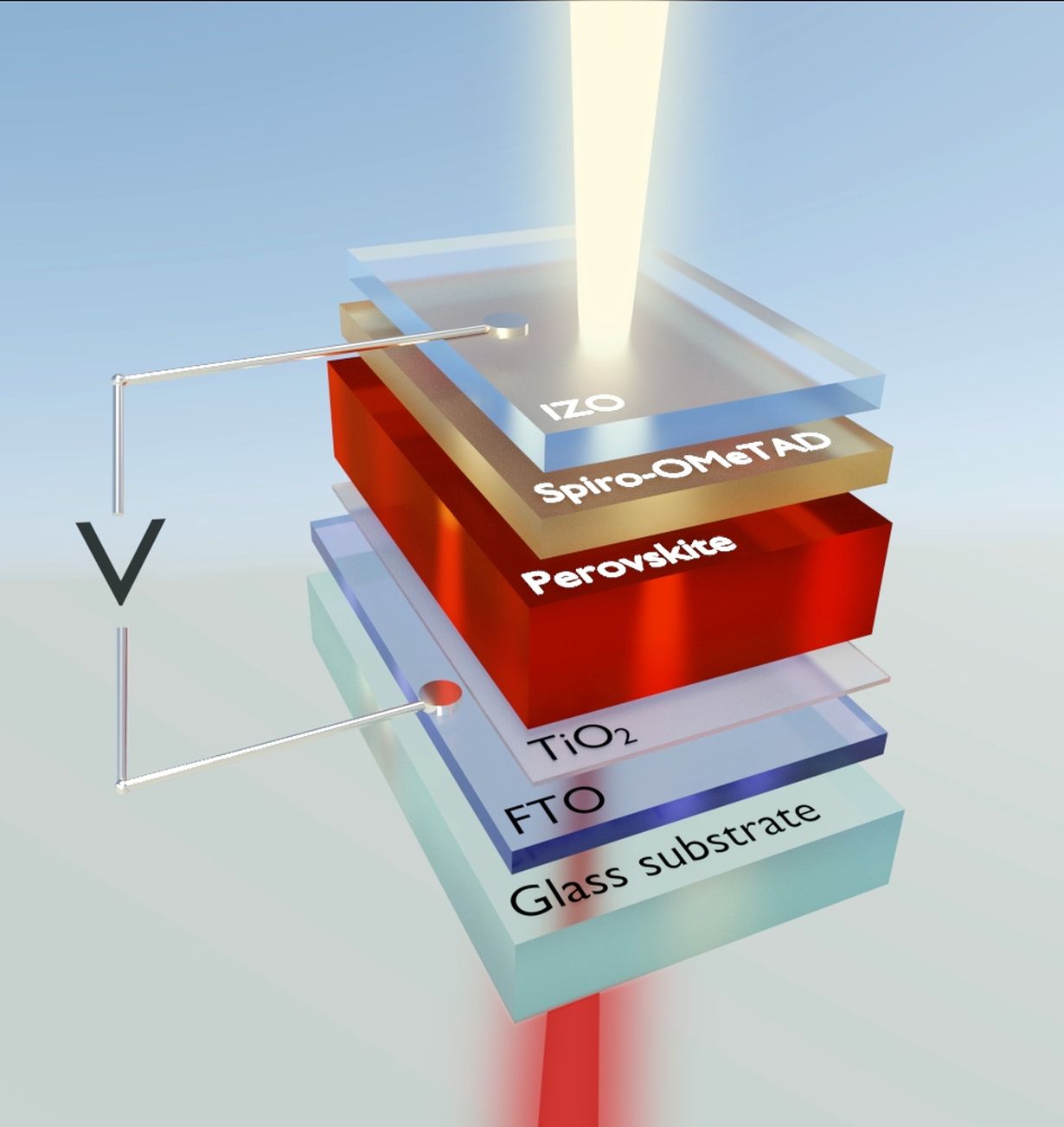
Perovskite solar cells are a new type of photovoltaic technology that uses a special crystal structure called perovskite to absorb sunlight and convert it into electricity.
Unlike traditional silicon panels, perovskite materials are:
- Extremely thin
- Lightweight
- Flexible
- Less energy-intensive to manufacture
- Capable of absorbing a wider range of sunlight
The name “perovskite” refers to the crystal structure rather than a single material. Scientists can adjust the chemical composition to improve efficiency, durability, and manufacturing costs.
Because these materials can be produced using printing or coating techniques, they may eventually become much cheaper to manufacture than conventional silicon wafers.
How Do Solar Cells Produce Electricity?
Before understanding why perovskites are revolutionary, it’s helpful to understand how any solar panel works.
Step 1: Sunlight Hits the Solar Cell
Sunlight contains tiny packets of energy called photons.
When photons strike the solar cell, they transfer energy to electrons inside the material.
Step 2: Electrons Become Excited
The absorbed energy causes electrons to move freely instead of remaining attached to atoms.
This movement creates electrical charge.
Step 3: Electric Current Is Generated
Special layers inside the solar cell guide these electrons in one direction.
The movement of electrons creates direct current (DC) electricity.
Step 4: Electricity Powers Your Home
An inverter converts DC electricity into alternating current (AC), which powers household appliances.
This basic process is known as the photovoltaic effect.
Why Are Perovskite Solar Cells Different?
Traditional silicon solar panels have improved steadily over the past several decades, but they are approaching their practical efficiency limits.
Perovskite materials solve many of silicon’s limitations.
| Feature | Silicon Panels | Perovskite Solar Cells |
|---|---|---|
| Manufacturing | High-temperature process | Low-temperature manufacturing |
| Weight | Heavy | Lightweight |
| Flexibility | Rigid | Flexible |
| Material Cost | Higher | Potentially lower |
| Efficiency Potential | Near practical limit | Much higher potential |
| Tandem Compatibility | Limited | Excellent |
The biggest advantage is their ability to capture wavelengths of sunlight that silicon cannot efficiently use.
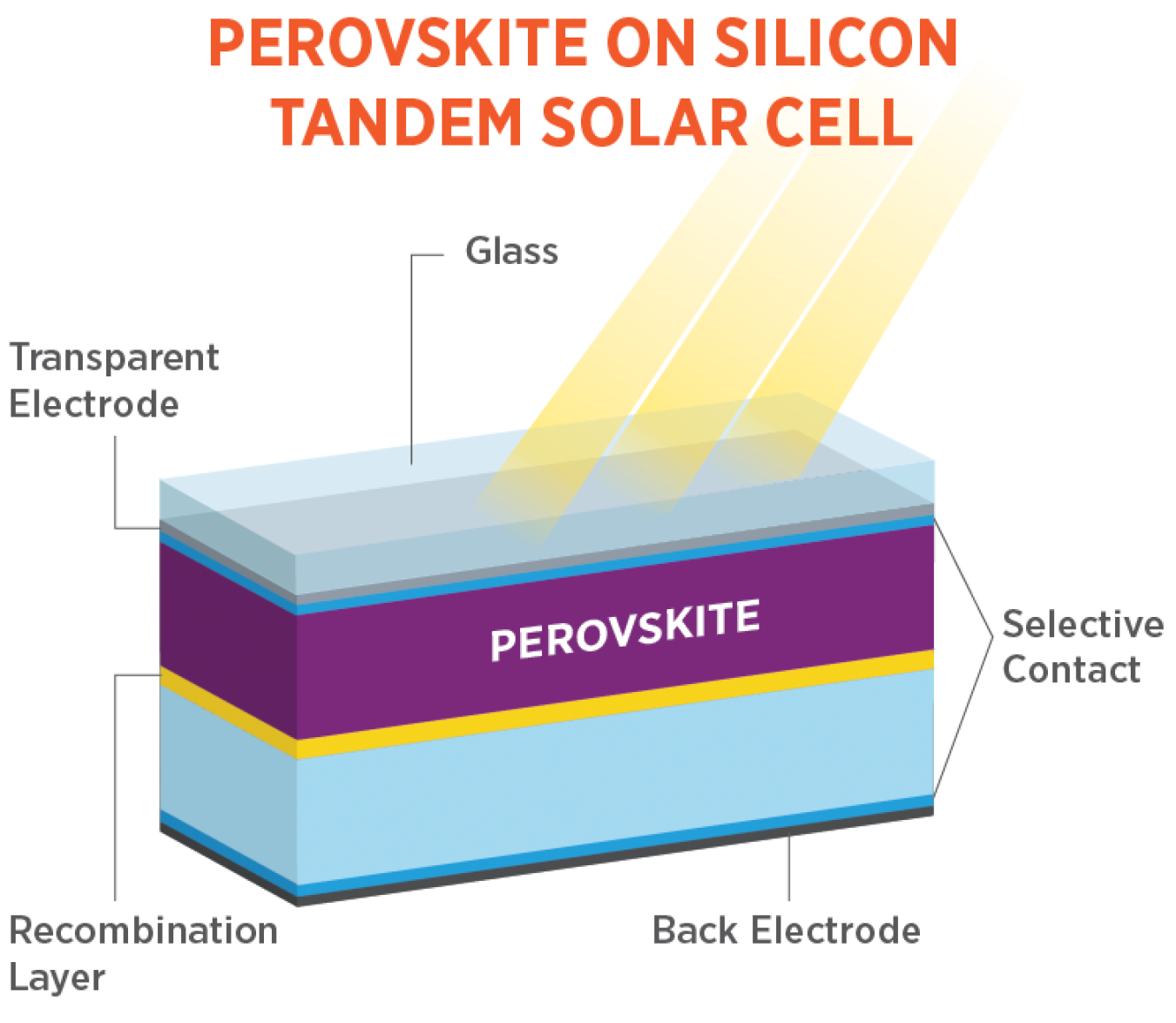
What Are Tandem Solar Cells?
One of the most exciting developments in next generation solar panels is the emergence of tandem solar cells.
Instead of replacing silicon, manufacturers stack a perovskite layer on top of a traditional silicon cell.
Here’s why this works:
- The perovskite layer captures high-energy light.
- Silicon captures lower-energy light.
- Together they harvest more of the solar spectrum than either material alone.
This dramatically increases electricity production from the same panel size.
Record-Breaking Solar Cell Efficiency in 2026
One reason everyone is talking about perovskite technology is the rapid pace of efficiency improvements.
Typical Residential Silicon Panels
Most modern residential panels deliver:
- 21–23% efficiency
Premium models can reach slightly higher, but gains have slowed as silicon approaches its theoretical limits.
Perovskite Tandem Cells
In 2026, laboratory demonstrations of perovskite-silicon tandem cells have crossed 35% efficiency, representing a major leap forward.
This means:
- More electricity from the same roof area
- Higher energy output
- Better performance where roof space is limited
- Lower cost per unit of electricity over time
These results are among the strongest indicators that tandem technology could reshape the future of solar power.
Why Higher Efficiency Matters
Many homeowners assume a few percentage points don’t make much difference.
In reality, higher efficiency means:
Smaller Roof Requirement
Generate the same power using fewer panels.
Lower Installation Costs
Fewer panels can reduce mounting hardware, wiring, and labor requirements.
Greater Lifetime Savings
More electricity generation translates into higher long-term savings on energy bills.
Better Urban Solar
Homes with limited roof space benefit the most from high-efficiency panels.
Can Perovskite Solar Cells Replace Silicon?
Not immediately.
Instead of replacing silicon, most companies are combining both technologies.
This approach offers:
- Lower risk
- Faster commercialization
- Better manufacturing compatibility
- Higher efficiency without redesigning the entire industry
Many experts believe tandem panels will become the dominant premium solar technology before fully perovskite-based panels reach mass adoption.
Companies Leading the Perovskite Revolution
Several companies are working to commercialize perovskite technology.
Oxford PV
Oxford PV is one of the industry’s pioneers in perovskite-silicon tandem solar technology. The company has focused on integrating a thin perovskite layer with conventional silicon cells to achieve significantly higher efficiencies while leveraging existing manufacturing infrastructure.
Other Innovators
Other companies and research organizations around the world are also advancing perovskite technology, including startups, universities, and established solar manufacturers. Their work includes improving manufacturing processes, enhancing stability, reducing production costs, and scaling up commercial production.
Competition across the industry is accelerating innovation and bringing the technology closer to mainstream adoption.
Why Isn’t Everyone Using Them Yet?
Despite their incredible efficiency, perovskite solar cells still face several technical challenges.
1. Moisture Sensitivity
Early perovskite materials degraded quickly when exposed to humidity.
Researchers are developing advanced encapsulation techniques and improved material formulations to protect the cells from moisture.
2. Heat Stability
High temperatures can reduce long-term performance.
New chemical compositions and improved device architectures are making perovskite cells more thermally stable.
3. UV Exposure
Continuous ultraviolet radiation can damage some perovskite materials over time.
Protective coatings and ultraviolet-resistant layers are helping extend operational lifetimes.
4. Long-Term Durability
Traditional silicon panels often last 25–30 years.
Perovskite technology is still proving that it can deliver similar long-term reliability under real-world conditions. Manufacturers are conducting extensive testing to validate durability before widespread deployment.
How Scientists Are Solving These Problems
The progress over the last few years has been remarkable.
Researchers are improving stability through:
- Better encapsulation materials
- Improved crystal engineering
- New additive chemicals
- Multi-layer protective coatings
- Advanced manufacturing methods
- Enhanced quality control
As these improvements continue, commercial products are expected to become increasingly reliable and competitive.
Benefits for Homeowners
If perovskite-based panels become widely available, homeowners could benefit from:
Higher Electricity Production
Generate more energy from the same roof.
Better Return on Investment
Higher efficiency can improve the economics of rooftop solar over the system’s lifetime.
Improved Performance
Some perovskite designs show strong performance in lower-light conditions, which may help increase energy production throughout the day.
Future-Proof Technology
Tandem solar panels are expected to play a major role in the next generation of residential solar systems.
Benefits for the Solar Industry
The broader solar industry could also see significant advantages.
Lower Manufacturing Costs
Perovskite materials can potentially reduce energy-intensive manufacturing steps.
Increased Energy Output
Higher-efficiency panels mean more electricity from each installation.
Faster Renewable Energy Adoption
Improved performance could make solar energy more attractive across residential, commercial, and utility-scale projects.
Greater Design Flexibility
Lightweight and flexible perovskite layers may enable applications on buildings, vehicles, and portable devices.
Will Perovskite Solar Panels Become Affordable?
Many analysts expect production costs to decline as manufacturing scales up and processes mature.
During the early years of commercialization, tandem panels may be priced above standard silicon modules because of their advanced technology.
Over time, increased production volumes and manufacturing improvements could narrow the price gap, making them more accessible to homeowners and businesses.
The Future of Next Generation Solar Panels
Perovskite solar cells are more than just another laboratory innovation—they represent one of the most promising advances in photovoltaic technology in decades.
As commercialization continues, they have the potential to deliver:
- Higher efficiency
- Lower manufacturing costs
- More power from limited roof space
- New applications beyond traditional rooftop installations
- Faster progress toward global clean energy goals
If current trends continue, perovskite-silicon tandem panels could become a common option in premium solar installations over the coming years, with broader adoption following as manufacturing scales.
Final Thoughts
The excitement surrounding perovskite solar cells is well deserved. They offer a compelling path to next generation solar panels by combining innovative materials with proven silicon technology.
Although challenges related to long-term durability and large-scale manufacturing remain, rapid progress in efficiency, stability, and commercialization suggests that perovskite technology is moving steadily from the laboratory to real-world installations.
For homeowners, businesses, and the renewable energy sector, this could mean cleaner electricity, greater energy output, and more efficient use of available space—helping accelerate the transition to a more sustainable energy future.
Frequently Asked Questions (FAQ)
Are perovskite solar cells available today?
Yes. Early commercial products, particularly perovskite-silicon tandem panels, are beginning to enter the market, while broader adoption is expected as manufacturing capacity and long-term reliability continue to improve.
Are perovskite solar cells better than silicon?
Perovskite cells offer higher efficiency potential and lower-cost manufacturing possibilities. However, silicon panels currently have a much longer proven track record for durability.
Why are tandem solar cells important?
Tandem cells combine the strengths of perovskite and silicon, allowing them to capture more sunlight and achieve efficiencies above 35% in laboratory settings.
Are perovskite solar cells safe?
Commercial developers are designing modules with robust encapsulation and safety features. Manufacturers also continue researching material formulations and recycling approaches to minimize environmental impact.
When will homeowners be able to buy them?
Limited commercial availability has begun, but widespread residential adoption will depend on manufacturing scale, certification, pricing, and long-term field performance.
Should I wait for perovskite panels before installing solar?
If you need to reduce electricity bills now, today’s high-quality silicon panels remain an excellent investment. Perovskite-tandem technology is promising, but standard silicon systems already provide reliable performance and long warranties.
SEO Tags
perovskite solar cells, next generation solar panels, solar cell efficiency 2026, tandem solar cells, Oxford PV, photovoltaic technology, renewable energy, high efficiency solar panels, silicon solar panels, clean energy, solar innovation, residential solar, solar industry, green technology, future of solar energy