
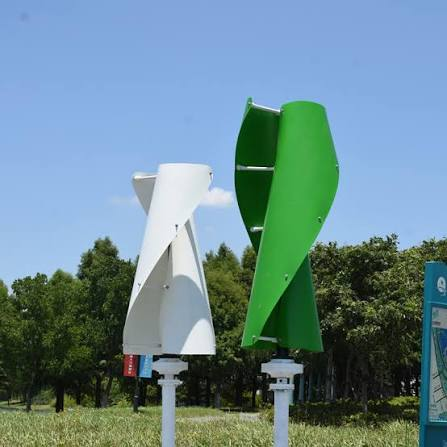
Small wind turbines can generate electricity for homes, but they are not a practical solution for every property. Unlike rooftop solar, which can work on many suburban and urban homes, residential wind power depends heavily on having a strong, consistent, and relatively unobstructed wind resource.
A small wind turbine for home use can make sense on a rural property, farm, coastal site, hilltop, or large open plot where wind speeds are consistently high. On the other hand, installing a turbine on a typical city rooftop or in a neighborhood surrounded by buildings and trees often produces disappointing results.
The key question is not simply, “Can a wind turbine generate electricity at my home?” It is:
“Does my property have enough usable wind to make the investment worthwhile?”
This guide explains how residential wind turbines work, how much electricity 1–10 kW systems can produce, installation costs, suitable locations, limitations, and how small wind compares with rooftop solar.
What Is a Small Wind Turbine for Home Use?

A small wind turbine is a compact wind-energy system designed to generate electricity for homes, farms, remote buildings, telecommunications equipment, or other small-scale applications.
Residential systems commonly range from approximately 1 kW to 10 kW, although larger systems are available for specialized properties.
The basic principle is straightforward:
Wind → Rotor → Generator → Electricity → Home/Grid/Battery
When wind moves across the turbine blades, the rotor spins. That mechanical rotation drives a generator, which converts the energy into electricity.
A complete residential wind system may include:
- Wind turbine
- Rotor and blades
- Tower
- Generator
- Inverter
- Controller
- Wiring
- Batteries, if used
- Electrical protection equipment
- Grid connection equipment, where applicable
The turbine itself is only one part of the system. The tower and installation location are particularly important because wind quality generally improves with height and becomes more turbulent near buildings, trees, and other obstacles.
How Does a Residential Wind Turbine Work?
A residential wind turbine operates using the same fundamental concept as a large commercial wind turbine, but at a much smaller scale.
1. Wind moves the blades
Moving air creates aerodynamic forces on the turbine blades. These forces cause the rotor to spin.
2. The rotor turns a shaft
The spinning rotor transfers mechanical energy through a shaft.
3. The generator produces electricity
The generator converts rotational energy into electrical energy.
4. Power electronics control the electricity
A controller and inverter convert and regulate the electricity so that it can be used by household appliances, stored in batteries, or exported to the electricity grid where permitted.
5. The electricity powers the home
The generated electricity can offset electricity purchased from the grid.
For an off-grid property, batteries can store excess electricity for use when the wind slows down.
How Much Wind Does a Home Wind Turbine Need?
This is one of the most important questions when considering home wind power.
A turbine may begin producing electricity at relatively low wind speeds, but that does not mean it will produce meaningful amounts of energy at those speeds.
Most small turbines have a cut-in wind speed somewhere around 2.5–4 m/s. Below this range, the turbine generally produces little or no useful electricity.
Power increases rapidly as wind speed increases. The amount of energy available in wind is approximately proportional to the cube of wind speed.
That means a relatively small increase in wind speed can make a major difference in energy production.
For example, ignoring turbine efficiency and other losses:
- 3 m/s wind contains relatively little energy
- 6 m/s wind contains roughly 8 times as much energy
- 9 m/s wind contains roughly 27 times as much energy
This is why average wind speed matters much more than simply having occasional windy days.
Typical wind-speed considerations
| Average wind conditions | Residential wind potential |
|---|---|
| Below ~3 m/s | Generally poor |
| ~3–4 m/s | Usually marginal |
| ~4–5 m/s | Potentially useful for carefully selected sites |
| ~5–6 m/s | Increasingly attractive |
| Above ~6 m/s | Strong potential, depending on system and costs |
| Strong, consistent winds | Best conditions |
These figures are general guidelines rather than guarantees. Actual performance depends on turbine design, tower height, turbulence, air density, local terrain, maintenance, and the turbine’s power curve.
Why Most Homes Don’t Have Enough Wind
The biggest problem with residential wind turbines is not the technology itself.
It is the wind resource.
Cities and suburbs are usually filled with:
- Buildings
- Trees
- Walls
- Utility poles
- Rooftops
- Roads
- Other structures
These objects disrupt airflow and create turbulence.
A turbine mounted close to a house may experience constantly changing wind directions and speeds. Even if the location feels windy to a person standing outside, the turbine may not receive the smooth, consistent airflow needed for good energy production.
Rooftop wind turbines have an additional problem
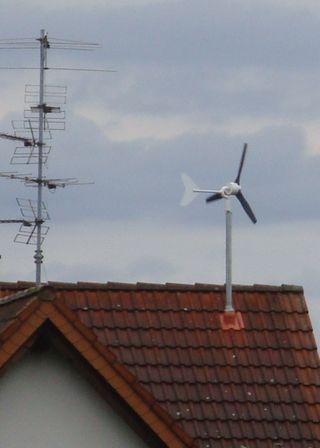
Putting a turbine directly on a roof might appear convenient, but rooftops are often turbulent environments.
The turbine may:
- Produce less electricity than expected
- Experience vibration
- Create noise
- Put additional loads on the building
- Require structural reinforcement
- Experience greater mechanical stress
- Have a shorter service life
For this reason, a properly designed tower located in an open area is usually preferable to simply attaching a turbine to a house.
How Much Electricity Can a 1–10 kW Wind Turbine Produce?
The rated power of a turbine does not mean that it continuously produces that amount of electricity.
A 5 kW turbine does not necessarily produce 5 kW every hour.
Actual annual generation depends heavily on the site’s wind resource.
A useful concept is capacity factor, which represents the average output of a generating system compared with its rated maximum output.
For example, a 5 kW turbine operating at an average 20% capacity factor would generate approximately:
5 kW × 8,760 hours × 20% = 8,760 kWh/year
Actual residential projects can vary considerably.
Illustrative annual output
| Turbine size | Example capacity factor | Approx. annual generation |
|---|---|---|
| 1 kW | 15% | ~1,314 kWh |
| 2 kW | 20% | ~3,504 kWh |
| 3 kW | 20% | ~5,256 kWh |
| 5 kW | 20% | ~8,760 kWh |
| 10 kW | 25% | ~21,900 kWh |
Important: These are illustrative calculations, not guaranteed production figures. A poorly located 5 kW turbine can generate far less electricity than a well-sited turbine of the same rating.
This is why using a turbine’s nameplate capacity alone can be misleading.
What Does a 1 kW Wind Turbine Power?
A 1 kW residential turbine is relatively small.
Depending on actual energy production, it may help power:
- LED lighting
- Electronics
- Small appliances
- Internet equipment
- Security systems
- Battery charging
It is unlikely to provide complete energy independence for an average household unless combined with other generation and storage.
For many homes, a 1 kW turbine is better viewed as a supplementary energy source rather than a complete replacement for grid electricity.
What Does a 5 kW Wind Turbine Power?
A 5 kW turbine can be considerably more useful when installed at a strong wind site.
Under favorable conditions, annual production could reach several thousand kilowatt-hours.
It may offset a significant portion of household electricity consumption, particularly for properties with:
- High electricity demand
- Strong winds
- Large open land
- Limited access to the grid
However, the same 5 kW turbine in a turbulent suburban location could perform poorly.
What About a 10 kW Residential Wind Turbine?
A 10 kW turbine is toward the larger end of what many people would consider a residential-scale system.
It can produce substantial amounts of electricity at a good site and may be suitable for:
- Farms
- Large rural properties
- Guesthouses
- Small businesses
- Remote facilities
- Agricultural operations
A 10 kW system can also require a more substantial tower, foundation, electrical infrastructure, and permitting process.
The economics therefore depend heavily on the property’s wind conditions and electricity requirements.
Small Wind Turbine Installation Cost
The purchase price of the turbine is only part of the total project cost.
A complete residential wind installation can involve:
- Turbine
- Tower
- Foundation
- Inverter
- Controller
- Electrical equipment
- Batteries, if required
- Transportation
- Crane or lifting equipment
- Installation labor
- Engineering
- Permits
- Grid-connection work
- Maintenance
As a result, the total cost can be significantly higher than the advertised price of the turbine alone.
Indicative cost structure
| Component | Potential cost impact |
|---|---|
| Turbine | Major |
| Tower | Major |
| Foundation | Moderate to major |
| Inverter/controller | Moderate |
| Wiring and protection | Moderate |
| Installation | Moderate to major |
| Batteries | Major if off-grid |
| Permits/engineering | Location dependent |
| Maintenance | Ongoing |
Exact prices vary dramatically by country, manufacturer, turbine size, tower type, site accessibility, and local regulations.
For Indian homeowners, obtaining several local installation quotes is particularly important because equipment, installation, approvals, and grid-connection rules can differ by state and utility.
How to Determine Whether Your Property Is Suitable
Before buying a small wind turbine for home, evaluate the site first.
Do not start with the turbine.
Start with the wind.
1. Check regional wind maps
Look for wind-resource maps covering your location.
These can provide an initial indication of whether your region has useful wind resources.
However, maps are only a starting point.
Your actual property may have very different conditions because of hills, buildings, trees, valleys, and local terrain.
2. Measure wind at the proposed turbine height
This is much more useful than simply looking at weather reports.
Professional site assessments may use:
- Anemometers
- Wind vanes
- Meteorological towers
- Long-term wind measurements
- Remote sensing in larger projects
The goal is to understand:
- Average wind speed
- Wind direction
- Seasonal variations
- Turbulence
- Extreme wind events
3. Consider tower height
Wind speed generally increases with height above ground because surface friction slows airflow.
Higher towers can also place the turbine above some nearby obstacles.
A useful rule of thumb is that the turbine should have sufficient clearance above nearby obstructions, but the exact requirements depend on turbine design, terrain, and local standards.
Simply putting a turbine on a short pole beside a house may not produce good results.
4. Look at nearby obstacles
Identify:
- Trees
- Buildings
- Hills
- Water tanks
- Walls
- Other structures
A location surrounded by obstacles is generally less attractive than an open site.
Where Small Wind Turbines Make the Most Sense
Small wind can be a good option in specific situations.
Rural properties
Large rural properties can provide space for a properly positioned tower away from buildings and trees.
Coastal locations
Coastal areas can experience strong and consistent winds, although salt, corrosion, storms, and extreme weather must be considered.
Hilltops and exposed locations
Elevated locations can have better wind resources than sheltered valleys or dense urban areas.
Farms
Agricultural land can sometimes provide enough space for a turbine while avoiding major obstacles.
Remote properties
For locations without reliable grid access, wind can complement batteries and solar.
Hybrid renewable systems
A wind turbine can complement solar because wind and solar production can occur at different times.
For example, a property might produce:
Solar during sunny daytime hours + wind during windy periods + battery storage
This can be particularly useful for off-grid applications.
Where Small Wind Usually Doesn’t Make Sense
Small wind is often a poor choice when:
- The property is in a dense city
- Buildings surround the house
- Large trees create turbulence
- Average wind speeds are low
- There is little space for a tower
- Local regulations restrict towers
- The turbine must be installed directly on a roof
- The expected electricity generation is too low to justify the cost
In these situations, rooftop solar is usually worth investigating first.
Small Wind vs Rooftop Solar
For most homeowners, the more important question is not whether wind power works.
It is whether wind power is better than solar for their particular property.
Comparison
| Feature | Small Wind | Rooftop Solar |
|---|---|---|
| Resource requirement | Strong, consistent wind | Adequate sunlight |
| Urban suitability | Usually poor | Usually good |
| Rural suitability | Excellent at good sites | Excellent |
| Moving parts | Yes | Very few |
| Maintenance | Higher | Lower |
| Installation complexity | Higher | Generally simpler |
| Noise | Possible | Essentially silent |
| Roof installation | Usually problematic | Common |
| Land requirement | Tower clearance needed | Roof area |
| Night generation | Possible | No |
| Cloudy-weather generation | Possible if windy | Reduced |
| Site assessment | Very important | Important |
| Visual impact | Usually higher | Usually lower |
| Typical residential economics | Site dependent | Often easier to justify |
Solar has a major advantage because sunlight is relatively easy to evaluate using roof orientation, shading analysis, and solar irradiation data.
Wind is more site-specific.
Can Wind and Solar Be Used Together?
Yes.
A solar-wind hybrid system can be an excellent solution for certain rural and off-grid properties.
Solar panels produce electricity during daylight hours, while a wind turbine can produce electricity whenever suitable winds are available, including at night.
A hybrid system may include:
Solar panels + wind turbine + battery + inverter + grid connection
The battery can help balance fluctuations from both sources.
This approach can be particularly useful when solar and wind resources complement each other seasonally.
However, adding a wind turbine simply because it sounds attractive does not automatically improve economics. The wind resource still needs to justify the additional equipment and maintenance.
Are Small Wind Turbines Worth It?
The honest answer is:
Sometimes.
A small wind turbine can be financially and technically worthwhile when a property has a strong wind resource and enough space for proper installation.
But buying a turbine without first evaluating the wind resource can be an expensive mistake.
For many homeowners, rooftop solar will offer a simpler path to renewable electricity.
Small wind is more likely to be worthwhile if:
- Average wind speeds are strong
- The site is open and exposed
- A tall tower can be installed
- Electricity prices are relatively high
- The property has substantial electricity consumption
- Grid connection is expensive or unreliable
- The turbine has a credible performance history
- Maintenance and replacement costs are understood
Advantages of Residential Wind Power
1. Can generate electricity day and night
Unlike solar panels, wind turbines can produce electricity after sunset when wind conditions are suitable.
2. Useful on rural properties
Large open properties can provide better conditions for wind generation.
3. Can complement solar
Wind and solar can sometimes provide power at different times.
4. Long operating life is possible
A well-maintained turbine can operate for many years, although components such as bearings, electrical equipment, and blades may eventually require replacement.
5. Can reduce grid dependence
A properly sized system can reduce electricity purchased from the grid.
Disadvantages of Small Wind Turbines
1. Wind resource is everything
A turbine in poor wind conditions can produce disappointing amounts of electricity.
2. Higher maintenance than solar
Wind turbines contain moving components that experience mechanical stress.
3. Tower installation can be complicated
Foundations, lifting equipment, permits, and electrical work can add significant cost.
4. Turbulence can reduce performance
Trees and buildings can make wind flow unpredictable.
5. Noise and vibration may be concerns
Modern turbines can be designed to reduce noise, but mechanical and aerodynamic sounds still exist.
6. Planning rules can be restrictive
Height, setbacks, noise, property boundaries, and grid-connection rules can affect whether a turbine can be installed.
Common Mistakes When Buying a Home Wind Turbine
Mistake 1: Buying based on rated power
A 10 kW rating does not mean the turbine produces 10 kW continuously.
Annual energy production matters more.
Mistake 2: Trusting a rooftop installation advertisement
A rooftop turbine may appear easy to install, but turbulent airflow can seriously reduce output.
Mistake 3: Ignoring the tower
A good turbine on a poor tower can perform badly.
Mistake 4: Not measuring wind
Guessing wind speed from how windy the property feels is unreliable.
Mistake 5: Ignoring maintenance
Bearings, blades, generators, controllers, and electrical equipment can require inspection and replacement.
Mistake 6: Comparing turbine price instead of energy cost
A cheap turbine that produces little electricity may be more expensive over its lifetime than a higher-quality system.
How to Choose a Residential Wind Turbine
If your property appears suitable, compare turbines based on more than their headline wattage.
Look for:
Power curve
The power curve shows how much electricity the turbine produces at different wind speeds.
This is one of the most important specifications.
Rated wind speed
Check the wind speed at which the turbine reaches its rated output.
Cut-in speed
This tells you approximately when the turbine starts producing electricity.
Survival or maximum wind speed
This is important for locations exposed to storms or cyclones.
Warranty
Look at warranty duration and what components are covered.
Certification
Independent testing and certification can provide greater confidence in performance and safety.
Maintenance requirements
Ask how frequently the turbine needs inspection and which parts are likely to wear.
A Simple Residential Wind Power Decision Test
Before purchasing, ask these questions:
1. Is my site genuinely windy?
If you cannot answer this with reliable data, investigate further.
2. Can I install a sufficiently tall tower?
If not, the turbine may experience excessive turbulence.
3. Is there enough open space?
The turbine needs appropriate clearance from obstacles and property boundaries.
4. Are local permits available?
Check planning and electrical regulations before purchasing equipment.
5. What will the turbine generate annually?
Use the manufacturer’s power curve and realistic site wind data.
6. What is the complete installed cost?
Include tower, foundation, inverter, wiring, installation, permits, and maintenance.
7. How does that compare with solar?
Calculate the expected cost per unit of electricity over the system’s lifetime.
If solar provides more electricity for significantly less complexity, solar may be the better investment.
FAQ: Small Wind Turbines for Homes
Can I put a small wind turbine on my house?
Technically, some small turbines can be mounted on buildings, but this is often not the best solution. Rooftops can create turbulent airflow, vibration, structural concerns, and noise. A properly engineered tower in a suitable open location is generally preferable.
How windy does it need to be for a home wind turbine?
Turbines can begin producing electricity at relatively low wind speeds, often around 2.5–4 m/s, but meaningful annual production generally requires substantially better average wind conditions. The exact requirement depends on the turbine and site.
How much electricity does a 5 kW wind turbine produce?
It depends on the wind resource. A 5 kW turbine might generate several thousand kilowatt-hours per year at a good site, but the same turbine can produce much less in a low-wind or turbulent location.
Are small wind turbines noisy?
They can produce aerodynamic and mechanical noise. Noise levels depend on turbine design, wind speed, installation height, distance from buildings, and surrounding conditions.
Can a wind turbine power an entire house?
A sufficiently large and well-sited system can supply a substantial amount of household electricity. However, a small turbine’s actual annual production depends on the wind resource, so it should not be assumed that a 5 kW or 10 kW rating equals continuous household power.
Is wind power better than solar for homes?
For most urban and suburban homes, solar is generally easier to install and evaluate. Small wind can become more attractive on rural, coastal, exposed, or remote properties with consistently strong winds.
Can I use a wind turbine without batteries?
Yes. A grid-connected system can send electricity to household loads and, where permitted, export excess electricity. Off-grid systems generally need batteries or another form of energy storage to provide electricity when the turbine is not producing enough power.
Do wind turbines work when there is no wind?
No. A turbine needs sufficient airflow to generate electricity. Below its operating threshold, production is negligible or zero.
How long does a small wind turbine last?
Service life varies by turbine quality, operating conditions, maintenance, and environmental exposure. Mechanical components generally require more maintenance than solar panels because the turbine is constantly moving.
Should I choose a vertical-axis wind turbine?
Vertical-axis turbines can be useful for certain applications, but their suitability for residential electricity generation depends on the specific design and site. Do not assume that a vertical-axis turbine will automatically perform better in turbulent urban wind.
Final Verdict: Do Small Wind Turbines Actually Work?
Yes—but only when the location is right.
A small wind turbine for home use is not a universal renewable-energy solution. It can work extremely well on a properly selected rural, coastal, agricultural, hilltop, or remote property with strong and consistent wind.
For a typical urban or suburban house surrounded by buildings and trees, however, residential wind power is often disappointing.
The most important lesson is simple:
Don’t buy the turbine first. Evaluate the wind resource first.
If your property has excellent wind conditions and enough space for a proper tower, a 1–10 kW turbine can become a useful source of renewable electricity. If the site has weak or turbulent winds, rooftop solar is usually the more practical residential option.