
AI renewable energy prediction, machine learning energy grid
AI Energy Forecasting: How Machine Learning Makes Renewable Energy More Reliable
Discover how AI energy forecasting uses machine learning, LSTM networks, weather data, and satellite imagery to predict solar and wind power and improve renewable energy grid reliability.AI energy forecasting
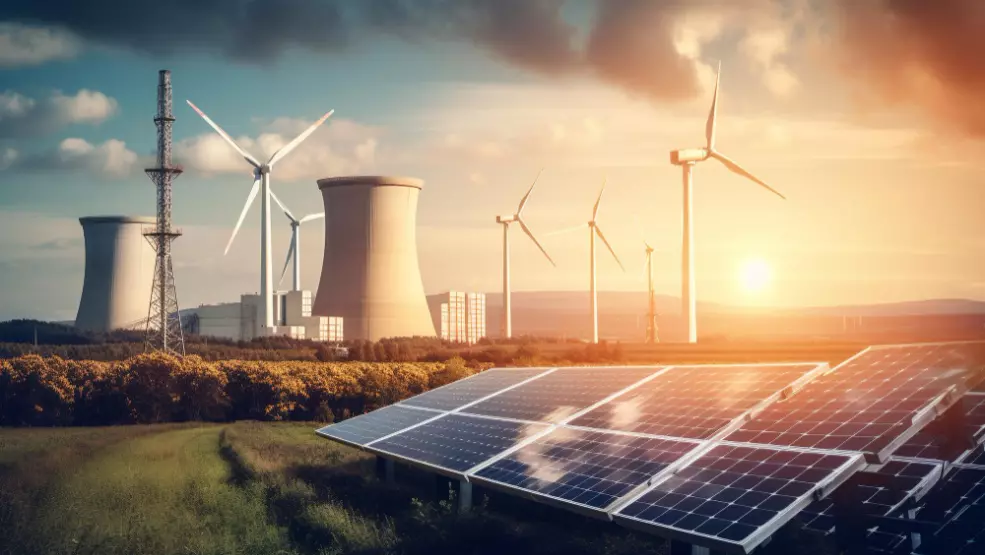
Introduction: What If the Grid Could See the Weather Coming?
Solar panels and wind turbines have one major characteristic that conventional power plants do not: their electricity production depends heavily on the weather.
A gas or coal plant can generally be instructed to increase or decrease generation. A solar farm cannot produce more electricity simply because the grid needs it when clouds cover the sun. A wind farm cannot force its turbines to spin when the wind suddenly disappears.
That variability has traditionally created a difficult problem for electricity-grid operators.
But artificial intelligence is changing the equation.
Modern AI energy forecasting systems can analyze enormous amounts of historical weather, satellite, turbine, solar and electricity-generation data to estimate how much renewable electricity will be available minutes, hours and sometimes days into the future.
Instead of asking:
“How much solar and wind power are we getting right now?”
grid operators can increasingly ask:
“How much renewable electricity are we likely to have at 2 PM tomorrow?”
That difference is enormously important.
Better predictions allow grid operators to schedule batteries, hydroelectricity and other flexible generation more efficiently, prepare backup capacity when necessary, and reduce the amount of reserve generation required to handle unexpected renewable-energy fluctuations.
The result could be a power system capable of integrating much larger amounts of solar and wind energy without sacrificing reliability.
Why Renewable Energy Is Difficult to Predict
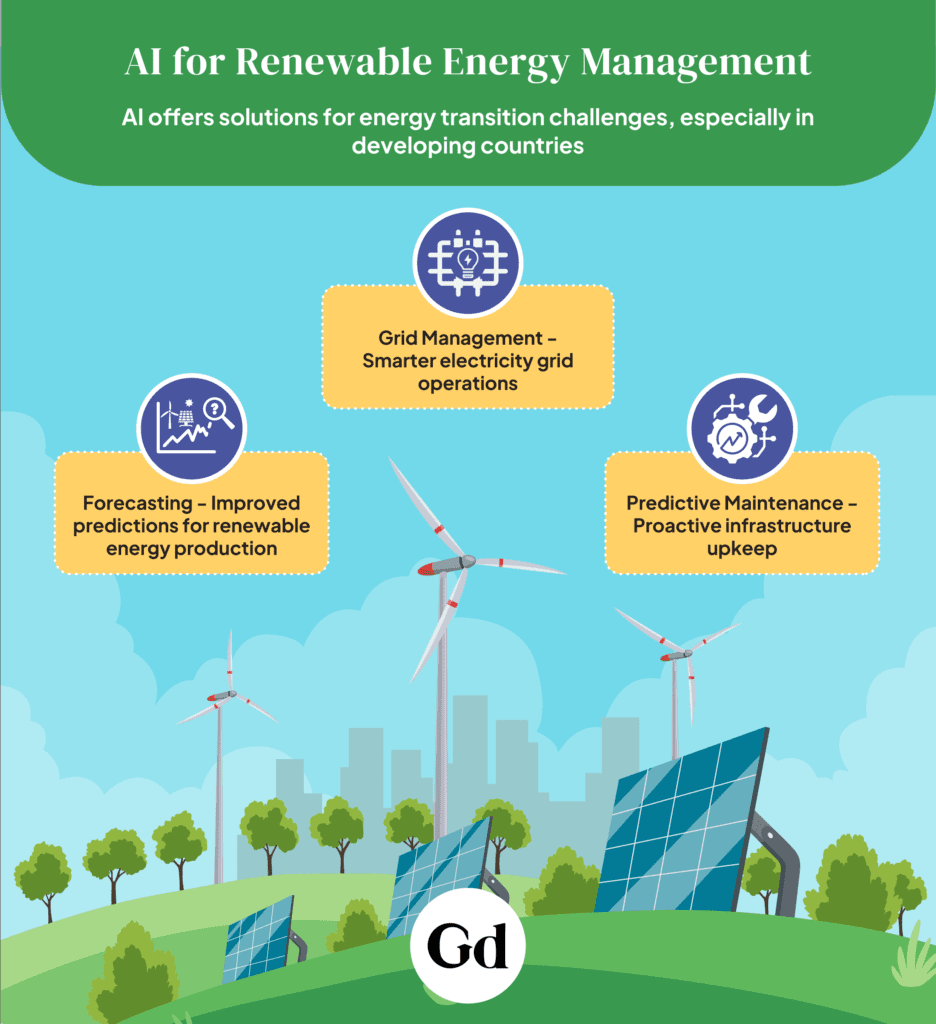
The challenge starts with the weather.
Solar electricity depends on factors including:
- Sunlight intensity
- Cloud cover
- Temperature
- Atmospheric conditions
- Time of day
- Season
- Location
- Panel orientation
- Dust and other environmental conditions
Wind generation depends on:
- Wind speed
- Wind direction
- Air pressure
- Temperature
- Turbine characteristics
- Turbine availability
- Weather systems moving through the region
Even a relatively small change in weather can produce a significant change in renewable electricity output.
Imagine a large solar farm producing 500 MW on a sunny afternoon.
If a thick cloud system arrives unexpectedly, generation could fall substantially within a short period.
For a grid operator, that creates a problem.
Electricity supply and demand have to remain balanced. If solar production suddenly falls, another source must compensate.
Traditionally, operators have relied on flexible generators and reserve capacity to handle these uncertainties.
AI offers another tool: better prediction.
What Is AI Energy Forecasting?
AI energy forecasting is the use of artificial intelligence and machine-learning algorithms to predict future electricity generation or electricity demand.
For renewable energy, the basic process looks something like this:
Weather data + historical generation + satellite information + plant data → AI model → renewable-energy forecast
The model learns relationships between weather conditions and actual electricity production.
For example, an AI system might discover that:
- A particular cloud pattern usually reduces solar generation within 30 minutes.
- A certain wind-speed pattern produces a predictable increase in turbine output.
- Temperature changes affect solar-panel efficiency.
- A particular weather system tends to cause wind generation to rise several hours later.
The model does not simply memorize yesterday’s weather.
It learns patterns from large historical datasets and uses those patterns to estimate future conditions.
How Machine Learning Predicts Solar and Wind Power
At a high level, an AI renewable-energy prediction system follows several stages.
1. Collecting Data
The first step is gathering as much useful information as possible.
A forecasting system may use:
- Historical electricity generation
- Weather forecasts
- Satellite imagery
- Radar information
- Solar irradiance measurements
- Wind speed and direction
- Temperature
- Humidity
- Atmospheric pressure
- Cloud movement
- Turbine sensor data
- Solar-farm measurements
- Electricity demand
- Historical forecasting errors
India’s power-sector planning documents have long identified weather information, plant output and equipment availability as important inputs for renewable forecasting.
The more useful and reliable data the system receives, the better the potential forecast.
2. The AI Learns Historical Patterns
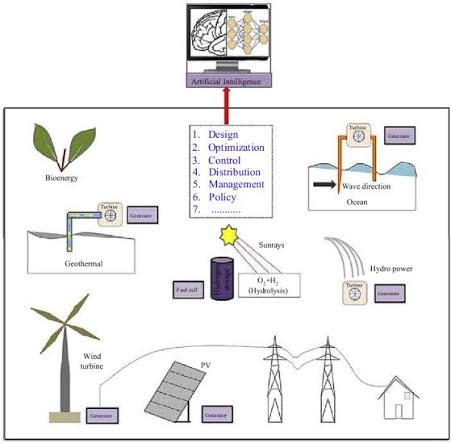
This is where machine learning becomes useful.
Suppose an AI system receives several years of data from a wind farm.
It sees:
Wind conditions → turbine output
Thousands or millions of these examples allow the model to learn relationships that may be difficult to capture using simple mathematical rules.
The same principle works for solar power.
The system might learn:
Cloud movement + sunlight + temperature → expected solar generation
Over time, the model becomes better at recognizing patterns.
3. LSTM Neural Networks Remember What Happened Beforehttps://openthemagazine.com/columns/can-ai-make-renewable-energy-more-efficient

One machine-learning architecture that has been widely used for time-series forecasting is the Long Short-Term Memory network, commonly called an LSTM.
The name sounds complicated, but the basic concept is relatively simple.
Electricity generation is a time-dependent process.
What happens five minutes ago can matter now.
What happened yesterday at the same time can also provide useful information.
And weather patterns from several hours earlier may help predict what happens next.
LSTMs are designed to learn relationships across sequences of data.
For example:
8 AM → 9 AM → 10 AM → 11 AM → 12 PM → future prediction
Instead of treating every measurement as an isolated number, the model can learn how previous observations relate to future conditions.
This makes LSTM-style models particularly useful for forecasting applications involving changing weather and energy production.
Modern systems, however, are not limited to LSTMs. Researchers increasingly use other neural-network architectures, satellite-image models, graph neural networks and hybrid approaches.
4. AI Turns Weather Into Electricity Predictions
There is an important distinction here.
A weather forecast might say:
Wind speed tomorrow: 12 m/s
But a grid operator needs something more useful:
Expected wind generation tomorrow at 3 PM: 640 MW
AI models can help make that translation.
The system combines weather information with knowledge about the renewable-energy facility.
For solar:
Expected sunlight + cloud cover + temperature + plant characteristics → solar generation forecast
For wind:
Expected wind speed + direction + turbine characteristics + historical behavior → wind generation forecast
This is what makes AI renewable energy prediction particularly valuable to electricity operators.
DeepMind’s Wind Forecasting Experiment
One of the best-known examples came from Google and DeepMind.
In 2019, DeepMind described a machine-learning system applied to approximately 700 MW of wind-power capacity in the central United States.
The neural network was trained using weather forecasts and historical turbine data.
It predicted wind generation 36 hours ahead and helped determine how much electricity could be committed to the grid in advance.
DeepMind reported that machine learning increased the economic value of the wind energy by approximately 20% compared with its baseline scenario.
This is an important distinction:
The reported 20% figure was an increase in the value of wind energy, not a 20% improvement in forecast accuracy.
The experiment demonstrated an important principle: better forecasting can make variable renewable electricity more useful to the grid because operators have greater confidence about how much power will be available.
What About the UK National Grid?
The UK provides another interesting example.
National Grid has worked with Open Climate Fix on machine-learning approaches for forecasting solar generation.
In one project, machine-learning systems were developed to predict short-term solar generation by analyzing satellite imagery and cloud movement.
National Grid reported that machine-learning developments had already produced a 33% improvement in the accuracy of solar forecasts in the years leading up to its 2021 project.
The reason this matters is simple.
Clouds can move across large solar-generation areas quickly.
If the grid knows that cloud cover is about to reduce solar output, operators have more time to prepare alternative sources of electricity.
That can reduce the amount of reserve capacity they need to keep ready for unexpected changes.
AI Renewable Energy Prediction in India
India is particularly interesting because its electricity demand and renewable-energy capacity are both growing rapidly.
The country’s power system is integrating increasing quantities of solar and wind generation, making accurate forecasting increasingly important.
The Indian government has established Renewable Energy Management Centres (REMCs) for renewable forecasting and real-time grid management. The government also reports that advanced meteorological inputs from NCMRWF and ISRO are used to support renewable-generation and demand forecasting.
There is also a more recent AI example.
Open Climate Fix reported in 2025 that it had been working with a state grid operator in India since 2024 to test AI-based forecasting.
Its results indicated:
- 10% reduction in large forecasting errors
- 5% reduction in mean error
- Forecasting horizon of approximately 24–48 hours
These results were reported as preliminary work rather than proof that every Indian grid can achieve the same improvement.
This distinction is important when discussing AI energy forecasting: performance depends on the quality of the data, weather conditions, geography, generation technology and the forecasting system being used.
AI Is Also Improving the Weather Forecast Itself
AI does not necessarily have to wait for a conventional weather forecast.
New AI weather models are beginning to predict atmospheric conditions directly.
Google DeepMind’s GraphCast, for example, was developed to produce global weather forecasts up to 10 days ahead and was reported to outperform the ECMWF’s HRES system across many tested forecasting targets while producing forecasts much faster.
DeepMind later introduced GenCast, an AI weather model designed to predict weather and uncertainty over longer time horizons. In its published evaluation, GenCast outperformed ECMWF’s ensemble forecasting system on 97.2% of tested targets.
These developments could eventually become useful inputs for renewable-energy forecasting.
If AI becomes better at predicting:
clouds → sunlight → solar generation
and
wind patterns → turbine output
then grid operators can potentially make better scheduling decisions.
The Future: From Weather Forecast to Energy Forecast
The next generation of renewable forecasting is likely to combine multiple AI systems.
Imagine a solar farm connected to an intelligent forecasting platform.
The system receives:
Satellite images
↓
AI weather forecast
↓
Cloud movement prediction
↓
Solar irradiance forecast
↓
Solar generation prediction
↓
Grid demand forecast
↓
Battery and generation scheduling
Instead of one prediction, the system creates a continuously updated picture of what the electricity system may look like over the next several hours or days.
How Better Forecasting Can Reduce Fossil-Fuel Backup
This is one of the most important potential benefits.
Electricity grids need backup resources because renewable generation can change unexpectedly.
Consider a simple example.
A grid operator expects:
10,000 MW of solar generation
But if clouds unexpectedly reduce actual output to:
7,000 MW
the grid suddenly has a 3,000 MW shortfall.
The operator needs to respond.
That could involve:
- Natural-gas generators
- Hydropower
- Battery storage
- Demand response
- Other flexible resources
- Electricity imports
Now imagine the operator has a much better forecast several hours earlier.
Instead of discovering the shortfall at the last minute, the operator knows that solar production is likely to fall.
The grid can prepare.
A battery can charge beforehand.
Hydropower can be scheduled differently.
Demand-response resources can be prepared.
Electricity can potentially be imported.
And fewer fossil-fuel generators may need to remain running purely as a precaution.
National Grid has specifically described improved renewable forecasting as a way to reduce the need for conventional generators held in reserve.
However, AI forecasting does not eliminate the need for backup generation. Weather forecasts still have uncertainty, and grids need dependable resources for extreme events, prolonged renewable shortfalls and other contingencies.
AI + Batteries Could Be Even More Powerful
AI forecasting becomes particularly useful when combined with battery storage.
Suppose an AI system predicts:
Very high solar generation from 11 AM to 3 PM
A battery could charge during those hours.
Then the system predicts:
Low solar generation from 5 PM to 8 PM
The battery can discharge when solar production falls and electricity demand remains high.
The same concept works with wind.
If AI predicts strong wind generation overnight, batteries could be scheduled differently in anticipation of that production.
This creates a much more flexible renewable-energy system.
AI therefore does not replace batteries.
Instead, AI can help batteries operate more intelligently.
AI Can Forecast Electricity Demand Too
There is another side to the equation.
Grid operators don’t only need to know:
How much electricity will renewable sources generate?
They also need to know:
How much electricity will consumers use?
Machine learning can analyze:
- Historical electricity consumption
- Weather
- Temperature
- Time of day
- Day of week
- Holidays
- Industrial demand
- Building consumption
- Smart-meter information
- Electric-vehicle charging patterns
This allows AI systems to estimate future electricity demand.
The real goal becomes:
Predict supply + predict demand + coordinate flexible resources
That is much more powerful than forecasting renewable generation alone.
The IEA identifies supply and demand forecasting as one of the important applications of AI in modern electricity systems.
Why This Matters as Solar and Wind Grow
The importance of forecasting increases as renewable electricity becomes a larger portion of the grid.
The IEA expects India’s variable renewable-energy share of electricity generation to rise substantially through 2030, with solar PV and wind providing an increasing share of additional electricity supply.
As renewable penetration increases, grid operators need increasingly sophisticated ways to manage variability.
That means the electricity system of the future may rely on three complementary technologies:
1. Renewable energy
Solar and wind provide low-carbon electricity.
2. Energy storage
Batteries, pumped hydro and other technologies shift electricity through time.
3. Artificial intelligence
AI predicts when renewable electricity will be available and helps coordinate the system around those predictions.
Together, these technologies can make variable renewable energy easier to integrate.
The AI Renewable Energy Forecasting Pipeline
A simplified AI energy forecasting system looks like this:
1. Data collection
Weather stations, satellites, turbines, solar panels and grid sensors collect information.
↓
2. Data processing
The system cleans and organizes the data.
↓
3. Machine learning
Models identify relationships between weather conditions and electricity production.
↓
4. Forecast
The AI predicts renewable generation for upcoming minutes, hours or days.
↓
5. Grid optimization
Operators use the forecast to plan generation, storage, imports and demand response.
↓
6. Continuous learning
Actual electricity production is compared with the prediction.
↓
7. Model improvement
The system learns from forecasting errors and improves future predictions.
This feedback loop is one of the biggest advantages of machine learning.
Every forecast creates another opportunity to learn.
The Biggest Challenges for AI Energy Forecasting
AI is powerful, but it isn’t magic.
Several challenges remain.
Data quality
Bad or incomplete data can produce poor forecasts.
Extreme weather
Unusual weather events are difficult to predict because historical datasets may contain relatively few examples.
Local conditions
A model trained in one region may not work equally well somewhere with a completely different climate.
Solar-panel visibility
Millions of small rooftop solar systems can be difficult for grid operators to monitor individually.
Model uncertainty
Even a sophisticated AI system can be wrong.
Cybersecurity
As AI becomes connected to critical electricity infrastructure, protecting forecasting and control systems becomes increasingly important.
Human oversight
Grid operators still need to understand and supervise automated systems, particularly during unusual or emergency conditions.
AI Won’t Make Renewable Energy Perfectly Predictable
This is an important point.
AI does not make clouds disappear.
It does not control the wind.
And it cannot predict the future with 100% accuracy.
Instead, its goal is to reduce uncertainty.
A forecast that says:
“Solar output will probably be between 7,500 and 8,000 MW”
is much more useful than having no idea whether production will be 5,000 MW or 10,000 MW.
Modern forecasting can also provide multiple possible scenarios instead of one number.
This allows operators to understand not just the expected outcome but also the uncertainty surrounding it.
The Bigger Picture
The electricity grid was historically designed around controllable power plants.
Operators could decide when many generators should produce electricity.
Solar and wind changed that model.
The weather now plays a much bigger role in electricity production.
Artificial intelligence is helping the grid adapt.
Instead of treating renewable variability purely as a problem, AI allows operators to anticipate it.
A cloud system moving toward a solar farm becomes a forecast.
A changing wind pattern becomes a generation prediction.
A hot afternoon becomes a demand forecast.
And those forecasts can become decisions about batteries, hydropower, flexible generation and electricity markets.
The result isn’t a grid controlled entirely by AI.
It is a grid where humans and automated systems have better information about what is likely to happen next.
Frequently Asked Questions
What is AI energy forecasting?
AI energy forecasting uses machine learning and artificial intelligence to predict electricity generation and demand. For renewable energy, it combines information such as weather forecasts, satellite imagery, historical generation and plant data to estimate future solar and wind output.
How does AI predict solar power?
AI models analyze factors such as cloud cover, solar radiation, temperature, satellite imagery, historical generation and weather forecasts. The model learns relationships between these inputs and actual solar production to predict future electricity output.
How does AI predict wind power?
AI systems analyze wind speed, wind direction, weather forecasts, historical turbine production and turbine characteristics. Machine-learning models then estimate how much electricity turbines are likely to produce.
What are LSTM neural networks used for?
LSTM neural networks are designed to learn patterns in sequential data. Because electricity generation and weather change over time, LSTMs can be useful for forecasting solar generation, wind generation and electricity demand.
Can AI predict renewable energy days in advance?
Yes. AI-based weather and renewable-energy forecasting systems can produce forecasts ranging from minutes and hours to multiple days ahead. The farther into the future the prediction extends, however, the greater the uncertainty generally becomes.
Does AI eliminate the need for fossil-fuel power plants?
No. Better forecasting can reduce the amount of reserve generation needed and improve the use of renewable energy, batteries and other flexible resources. But reliable electricity systems still require dependable resources to handle unexpected events and prolonged periods of low renewable generation.
How is AI being used for renewable energy in India?
India is using advanced forecasting systems and has established Renewable Energy Management Centres for renewable forecasting and real-time grid management. AI and machine learning are also being incorporated into weather forecasting and renewable-generation forecasting projects.
What is the biggest benefit of AI renewable energy prediction?
The biggest benefit is improved visibility. When grid operators have a better estimate of future renewable generation and electricity demand, they can make better decisions about storage, generation, transmission and reserves.
Is AI more accurate than traditional weather forecasting?
It depends on the model, variable, location and forecasting horizon. Some modern AI weather systems have demonstrated major improvements on particular benchmarks, but AI and traditional numerical weather prediction are increasingly being used together rather than treated as mutually exclusive technologies.
Final Thoughts
The future of renewable energy isn’t simply about installing more solar panels and wind turbines.
It is also about knowing when those technologies will produce electricity.
AI energy forecasting is becoming an important part of that puzzle.
LSTM networks, satellite-image models, machine-learning algorithms and newer AI weather systems can turn enormous quantities of weather and energy data into practical forecasts.
Those forecasts can help grid operators prepare for changes before they happen.
As renewable electricity expands across countries such as India, the ability to predict solar and wind generation accurately could become just as important as building the generation itself.
The long-term vision is straightforward:
Predict the weather. Predict renewable generation. Predict demand. Coordinate storage and flexible power. Keep the grid balanced.
AI cannot control the weather—but it can help the electricity grid get much better at preparing for it.